USNI News Fleet and Marine Tracker: Feb. 2, 2026
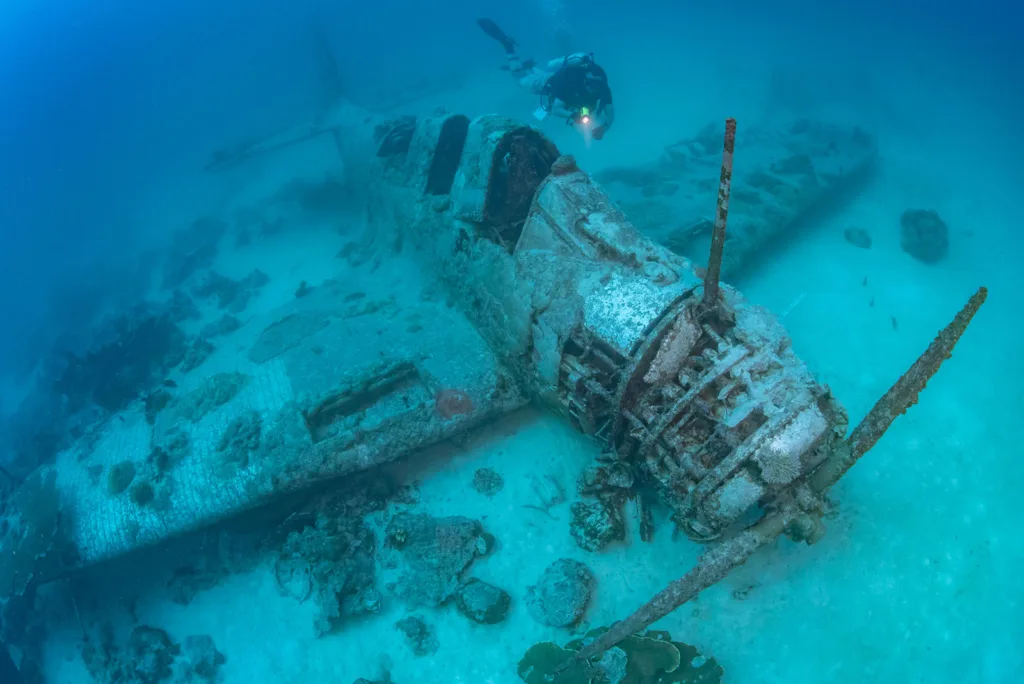
Bureau Number 1515, a Douglas TBD-1 Devastator submerged off Jaluit Atoll in the Marshall Islands. The aircraft went down Feb. 1, 1942. Air and Sea Heritage Foundation photo
A team of maritime and naval conservation organizations are embarking on a project to recover a World War II torpedo bomber from the sea floor where the rare plane has rested for more than 80 years.
The U.S. Naval History and Heritage Command and the Air and Sea Heritage Foundation are working to recover Bureau Number 1515, a Douglas TBD-1 Devastator submerged off Jaluit Atoll in the Marshall Islands, the conservation organizations announced Friday. The TBD-1 Devastator was the Navy’s first carrier-based all-metal plane with a singular pair of foldable wings for carrier stowage. The aircraft, which was the most modern at the time, played a critical role during the opening months of the Pacific campaign, including the Battles of the Coral Sea and Midway.
Bureau Number 1515 launched Feb. 1, 1942, from USS Yorktown (CV-5) and ditched in the Jaluit lagoon during the U.S. Navy’s first offensive operation in the Pacific, an air and shore-bombardment dubbed the Marshall-Gilberts raids, according to the Naval History and Heritage Command. All three naval aviators on board survived the emergency landing but endured captivity as Japanese prisoners of war for three years until their liberation in 1945, the command said.
The goal, the conservation organizations said, is to exhibit the bomber in the future U.S. Navy National Museum, which is under development in D.C. If recovery and preservation is successful, Bureau Number 1515 would be the first TBD-1 Devastator to be preserved in a museum.
“Of the 129 TBD-1 aircraft built for the service, none have been preserved in museums or private collections; all known examples rest on the ocean floor,” reads a press release from the Naval History and Heritage Command.
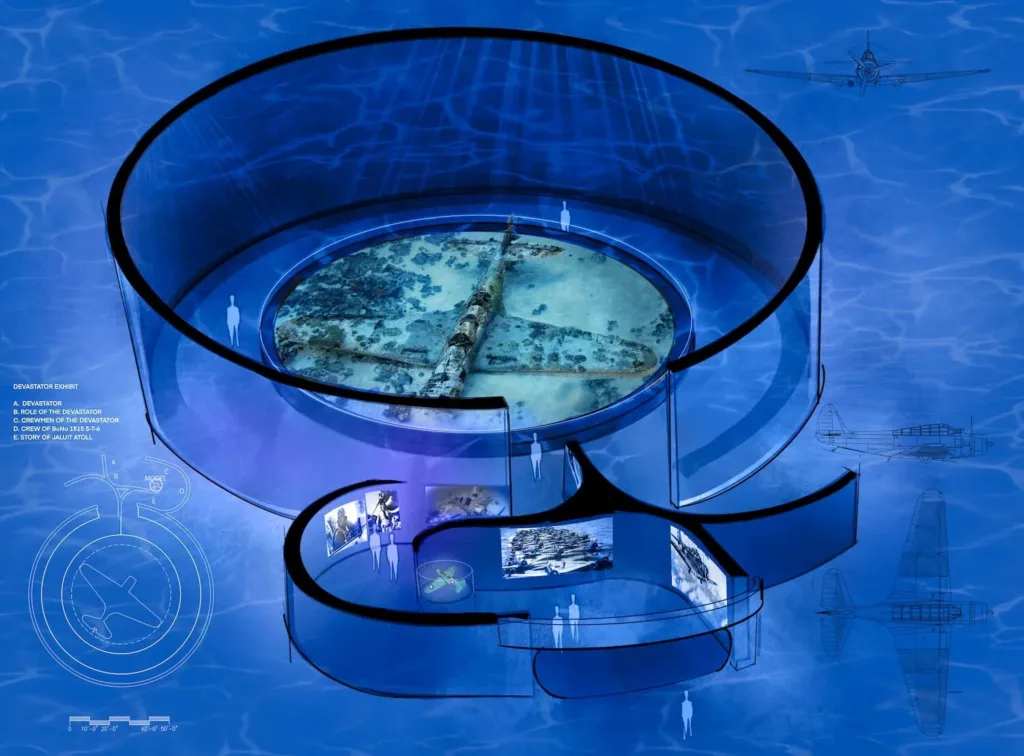
Concept for a Devastator display at the National Museum of the U.S. Navy. American Scenic Design, Inc. graphic
The aircraft has been eyed as a candidate for recovery for 23 years, during which Air and Sea Heritage Foundation leadership conducted seven expeditions to Jaluit Atoll in coordination with the U.S. Navy, Center for Maritime Archaeology and Conservation, the Republic of the Marshall Islands Cultural and Historic Preservation Office and Jaluit Atoll local government officials. Additionally, the Center for Maritime Archaeology and Conservation, a research center at Texas A&M University, has also been involved in documenting and studying the aircraft since 2006.
The recovery and preservation will occur in four stages:
- Coordination and staging in the Republic of the Marshall Islands
- Archeological recovery of the aircraft from Jaluit Lagoon
- Cleaning and stabilization at Texas A&M Center for Maritime Archaeology and Conservation
- Permanent public exhibition at the future U.S. Navy’s National Museum in D.C.
“[Bureau Number] 1515 will act as a touchstone to the extraordinary events and remarkable people of the past, allowing visitors to blur time and space by standing in its presence, absorbing the stories of Jaluit, the Devastators, their crews, pioneering aviation, desperate naval warfare, the thrill of exploration, archaeology, materials science, and so much more,” reads the Air and Sea Heritage Foundation’s Devastator Project webpage.