U.K. Mine Countermeasures Mothership Leaves Gibraltar for Potential Strait of Hormuz Mission
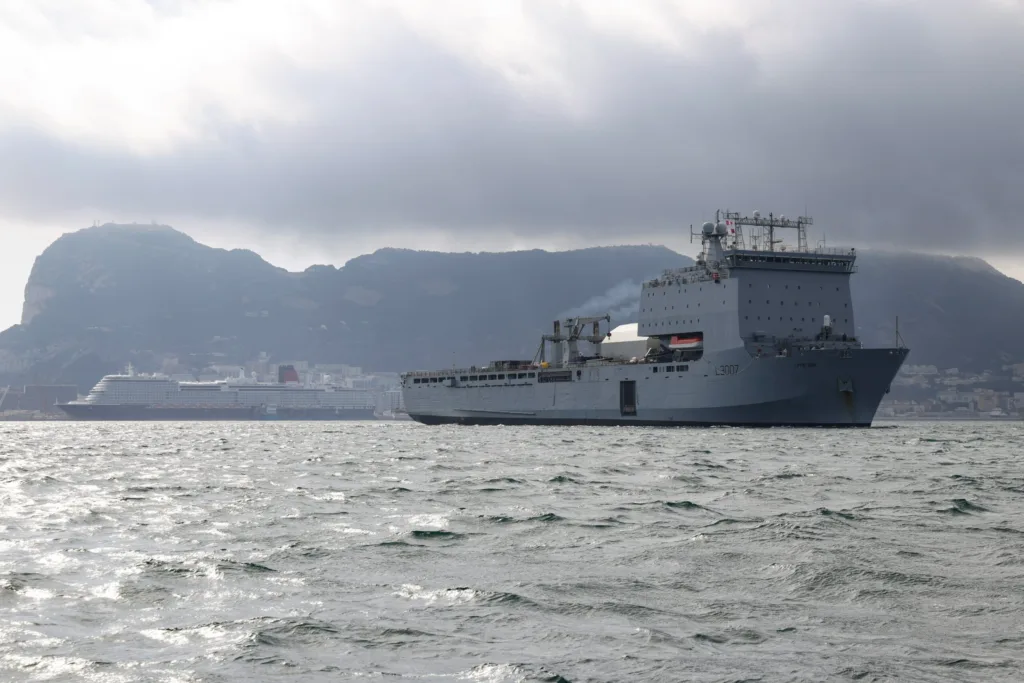
The Royal Navy’s mine countermeasures mothership RFA Lyme Bay (L3007) departed Tuesday from Gibraltar as the U.K. and France prepare to launch a multinational military mission to ensure freedom of navigation through the strait.
More than 100 minehunting personnel from the Royal Navy’s diving and threat exploitation group and mine and threat exploitation group are on board Lyme Bay for a potential Strait of Hormuz mission, the Royal Navy announced.
“RFA Lyme Bay’s potential deployment to the Gulf with advanced uncrewed minehunting systems is demonstrative of a shift towards agile, high-tech maritime capabilities. The mission showcases rapid deployment of innovation, developed with U.K. industry in partnership by Royal Navy and National Armaments Director teams, to secure vital shipping lanes and strengthen defences against evolving maritime threats,” reads the news release.
French President Emmanuel Macron and U.K. Prime Minister Keir Starmer announced in April a commitment to a multinational military mission to allow transits through the Strait of Hormuz. France deployed the French Carrier Strike Group to the Middle East in early May in advance of the mission.
Lyme Bay was originally a dock landing ship that provided amphibious and sealift capability in Gibraltar until 2025 when it was stood down. The ship was reactivated shortly after Operation Epic Fury began on Feb. 28. Lyme Bay was then refitted as a mothership for autonomous and uncrewed minehunting drones and became part of a force package pledged by the U.K. for the Strait of Hormuz multinational mission.

Lyme Bay’s embarked minehunting systems including the following, according to a graphic shared Wednesday by the U.K. Ministry of Defense (MOD) National Armaments Director Group:
- Maritime Mine Countermeasures System that includes one primary system made up of Royal Navy Motor Boat Ariadne Uncrewed Surface Vessel (USV) with towed Synthetic Aperture Mine Detection Imaging Sonar system, Remotely Operated Vehicle and a portable operations center.
- ATLAS Remote Combined Influence Minesweeping System USV that includes the ARCIMS System, 1 ARCIMS USV and a portable control center.
- Seacat Autonomous Underwater Surveillance Vehicle systems and vehicles
- Remote Environmental Monitoring Units AUVs – R300 and R100 AUVs
- VideoRay Defender ROV
The equipment for Lyme Bay – four specialist minehunting vessels, three rigid hull inflatable boats, more than 20 containers of technology, plus additional freight – was delivered to the ship by U.K.-based mine countermeasures ship HMS Stirling Castle (M01) while in Gibraltar.
The Royal Navy also conducted the first successful docking of Ariadne into Lyme Bay’s flooded well deck in the waters off Gibraltar after the USV was unloaded from Stirling Castle, according to a news release. During the trial, personnel were embarked as a safety measure but Ariadne is designed to operate without a crew and can be controlled both locally and from a Portable Operating Center.
While Lyme Bay has departed Gibraltar, it is still unclear when the multinational force will begin operations.
“The Royal Navy is currently taking steps to be prepared for a potential multinational Strait of Hormuz mission, as the U.K. and France plan strictly defensive operations when conditions allow – aimed at restoring confidence of commercial shipping along the critical trade route,” reads the release.

Destroyer HMS Dragon (D35), which is operating east of the Suez Canal, will also be part of the mission.
Italy, Germany and the Netherlands are also deploying mine warfare ships in anticipation of the mission.
Italian Navy minehunters ITS Crotone (M5558) and ITS Rimini (M5561) have already transited the Suez Canal to enter the Red Sea. German Navy minehunter FGS Fulda (M1058) is inbound to the Mediterranean to operate with Standing NATO Mine Countermeasures Group Two while waiting for the Hormuz mission to be initiated.
The Netherlands announced Wednesday that minehunter HNLMS Willemstad (M864) will set sail this week to join the NATO mine countermeasure group in early June, placing the ship in position to join the Hormuz mission if the Netherlands Cabinet decides to participate in the mission. The cabinet has not decided yet on participation, according to the release.