U.S. Marines Deploy Neros Archer Drone in Camp Fuji Exercise
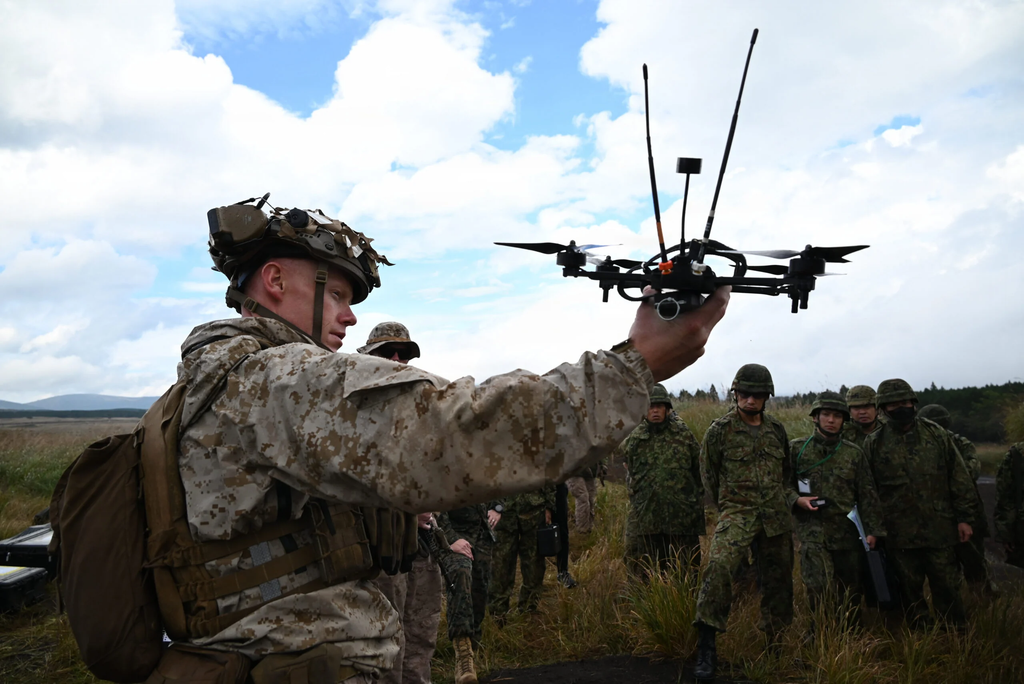
The U.S. Marine Corps recently used the Neros Archer First Person View drone in a live-fire exercise at Camp Fuji, Japan, for the first time, the service announced.
Marines of Battalion Landing Team 1/1, 31st Marine Expeditionary Unit (MEU) carried out two strike missions on Oct. 20 at Combined Arms Training Center, Camp Fuji with the Neros Archer based on two different scenarios as a proof of concept tied to the unit’s hunter-killer teams.
Neros Archer is the current Marine Corps’ program of record for one-way attack drones flown by a first-person view pilot. The Marine Corps issued a contract in November of 2025 to Neros for an unspecified number of Neros Archer drones to be deployed across the Fleet Marine Force.
The hunter-killer concept for drones sees an Intelligence, Surveillance and Reconnaissance (ISR) drone detecting and tracking targets, passing coordinates to a paired FPV strike-drone operator who executes a precision kinetic strike. The exercises this month were meant to extend the Marines’ capabilities with defeating armor and interdicting ground line communications of adversaries, according to a service news release.

One flight scenario was designed as an anti-armor ambush. CATC Camp Fuji Explosive Ordnance technicians also attended the drone test as the drones were equipped with explosive payloads. Both scenarios involved successful detonations of the targets, the service said.
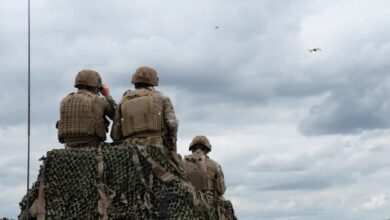
A few dozen observers watched the exercise as the Marines flew the drone for two separate flights on Oct. 20. Imagery released of the exercise show that members of the Japan Ground Self-Defense Force observed the drills.
Neros Archer drones are operated by junior enlisted Marines between the ranks of lance corporal to sergeant with unit leadership hand-picking a Marine to take part in the three-week training course. No prior drone experience is the only pre-requisite for selection as with nothing to compare to, it ensures that the operator can master the skills needed for the Neros Archer drone, the service announcement reads.
“All this is handled by non-commissioned officers and non-NCOs,” said Master Sgt. Glenn Dayton, Company Operations Chief, Weapons Company, Battalion Landing Team 1/1, 31st MEU. “You’re looking at the heart and soul of our ground force. This is not executed by staff NCO or officers, I think that’s a huge aspect. Our lower enlisted are the ones we rely on to master this craft.”
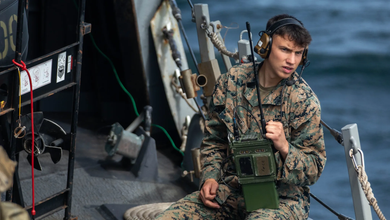
Japan-based U.S. Marines have also been experimenting with deploying Neros Archer from maritime platforms to carry out reconnaissance missions at the shore. A Pentagon imagery release shows a Marine of 3rd Battalion 7th Marine Regiment, forward deployed with 4th Marine Regiment, 3rd Marine Division, as part of the Unit Deployment Program, launching a Neros Archer drone from a Multi-Mission Reconnaissance Craft-B off the coast of Okinawa on Sept. 18.

“The training served as a proof of concept for employing small unmanned aircraft systems from maritime platforms in support of sea-to-shore operations,” reads the image caption.
Late last month, the drone was used in the U.S. National Drone Association Drone Crucible 26.3 exercise and competition held Sept. 27 to Oct. 2 in Starke, Fla.
“In an evolving battlefield the Marines of 2nd [Marine Division] are using exercises such as the Drone Crucible to refine their skills, combat these developing threats and maintain the legacy as the tip of the spear,” reads a Marine Corps news release.
The USNDA-hosted exercise is primarily focused on modernizing squad-level capabilities in the use of drones and counter-drone technologies and tactics, techniques, and procedures (TTP) and also works to enhance squad level capabilities through employment and evaluation of short-term future systems, according to a USNDA description of the exercise.

The 2nd Marine Division conducted approximately 140 Small Unmanned Aerial Systems (SUAS) flights during Drone Crucible to assess system durability, develop new standard operating procedures and build pilot proficiency under various flight conditions, including in low light.
“The fight doesn’t stop just because the sun goes down,” said 2nd Lt. Tanner Wodovick, a platoon commander with 2nd Battalion, 2nd Marine Regiment, 2nd MARDIV.“It’s a new experience for the pilot, so we’re getting them used to it.”
Low-light operations added another layer of complexity for the drone team, reads the 2nd Marine Division release.
For the competition, pilots used thermal cameras to positively identify targets before striking. The team developed hand and arm signals to reduce noise signatures at night. The training helped operators become familiar with night-flight procedures and use their systems effectively in low-light conditions, the service said.
“We’re testing out new thermal cameras for the drones. Being able to fly at night is a new capability of ours, as well as doing night strikes and flying inside buildings with these drones.” said Sgt. Xander Morris, a drone operator with 2nd Battalion, 2nd Marine Regiment, 2nd MARDIV.
Drone Crucible is designed to enable flexible field experimentation and a key part of that experimentation was testing hunter-killer integration at the small-unit level, giving drone teams a chance to develop standard operating procedures in complex urban environments, including long-distance navigation and operations within structures.
“We can strike a target with precision and also have the capability to have an ISR platform up in the air to be able to give us corrections, spotting and do long-range strikes beyond line-of-sight strikes,” said Morris. “It’s really good training and whatever tactics we see fit, we can try out here.”