The J&C Armament Black Widow Mk.III: A New Piston-Driven PDW
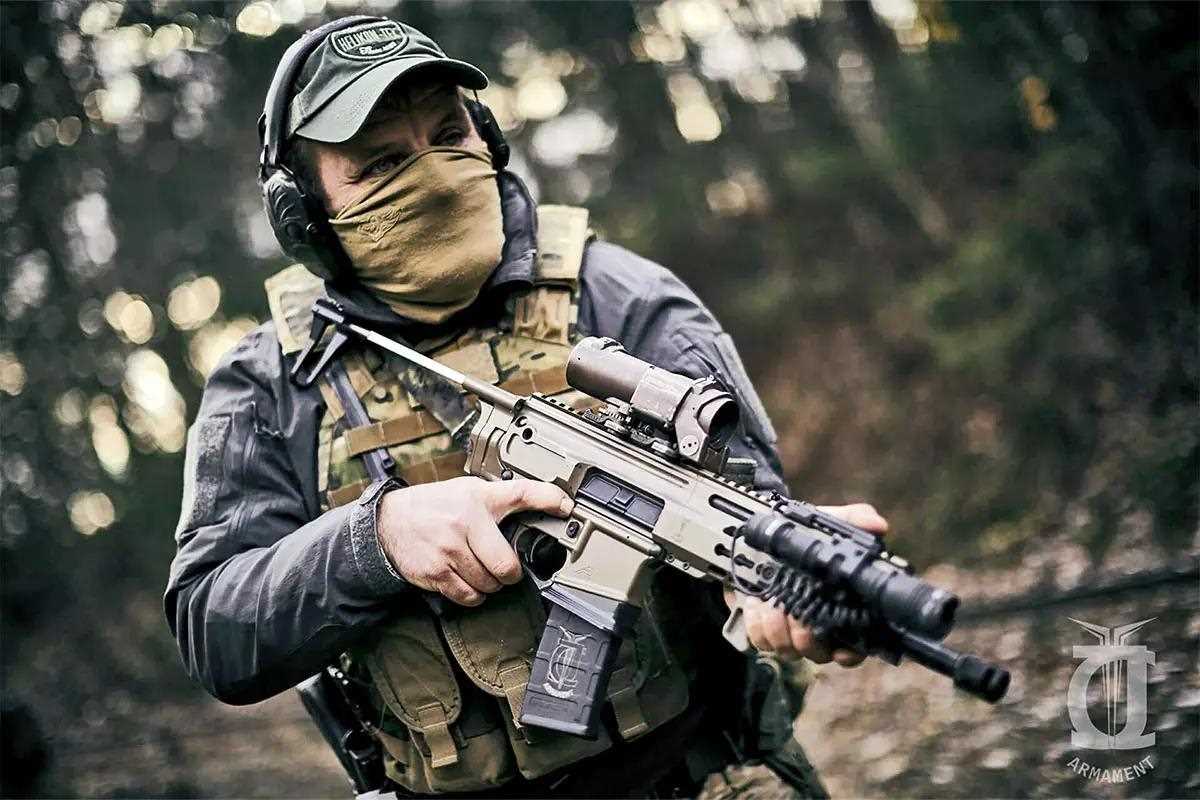
Manufactured by a relatively small, independent company in Poland, the Black Widow Mk.III is a gas piston operated PDW/SBR compatible with AR-15 lower receivers and accessories that aims at providing versatility and reliable operation for professional and civilian users alike.
In recent years, Poland has been at the forefront of European development in small arms. A combination of relatively favorable gun laws compared to the European average, an entrepreneurial mindset free from the constraints of the long-gone communist shackles, and the close proximity to the increasingly aggressive Russian neighbor, spurred Poland to become a powerhouse in the development and production of armament for all levels of defense—personal and national.
It’s in this context that two designers, Przemek Jaworski and Rafał Cygański, started a project aimed at developing a short-barrel, intermediate caliber rifle that could
potentially replace the sub-machine gun in close combat, close protection, clandestine operations and other similar duties, that could be easily carried into (and deployed from) a backpack, and used within the tight confines of a building, an aircraft, or from inside a motor vehicle.
Sure thing, the market is full of rifle-caliber PDWs and SBRs; not many, however, are manufactured in Europe, based on an indigenous design rather than the usual AK or AR pattern, and overcome at least in part the drawbacks of the most common short barrel rifles. A firearm like the one envisioned by Jaworski and Cygański would thus enjoy a potentially huge market in Europe, particularly within the law enforcement community.
In most of Europe, submachine guns (not rifles, much less shotguns) are the to-go patrol weapon for law enforcement, with limited adoption of semi-automatic, short-barrel pistol-caliber carbines in countries such as Great Britain. However, a series of relatively recent high-profile events, last but not least the Charlie Hebdo and Bataclan attacks in Paris back in 2015, highlighted the insufficiency of pistol-caliber firearms against attackers often armed with AKM-pattern full-automatic weapons and equipped with body armor. Although not common, when gun crime happens in Europe, it is often crazy even by American standards.
The Black Widow: It’s Small, But It Bites…
The work on the platform, dubbed the “Black Widow,” started in 2019 at J&C Armament (J&C standing, of course, for Jaworski and Cygański), and by early 2020, the first working prototype had been cobbled together. The prototype, called the Mk.I, was initially meant to test the viability of the working system, and in that scope it has so far fired over 30,000 rounds.
Of course, the prototype was not without its flaws, and the project was refined in a pre-production model (the Mk.II) before being finalized: the Black Widow Mk.III was first showcased in selected occasions in 2023 and made its official debut at the MSPO expo in September that year. The J&C Armament Black Widow Mk.III is a short-barrel rifle chambered in 5.56x45mm NATO, available in select-fire variants for MIL/LE/Govt. sales and in semi-automatic variants for commercial sales to law enforcement agencies, private security, and civilians.
The European firearms directive provides that any firearm shorter than 601 mm (23.66″) overall and with a barrel shorter than 301 mm (11.85″) is to be considered a handgun, while anything longer is to be considered a long gun. The intended shooting position (eg. if a firearm is “originally intended to be fired from the shoulder”) is irrelevant, and so is the presence of a stock or the absence thereof: if a firearm does have a stock, it has to be shorter than 23.66 inches overall with the stock folded or collapsed in order to be considered a handgun.
The absence of the “short barrel rifle” category typical of the 1934 NFA, and of the restrictions thereof, does indeed open the civilian markets in Europe to short-barrel rifles for uses like home or property defense, for which the Black Widow Mk.III appears to be very well versed.
The Black Widow Mk.III is almost entirely CNC machined out of a solid billet of 7075-T6 aircraft-grade aluminum alloy; alternatively, customers can request it be machined in Grade 5 titanium, which shaves off a few grams from its already low weight of 5.5 pounds (around 2,5 kilograms when empty on average). The barrels, bolt carrier group, and other pressure-bearing components are instead manufactured out of steel with no less than three types of steel being employed by J&C Armament: 42CrMo4 (one of the most used all around the world for gun barrels), H10s2, and WNLV, which is the Polish denomination for W500 tool steel alloy, used for parts that require high mechanical properties and high resistance against deformation at high temperatures.
The handguard is a separate component, its top portion forming the front part of the full-length MIL-STD 1913 Picatinny rail that replaces any factory sighting system, allowing users to install their favorites instead. A set of M-LOK or KeyMod slots (customer’s choice) at 3, 6, and 9 o’clock provide plenty of room for additional rail
segments for accessories.
The two nuts at the rear bottom portion of the handguard represent the securing point for the barrel, which is otherwise free to float. Barrels are available in different lengths, depending on the variant, but all are Government/SOCOM profile and chrome-lined, with an external QPQ treatment (a.k.a. Tenifer, or Melonite) treatment and a removable two-port muzzle brake installed on a suppressor-compatible ½×28 muzzle thread. With a 1:7-inch twist rate, it can properly stabilize basically all 5.56x45mm NATO and .223 Remington loads currently available. J&C Armament offers the Black Widow Mk.III in a standard MIL-STD hard-anodized black finish. Alternatively, a flat dark earth Cerakote is also available.
Three Variants, Same Gas System
All the variants of the Black Widow Mk.III platform are based on the same working system: a proprietary take on the familiar short-stroke gas system, with the gas valve pinned to the barrel and with no connection to the receiver so that the barrel itself is fully free floating.
The rotating bolt of the Black Widow Mk.III is literally just an AR-15 bolt; the bolt carrier group is a shorter version of the standard AR-15 bolt, without a gas key.
In its lieu, we find an op-rod riding it, on which the piston impinges. The return spring and recoil buffer ride within, and all are located in the upper receiver, making standard AR buffer tubes redundant.
The gas system is sealed, to prevent foreign objects from penetrating and obstructing normal operation, and is carbine-length on all variants for a better handling of the time-pressure curve, improving reliability and controllability in full-automatic fire, which in the select-fire versions of the platform runs at a smooth 500/550 rounds per minute. The charging handle is located within the handguard, is non-reciprocating, and upon field stripping, it can be removed to be reassembled to the opposite position for left-handed or right-handed operation. The gas valve, located right up front, can likewise be fully disassembled upon field-strip for cleaning and maintenance.
The gas valve can be adjusted manually with four positions, the first two being for normal-pressure ammunition (or for normal working conditions), and for high-pressure ammunition or adverse working conditions, while the third is dedicated to subsonic ammunition, for better performance when running the Black Widow Mk.III with a can.
The fourth and final position closes the gas valve completely, turning the gun into a single-shot manual repeater. While that provision, in the past, was privy to infantry rifles for the use of rifle grenades, on the Black Widow Mk.III it has a very different role: blocking the movement of all parts, it removes any factor that can disrupt accuracy when a critical single shot has to be taken.
Additionally, with the loading cycle blocked, the Black Widow Mk.III loaded with subsonic ammunition and equipped with a sound suppressor becomes extremely silent (once again, for critical single shots), reminiscent of the reason why the US Navy SEALs’ Mk.22 Mod.0 “Hush Puppy” pistol during the Vietnam War was equipped with a manual slide lock.
Three variants of the Black Widow Mk.III are available so far, dubbed respectively the “Regular,” the “Short,” and the “Super Short.” The “Regular” is available with a 10.3- or 16.5-inch barrel and comes equipped with a standard M4-type collapsible buttstock and buffer tube. The “Short” model is available with 10.3- or 14.5-inch barrel options, while for the “Super Short” customers have a choice between 10.3 and 11.5 inches. The “Short” and “Super Short” models come with proprietary collapsible PDW-type stocks designed and built by J&C Armament to reduce overall size. Outside of the tight confines of these three main variants, however, the Black Widow Mk.III can be configured basically in any possible way, mixing stock types and barrel lengths at the user’s will.
A Touch of Familiarity
Despite aiming at providing an alternative to the AR-based short barrel rifles all too common on the market today, the fine folks at J&C Armament do recognize the advantages of the AR platform in terms of availability of parts, familiarity among sport shooters and professional operators, and ergonomics. As such, they opted for building the Black Widow Mk.III on an unmodified AR-15 lower receiver.
This allows the Black Widow to retain the same configuration of controls as any AR variant, the only exception being the charging handle, reminiscent of Heckler & Koch’s roller-delayed weapon systems or, in more recent times, the Faxon Firearms ARAK-21. Virtually, the controls on the lower receiver can be configured to be completely ambidextrous. Additionally, the Black Widow Mk.III is compatible with AR-15 rotating bolts, trigger groups, and of course magazines, and is available both as a ready firearm or as a conversion kit for existing AR-15 lowers, since it field strips like an AR-15 and requires no modification to the lower—not even when using the proprietary stocks developed for the “Short” and “Super Short” variants.
As of today, J&C Armament manufactures the Black Widow Mk.III only in 5.56x45mm NATO; variants in 6.5 Grendel and .300 Blackout are planned to be introduced by the end of 2024. A 9mm Luger version is planned for 2025. The Black Widow Mk.III isn’t a cheap gun: the starting price is 11,900 Polish Złoty, equivalent to approximately 2,700 Euro or $2,900 USD, with the final price depending on any special custom requests. After all, it’s a Polish industrial product, and the Poles, like the Czechs, are well known for doing great things in terms of machining, and being very proud of that. Mass production and an increase in request, particularly on export markets, may one day lead in a price decrease.
*If the Trump Administration eliminates the 1989 imported assault weapons ban, which it can do without Congress, U.S. gun owners may get to purchase these and other similar products.