The Henry U.S. Survival Rifle
Henry Repeating Arms’ version of the famous AR-7 Survival Rifle

Designed in the late 1950s by AR-15 inventor Eugene Stoner, the AR-7 actually began as the bolt-action AR-5 rifle, chambered in .22 Hornet, in the ArmaLite drawing room. The 2.5-pound AR-5 was a more practical survival rifle than the bolt-action, four-pound M4 Survival Rifle the U.S. Army Air Corps used during and after WWII (the M4 was also a magazine-fed rifle in .22 Hornet). Whereas many military rifles, as far back as the 1800s, had storage in the stock to house cleaning tools, the AR-5 was unique, as the entire rifle action (with magazine inserted) and removable barrel could be stored in its hollow, fiberglass stock. Since emergency landings in water were common during the war, especially during long-range bombing runs in the Pacific, the idea that a rifle could be stored within its own stock, which could keep it afloat, was novel, as the all-steel M4 would just sink if let go.
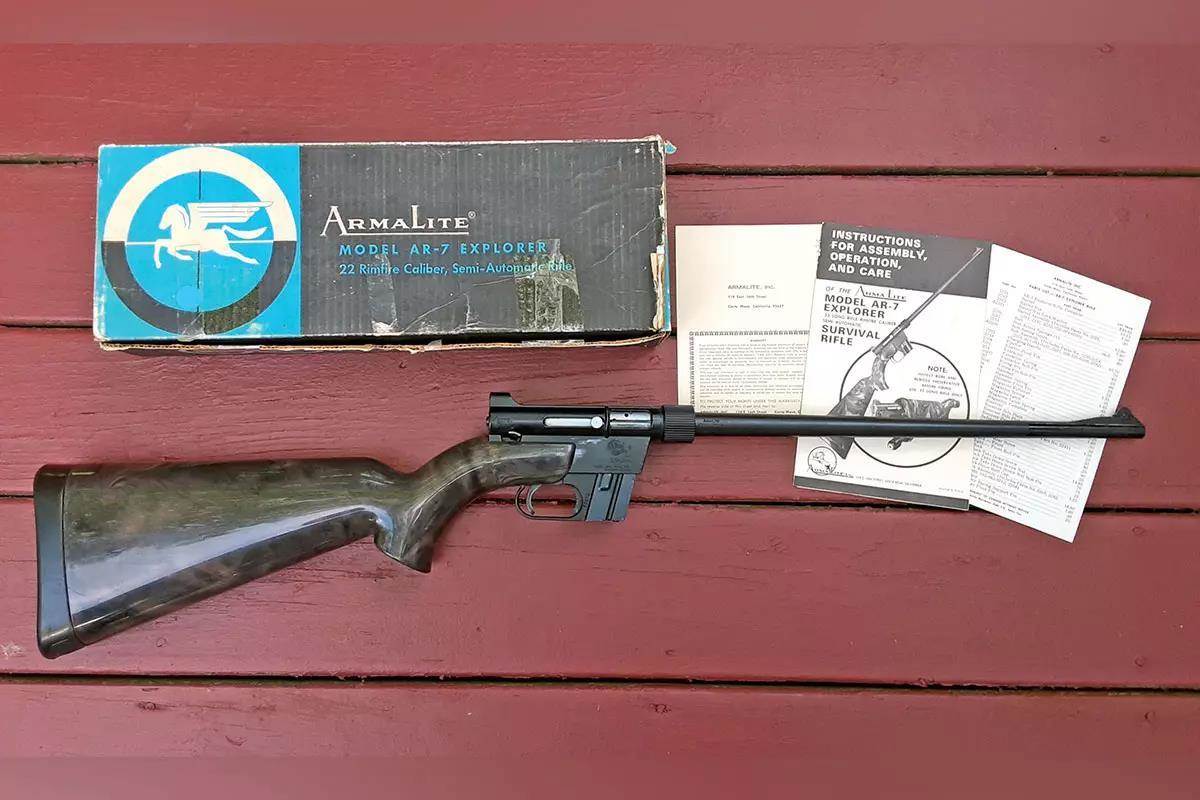
Developed in the early to mid 1950s, the ArmaLite AR-5 was eventually accepted by the U.S. Airforce and designated as the MA-1. However, the USAF realized soon after that it was overstocked on M4 Survival Rifles as well as M6 Aircrew Survival Weapons (an over/under-barreled .22 LR and .410 shotshell longarm manufactured for survival kits issued to military pilots flying missions over remote areas). The USAF halted the order, and ArmaLite decided to go in another direction regarding this concept, and that direction was commercial sales. ArmaLite then decided to redesign the AR-5 while keeping the dimensions and concept as close to the original as possible, but to engineer it into a semi-auto .22 LR rifle. The idea was to market it to pilots, boaters, campers, hunters, and other sportsmen as a rifle that could be used for small-game hunting and plinking in addition to emergencies.
After ArmaLite stopped manufacturing the AR-7 in the early 1970s, production resumed under Charter Arms around 1973. After Charter Arms stopped production in 1990 (or so), it was manufactured by Survival Arms throughout most of the 1990s, then AR-7 Industries picked it up for about six years, starting in 1997. Henry Repeating Arms also began making its version in 1997, and is currently the only manufacturer of the rifle today. Every manufacturer, after ArmaLite, put their own “twist” on the design: change in the type of polymers used to make the stock, plastic barrels with rifled metal tube sleeves, and even changes to the type of aluminum used for the receiver. Henry has made the most radical departure from the original design.
Starting in the 1960s, and through the 1980s, many accessory options became available such as telescopic stocks, pistol grips, barrel shrouds, extended magazines, threaded barrels, and scope mounts. There were even kits to make the AR-7 look like a “Tommy Gun” or an M1 Carbine. The Israeli Air Force obtained a bunch of original ArmaLites and modified the rifles using a telescopic stock (of their design) and FAL rifle pistol grips—this became their pilots’ survival rifle. It was back in 1978 when I first saw an AR-7 rifle at a gun store, and in 1982, I got a Charter Arms-manufactured AR-7 pistol, which resembled a cut down AR-7 rifle with a Broomhandle Mauser-shaped pistol grip. I later obtained AR-7 rifles manufactured by Charter Arms, Survival Arms, AR-7 Industries, and ArmaLite.
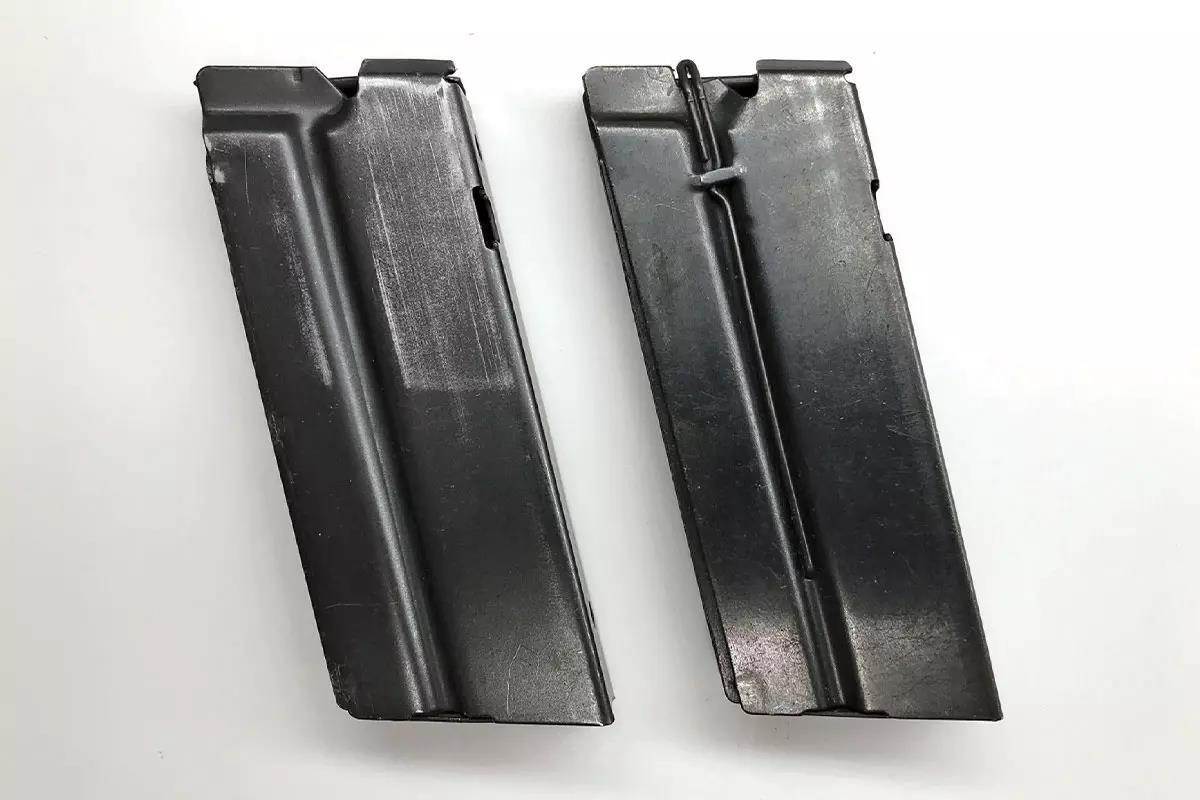
There are varying degrees of reliability with many of the manufacturers after ArmaLite and before Henry, and one of the main issues has been centered around the magazine. Another issue is choice of ammunition. Regarding reliability, the AR-7 copies made by Charter Arms and other manufacturers are known to have jamming issues, and I have dealt with these since 1982. Failure to feed rounds was the norm, and much of the time it was directly related to the magazine. With the exception of the plastic magazines made by Ram-Line, I don’t know how many times I took AR-7 magazines apart and experimented with modifying the follower and bending the feed lips. It seems like I always kept needle-nosed pliers in my pocket when shooting an AR-7. I did learn some other tricks to help with getting the rifle (or pistol) to feed properly. One involved making a small ramp on the chamber with a Dremel tool to improve reliability. However, not all feeding issues were parts related; the other issues were ammo related. You must use quality, high-velocity ammo (over 1,300 fps is best) for this gun to run properly—that goes for all AR-7 firearms, even the original.
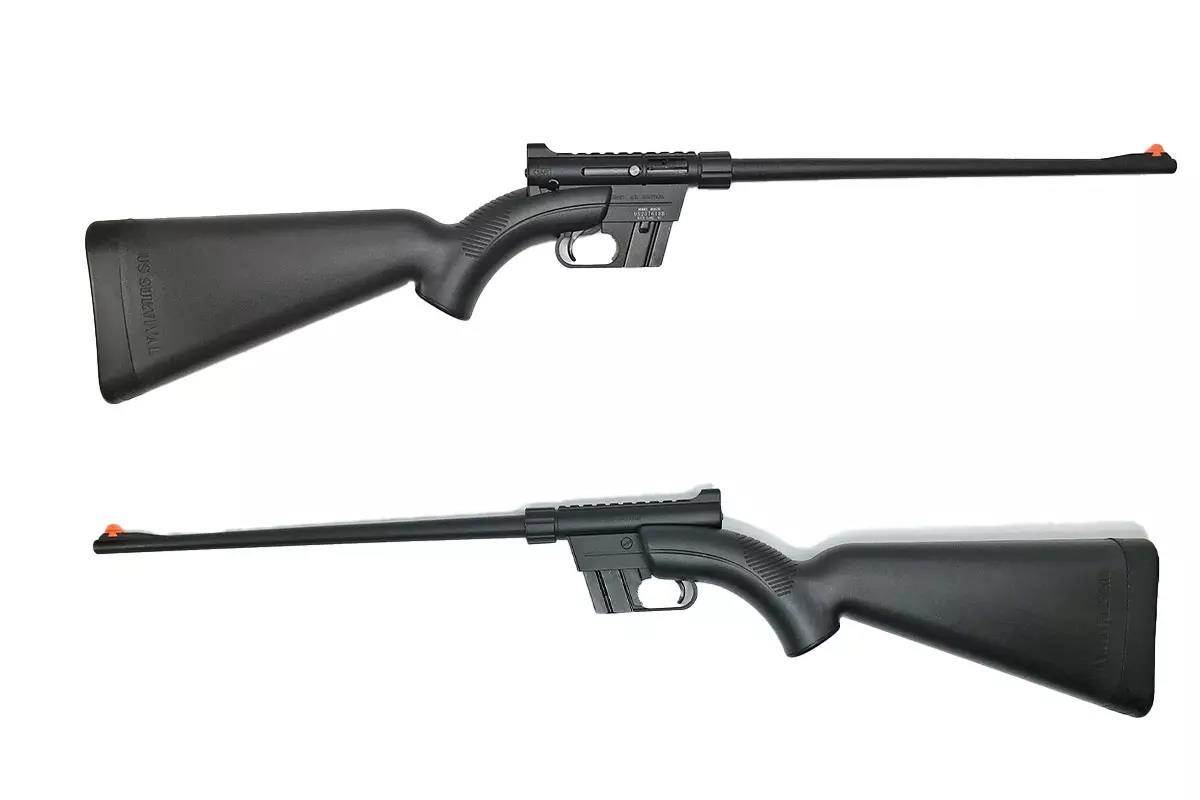
I have been into preparedness/survivalism since the late 1970s, so anything that has to do with this subject gets me excited—especially firearms, so let’s take a look at Henry’s version. Although the Henry Repeating Arms U.S. Survival Rifle isn’t called an AR-7 by the manufacturer, I’m going to refer to it as the Henry AR-7.
The Henry
The first thing I noticed when I picked it up was the weight. The Henry AR-7 is heavier than my other AR-7 rifles. The specification sheet states 3.5 pounds. That’s not bad considering that most semi-auto .22 LR rifles weigh 4.5 to 5.5 pounds. However, when comparing an original AR-7 rifle or say an AR-7 Industries AR-7 rifle, which weigh roughly around 2¾ pounds, to Henry’s version at 3½ pounds, that’s almost a pound difference at approximately 14 ounces heavier. I toted around a two-pound, 10-ounce AR-7 for four decades—I can feel this extra weight. It’s not like we are comparing an AR-10 sniper rifle tipping the scales at 13 pounds and another AR-10 (loaded-up with even more accessories) coming in 14 ounces heavier, that wouldn’t be noticed as much. The extra 14 ounces/close to a pound of extra weight feels like a lot, it’s a 33% increase in weight. So, where is the weight coming from?
I decided to start weighing parts. I’m not going to include a chart of every part on all three AR-7 rifles I own (that will be included on a review of the original ArmaLite AR-7 in a future issue of Firearms News), but here is what I discovered after tearing all three guns down and weighing the parts out. The Henry’s receiver section, with all internal parts, weighs in at one pound and 7¾ ounces. Compare that to the ArmaLite receiver section at 14 ounces, and the AR-7 Industries receiver section at 14 and 7/8 ounces. At this point, I briefly thought that maybe the Henry’s bolt was heavier, although there would have to be a major difference in the recoil springs. After stripping all parts completely from the Henry receiver (except for the safety) I found my answer. The metallurgy of the stripped Henry receiver is substantially heavier at 12¾ ounces. The AR-7 Industries receiver stripped (except for the safety) weighs only 53⁄8 ounces. The Henry receiver is where most of the extra weight is.
I reached out to Henry and inquired about the metallurgy details for the receiver, but I did not receive the information. I can understand why Henry “beefed up” the receiver as I have seen Charter Arms AR-7s with hairline cracks on the front part of the magazine well. I have two Charter Arms AR-7 pistols in the silver finish; both have this issue. However, I have never seen or heard of this issue with any other types of AR-7s from other manufacturers.
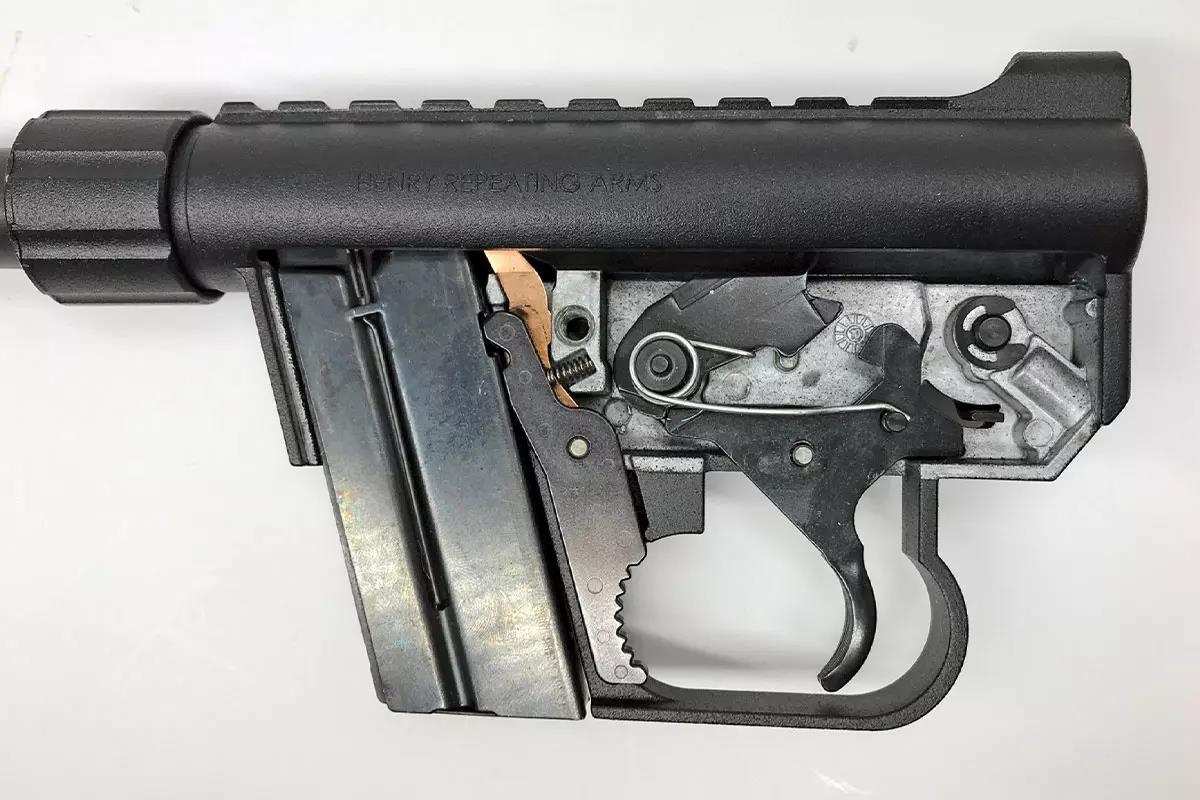
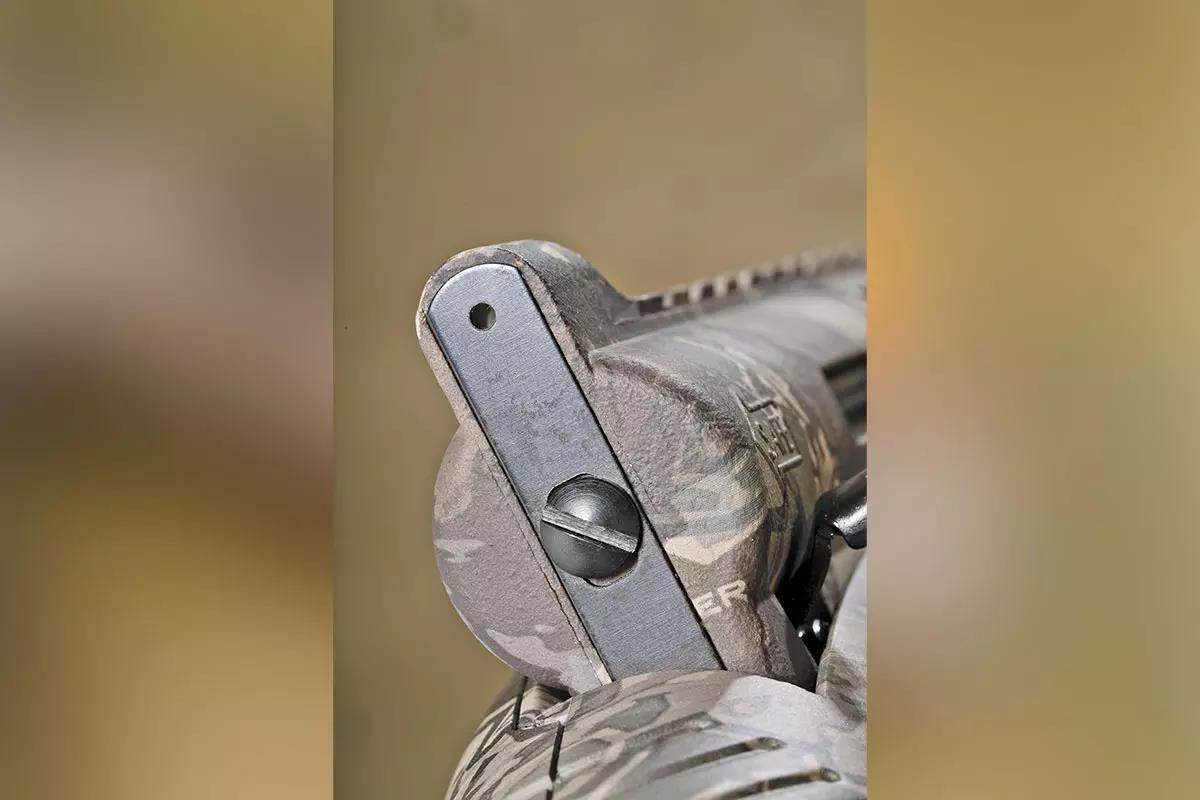
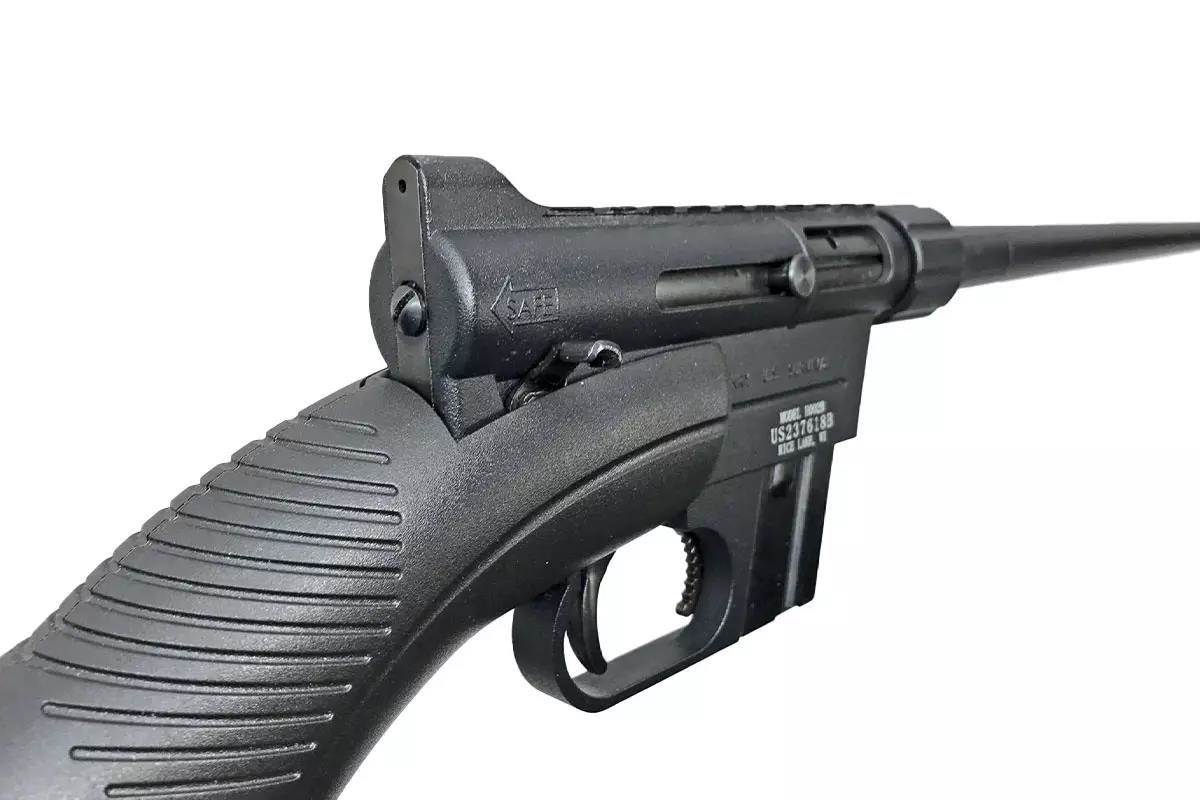
Continuing on the receiver, it features a built-in grooved rail at the traditional rimfire 3/8-inch size, and a hooded rear sight assembly. Notice, I did not say hooded rear sight because the adjustable rear peep sight is a flat, thin piece of steel (with two different-sized apertures) which rides in a channel and is adjustable for elevation with a flat-head bolt. The safety is a protruding lever type and only engages when the hammer is cocked—forward to Fire and backward for Safe. Although the safety is located on the right side near the rear of the receiver, it is easily manipulated with the right thumb. There is a flat-head countersink screw holding a plate in the left side of the receiver, and this plate makes up part of the magazine well and also covers and contains the fire control group, ejector, and one-piece magazine release lever. The trigger guard is generous in size and also contains the magazine release, which when pushed forward will release the magazine. The charging handle resembles a fired .22 LR case and is captive (within a channel cut into the receiver) and free floating inside a hole in the bolt.
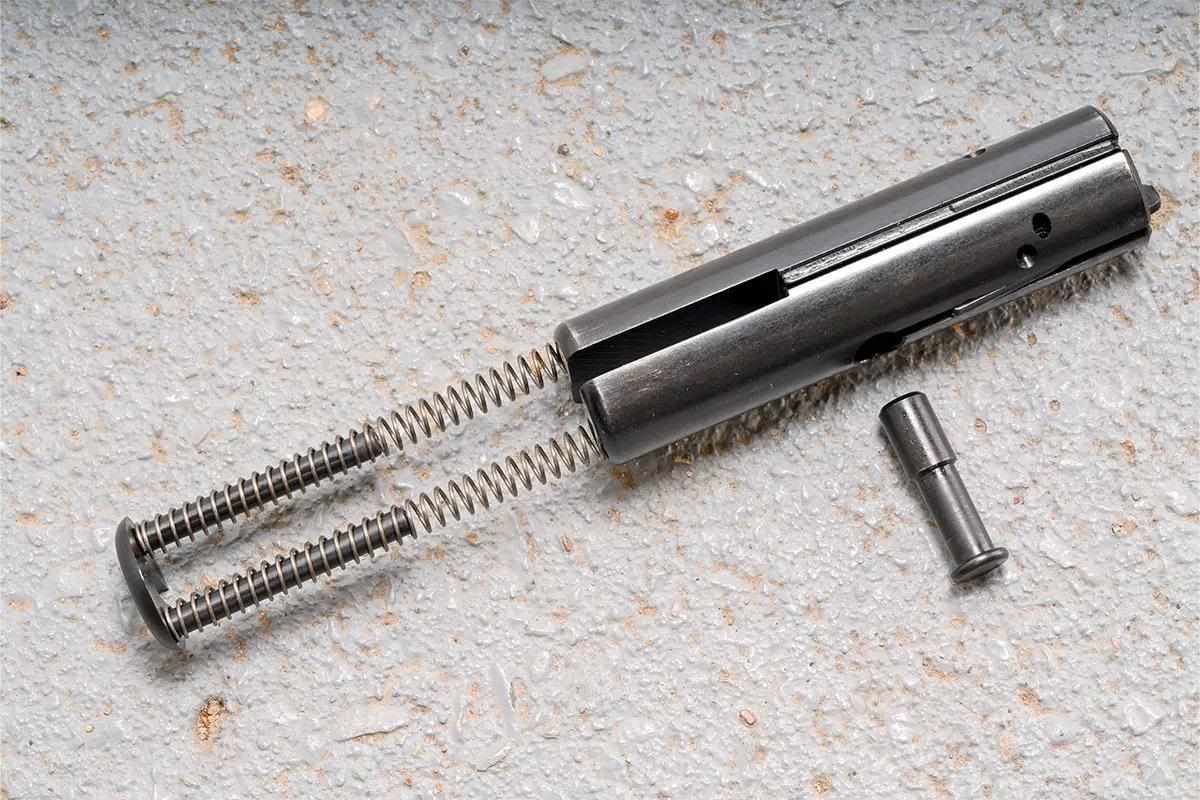
The bolt operates using two recoil springs, which are guided by two rods attached to a disc that sits at the rear of the receiver. The bolt weighed in at 61⁄8 ounces, only a fraction heavier than the bolt on the Survivor Arms AR-7 that came in at 57⁄8 ounces. The firing pin and extractor are the typical .22 rimfire set up.
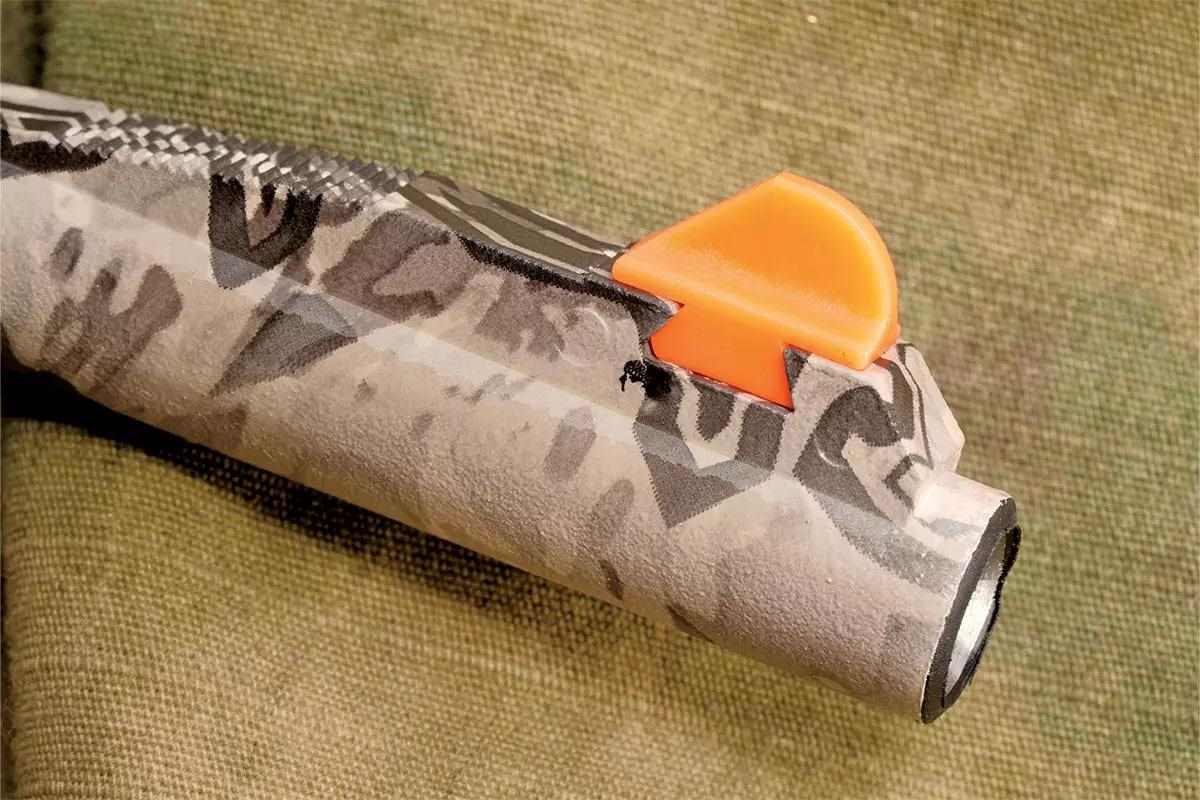
The 16.125-inch barrel is steel, covered in ABS plastic. So, what is ABS plastic? Its stands for acrylonitrile butadiene styrene and has a proportion of all three of those compounds mixed for whatever purpose/result the manufacturer wants to achieve. It is known for its high impact and heat resistance properties, so it’s a perfect polymer for firearms. Interesting to note, the polymer-covered steel barrel of the Henry AR-7 weighs in at 10¼ ounces, while the mostly aluminum barrel of the ArmaLite comes in at 123⁄8 ounces. The barrel has a dovetailed blaze-orange plastic sight, which is adjustable for windage. The sight has stayed put during the time I have used it, but it can be adjusted with a push of a finger. I would probably epoxy/glue it in place just to be sure it would not get knocked out of place.
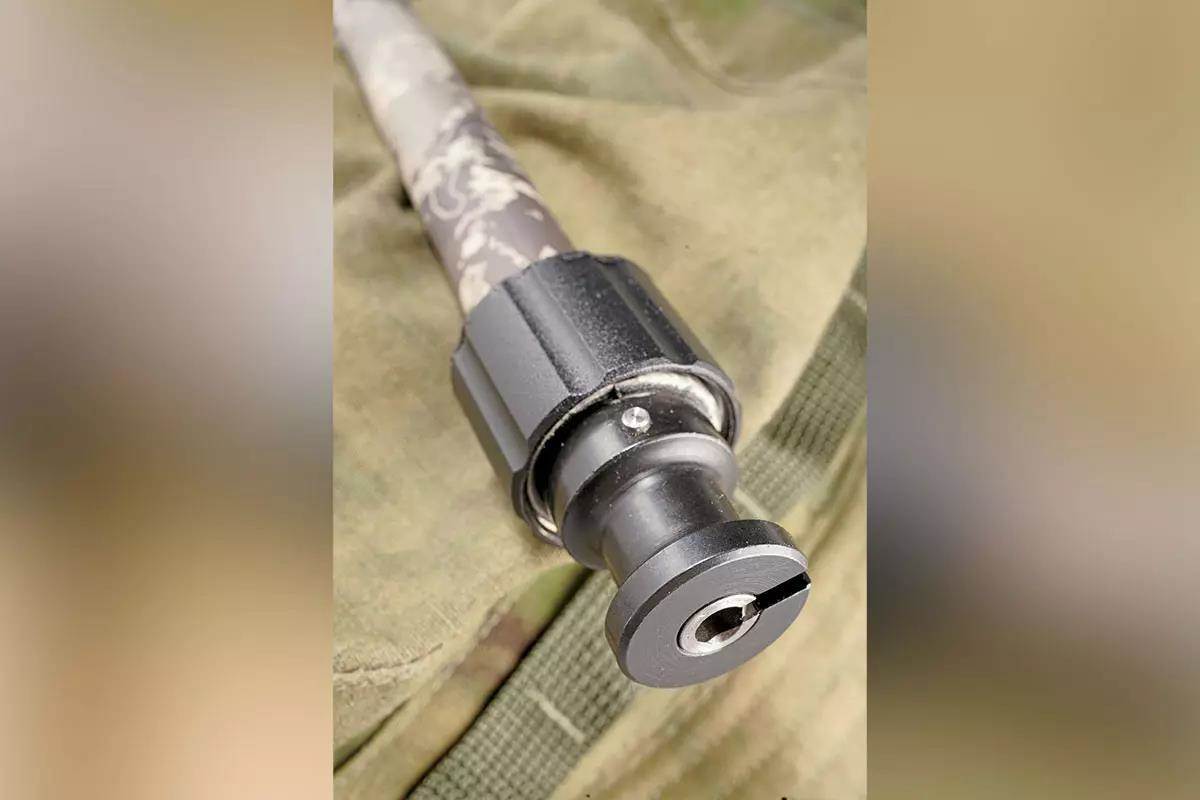
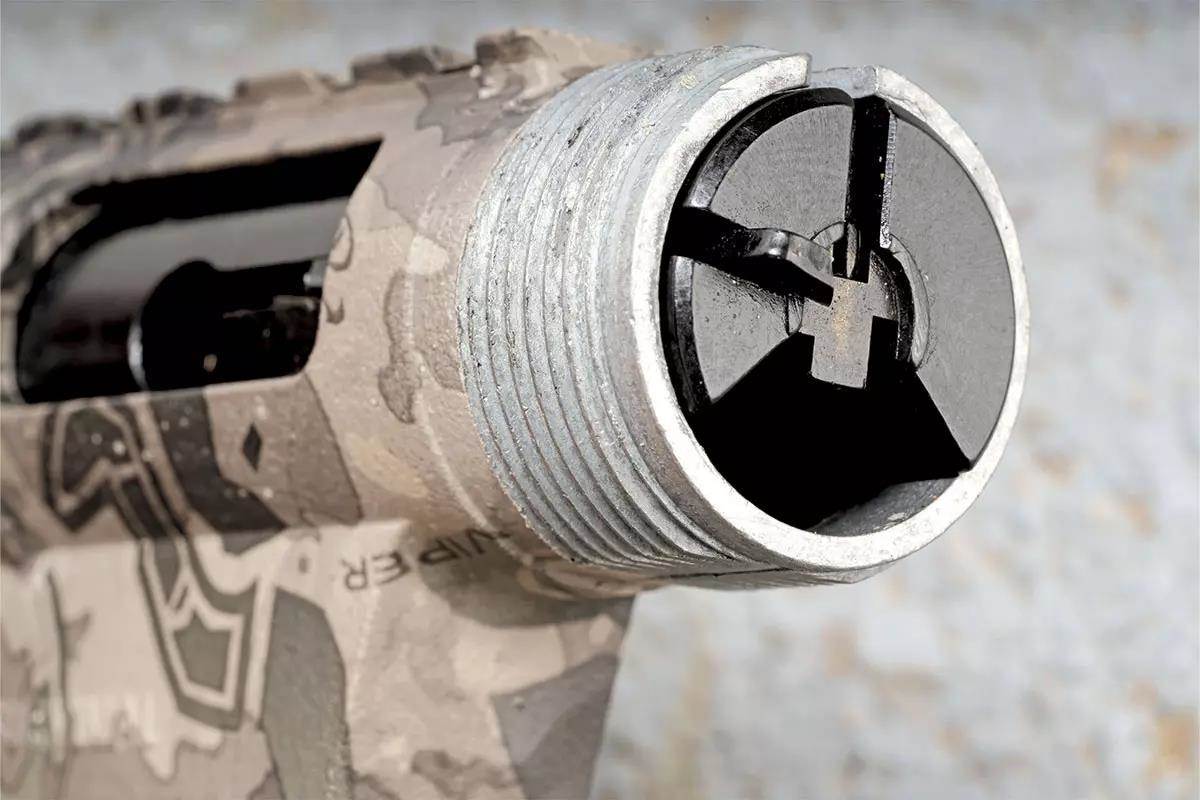
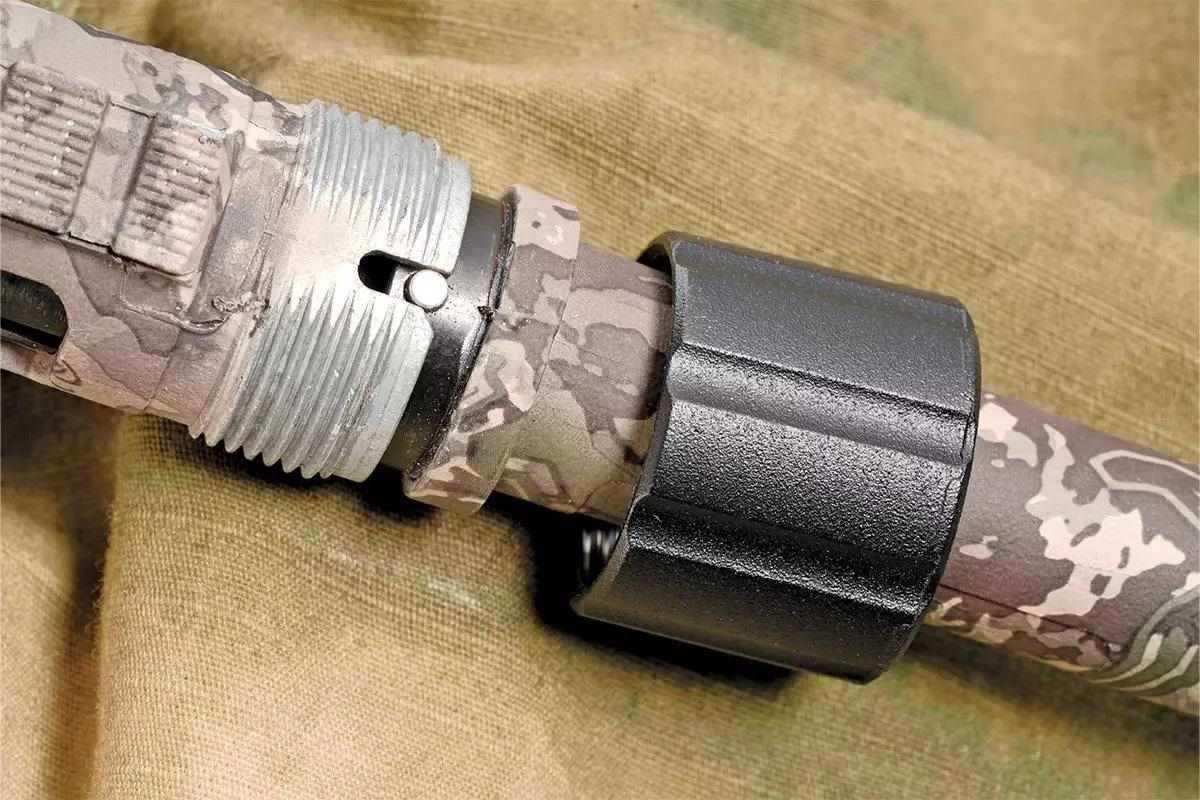
The barrel has a steel chamber shank which is inserted into the receiver and is held in place by a metal, captive, threaded-barrel nut that is hand tightened—just like the original. There is also a stud at the 12 o’clock position of the shank, which is inserted inside a milled-out channel on the receiver to keep the barrel properly aligned. However, the shank portion of the barrel is quite different from the original as it’s turned down steel instead of a solid piece. The chamber also has a slight ramp at the six o’clock position, something other AR-7 barrels I’ve seen don’t come with.
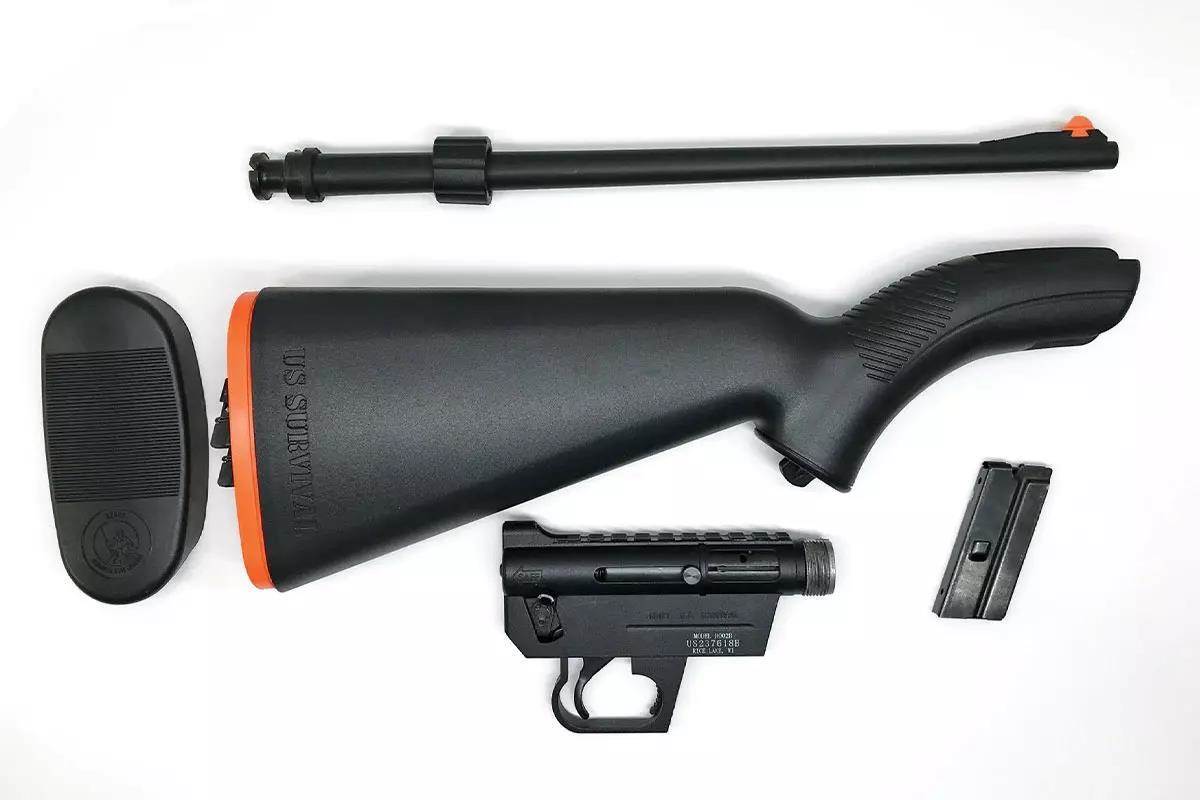
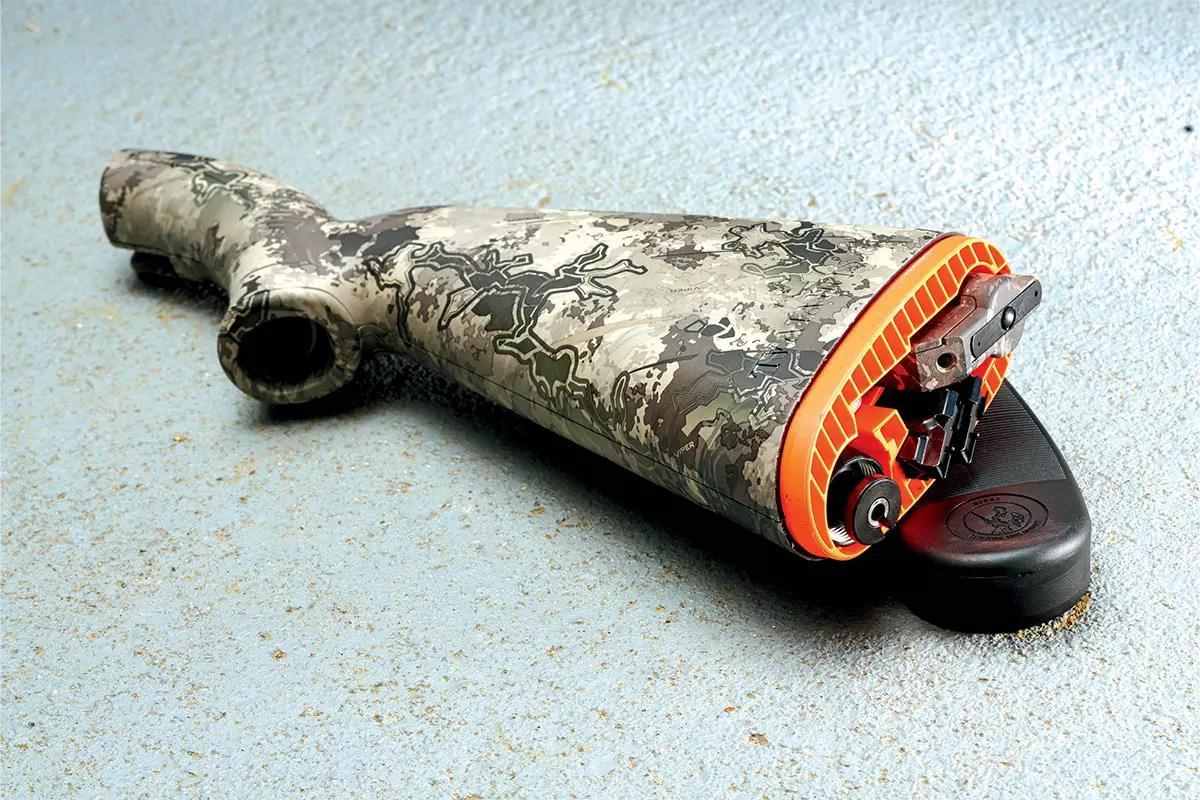
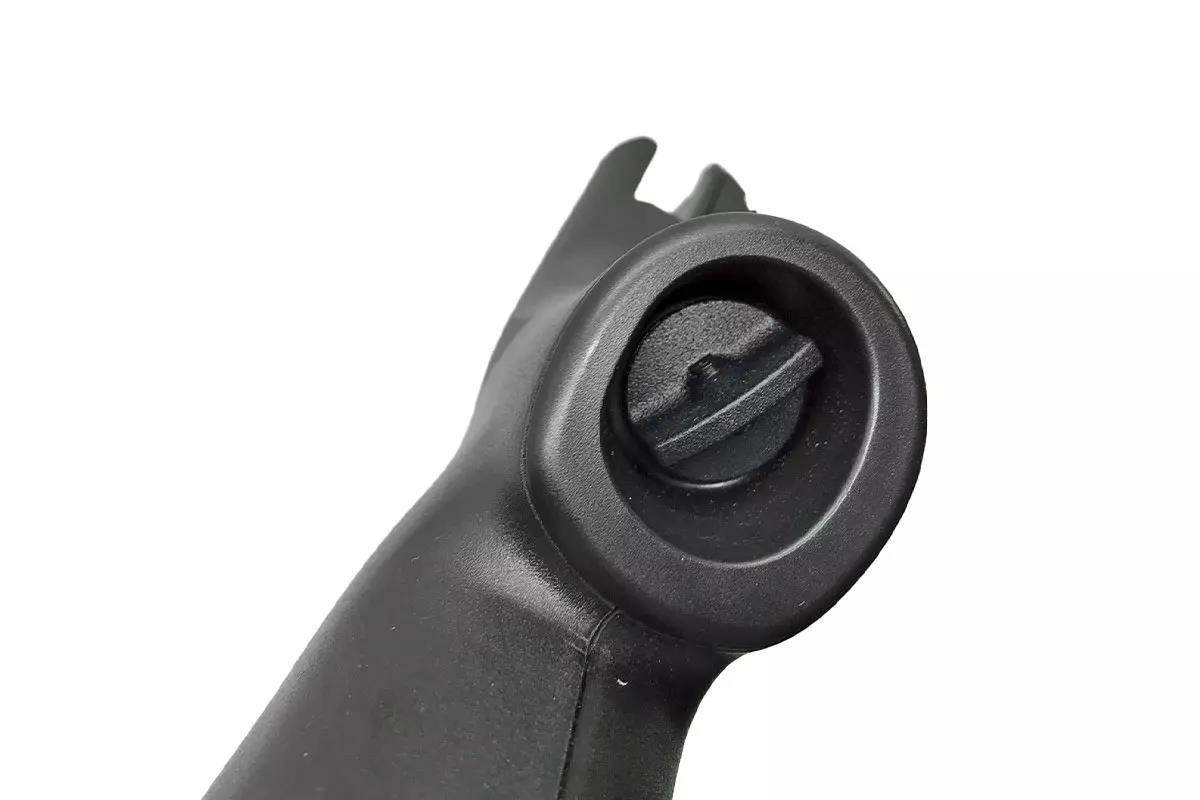
The stock is slightly larger than the other AR-7 variants, and this is apparent as soon as you grab the palm swell portion (if you handled the other versions). The takedown screw with nut is located on the underside of the pistol grip and this is what locks the receiver onto the stock. With the butt cap off, the interior is a blaze orange color (could be used to signal someone on a sunny day) and it houses the barrel, receiver/action with a magazine inserted, and two additional magazines. This is a big improvement in my opinion, as the original and previous copies only held the action without a magazine with place for one magazine. The two spare magazines are inserted, bottom first, into a pressure-fit track which keeps them from falling out when the butt cap is removed. Nice.
The magazine change is the big winner here. As stated earlier, the magazine has been the Achilles’ heel as far as copies are concerned. Henry added a wire spring bullet guide to a channel on the left side of the magazine. This helps guide the round into the chamber and prevent the round from popping upwards and hitting the top of the chamber—a common malfunction in copies. If you have one of the other AR-7 copies, I will strongly suggest buying Henry magazines and trying them in your AR-7. You will see most of your reliability issues go away. They even work perfectly in an original ArmaLite.
Shooting
When the rifle arrived, I hurried up to put some rounds down range on my property. I used high-velocity 40-grain Winchester Wildcat lead round nose (LRN) and was pleasantly surprised I did not experience a jam. Brass ejects at about two o’clock and lands over six feet away. After about 200 rounds, I was convinced that Henry had fixed the reliability issues which have plagued copies of the ArmaLite. I did notice that the firing pin hits seemed small and light, but, after checking, they are the same as the ones from my AR-7 Industries and ArmaLite AR-7s. The Henry AR-7 doesn’t need anything engineering-wise regarding reliability—it just works. Regarding the trigger, there is almost no trigger travel and almost no creep with a clean break at 3¼ pounds and a short reset (my ArmaLite breaks at five pounds).
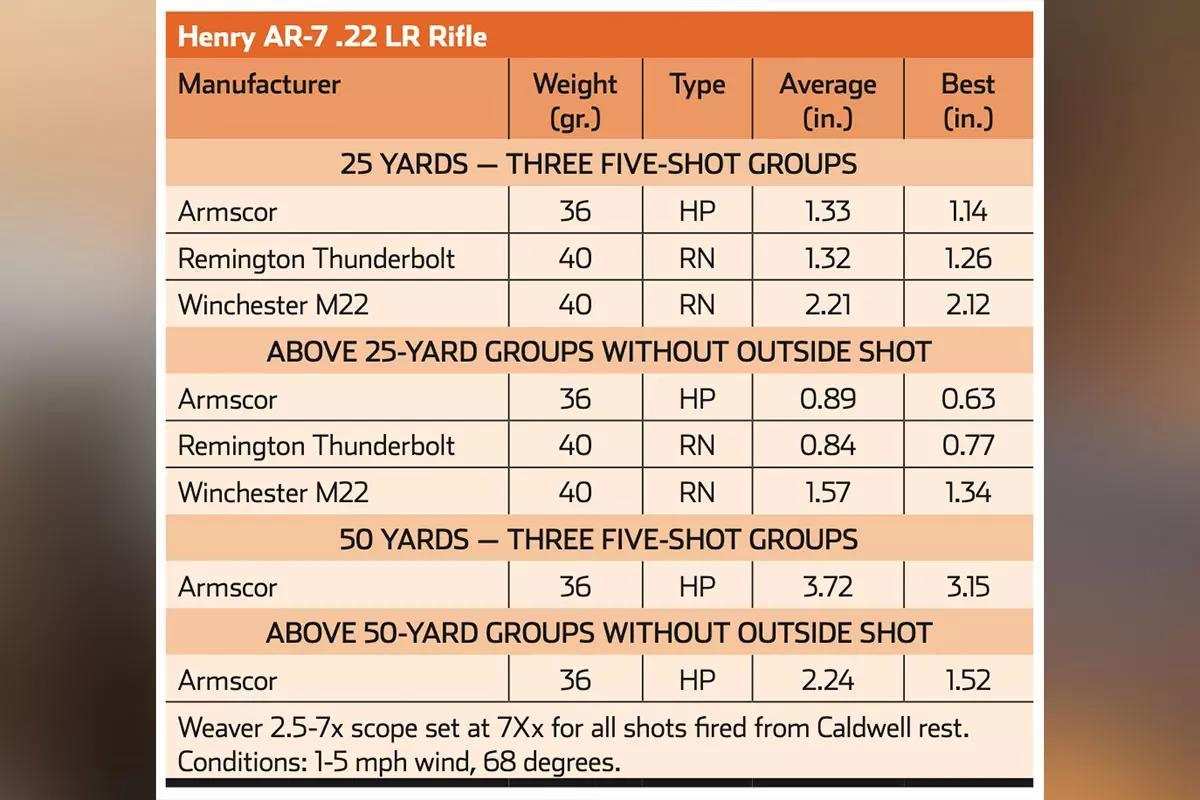
For my accuracy test, which would consist of three five-shot groups at 25 yards, I used a Caldwell sled on a shooting bench, targets held by the Caldwell Ultimate Target Stand (CaldwellShooting.com). The wind was coming in at one to five mph and the temperature was 68 degrees. I mounted a Weaver 2.5-7x28mm scope and set it to seven power. Although the wind was light that day, I included groups without the outside shot/flyer in my accuracy chart. I did use a flag down range to watch the wind, but I noticed some slight movement at times with the target stand.
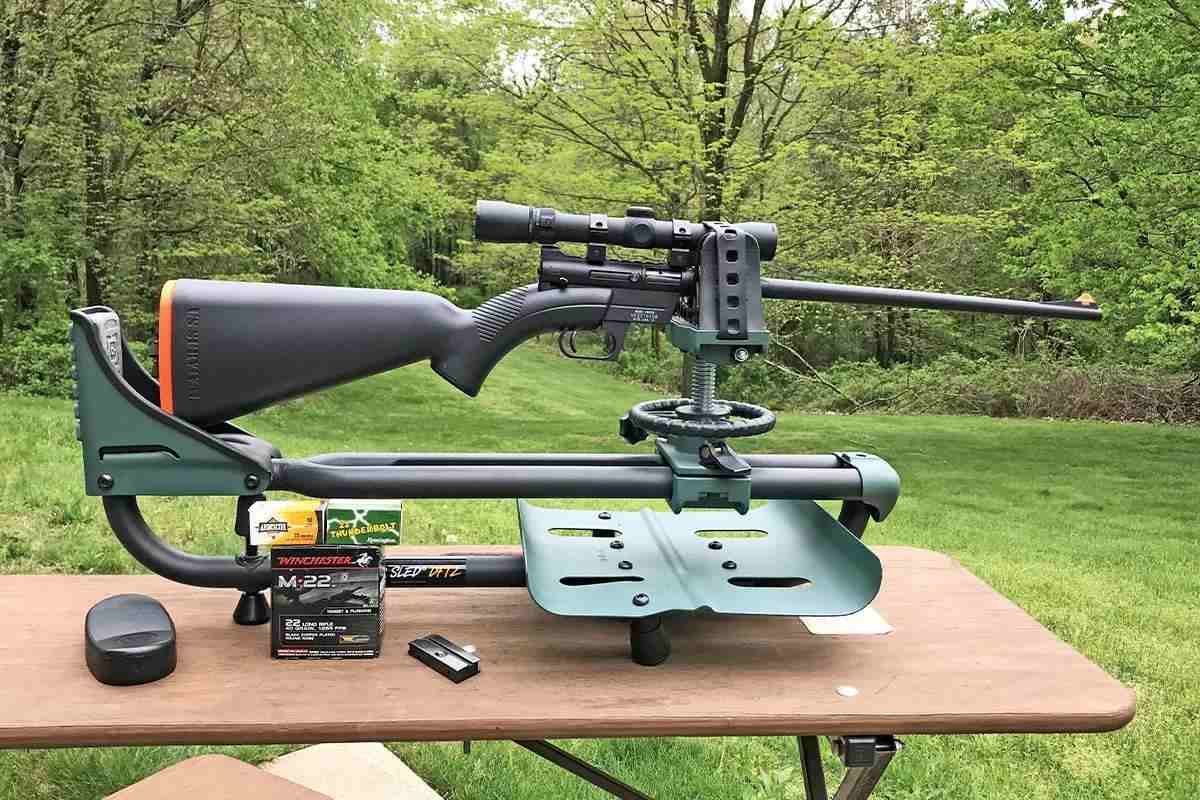
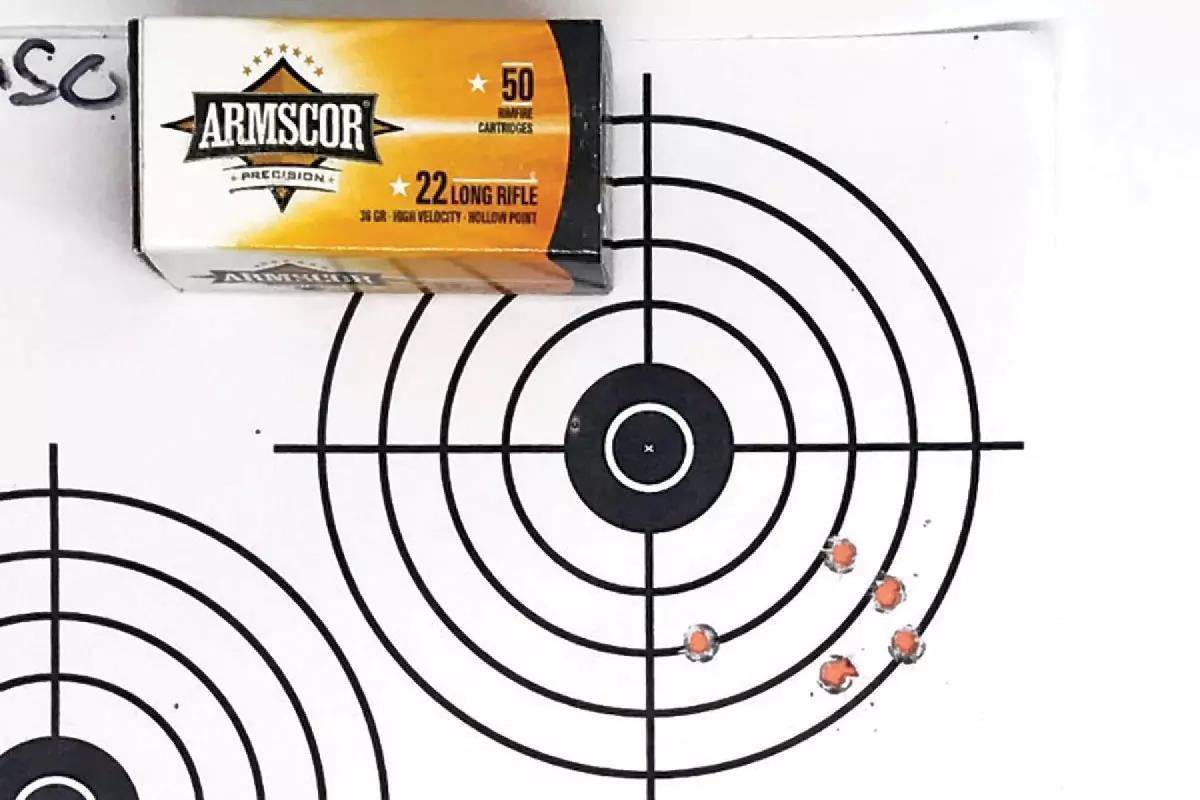
First up was Armscor 36-grain high-velocity hollow point .22 LR. My first group was 1.6 inches and the second, my best, came in at 1.14 inches—only 0.63 of an inch without the “flyer.” Remington Thunderbolt always has great results, especially for bulk packed rimfire. The first two groups were very consistent for this 40-grain round nose load: 1.28 inches (0.78 without the flyer) and 1.26 inches (0.77 without the flyer). The last group opened up a bit to give it a 1.32-inch average. Last up was bulk packed 40-grain Winchester M22, also a round nose. All three groups were between 2.12 and 2.32 inches. Since Armscor had the best score, I took it out to 50 yards onto a life-sized rabbit paper target with a bullseye. All five rounds struck kill zones on the target. The other two groups were fired onto other targets. The best group was 3.72 inches with the best group at 3.15. The best group without the flyer came in at a “hare” over an inch and a half. See the chart for more details.
So, What’s the Verdict?
Be Ready! Editor David Fortier and I talk a lot about guns. We are the same age and grew up with piles of cool guns, going to gun shows, and reading gun magazines and books as much as was possible. Over fifty years of shooting for each of us, and we have both been into prepping/survival for almost as long. I mentioned to Dave that I like throwing a .22 LR conversion in my bug-out pack for my AR-15 pistol, instead of bringing along another .22 rimfire rifle. The idea is that if my supply of 5.56 runs dry, I can start feeding the AR .22s, especially since I pack hundreds of rounds in such a small space. If on a big trip, my .22-converted AR-15 pistol wouldn’t do my buddy any good if we ran out of the other firearms’ ammo. David said, “You’ll always need what you don’t have, Murphy’s Law.” He’s right, your buddy might need to throw lead downrange at bad guys along with you, or go on his own to hunt for food.

If travelling by vehicle, taking along another rifle isn’t a big deal—the Henry AR-7 packs small. Although a significant design change would be in order, I brought up other calibers I would like to see an AR-7 in, like 5.7, as a better choice for defense or hunting. Dave also thought a round with more power would be a good thing in this design. Don’t get me wrong, .22 LR is a perfect cartridge for survival for many reasons, but it just isn’t for “everything” like a 5.56x45mm could be. Still, dumping eight rounds of .22 LR into the chest of a bad guy would wreck his day thoroughly (probably much worse than some shotgun blasts), and most likely that day would be his last one.
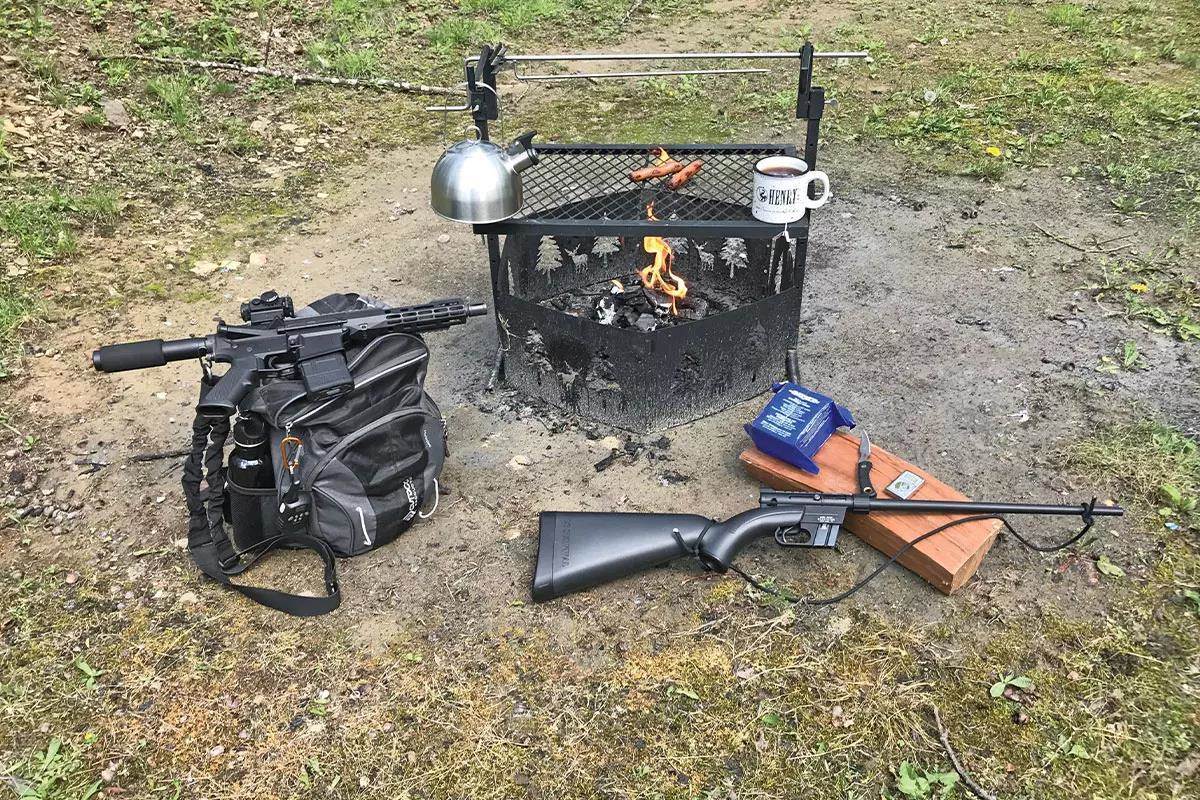
Regarding weight, even though other older AR-7 variants weigh about 14 ounces less, 3.5 pounds isn’t a big deal, as most semi-auto rimfires weigh at least a pound more. A cousin, who was in Army intelligence during the Vietnam War, once told me that they even cut the handles off of their toothbrushes just to save that little bit of weight in their recon packs. One pound (or two) off of what you are carrying for miles daily is a big deal.
As stated earlier, there are a bunch of kits which turn an AR-7 into a collapsing-stock rifle or into other configurations. Haga Defense has the most modern take on the AR-7 with its kit. However, from a prepper or survivalist point of view, the unique AR-7 stock makes the AR-7… unique. Without it, the U.S. Survival Rifle is just a lightweight semi-auto rimfire with quick-detach barrel. To me, using anything but original stock doesn’t make much sense (other than just having fun) as two elements of this unique rifle go away—the ability to store the whole gun inside the stock, and the ability for the rifle to float in water, for at least 15 seconds.
I tested the Henry and it went vertical in that time. I also tested my AR-7 Industries version, it stayed floating horizontal for one minute and 45 seconds (both tests were conducted in still water with the rifles stored inside the stocks). The extra 14 ounces is obviously what caused the Henry to sink much faster, although both rifles’ stocks are not waterproof. Still, 15 seconds is better than sinking to the bottom instantly. If you drop it into water while boating, you will be happy it has this feature. However, if you and your gear get dumped in the river while white water rafting, it’s probably going to be gone.
As far as price, I’ve found brand-new Henry AR-7s for as low as $280. That’s about $130 more than a budget .22 rimfire semi-auto rifle on sale. However, with that heavier budget rifle, you won’t have a quick-detach barrel or a floating stock to store the entire rifle in. Your prepper needs and situations will dictate whether you want to spend the extra money for these features.
If you are in need of a semi-auto .22 rimfire rifle to complete your prepper “arsenal” (carry handgun, MSR, pump shotgun, long-range rifle), the Henry AR-7 can certainly fill that need. This is especially true when space in an RV, small plane, ATV, car, or boat is limited.
HENRY REPEATING ARMS U.S. SURVIVIAL RIFLE SPECS
- Model #: H002B
- Action: Blow-back semi-auto
- Caliber: .22 LR
- Weight: 3.5 lbs.
- Overall Length: 16.5 inches stored, 35 inches assembled
- Barrel: 16.125” w/ 1:16-inch rifling twist rate
- Capacity: 8-round detach box magazine (larger capacity aftermarket mags available)
- Metal Finish: Black Teflon (camo finishes avail.)
- Trigger: Single-stage, 3.25 lbs. (as tested)
- Front Sight: Blaze-orange blade adjust. for windage
- Rear Sight: Aperture adjust. for elevation
- Optic Mount: Built-in 3/8” scope rail
- Stock: ABS plastic, 14” length of pull
- Packaging: 17.5”L x 2.75”H x 6”D suitcase-style cardboard box with plastic handle, comes with 2 magazines, manual, and lock
- MSRP: $ 350.00
- Contact: (866) 200-2354, HenryRifles.com