Smith & Wesson’s New M&P V Series is a Victory
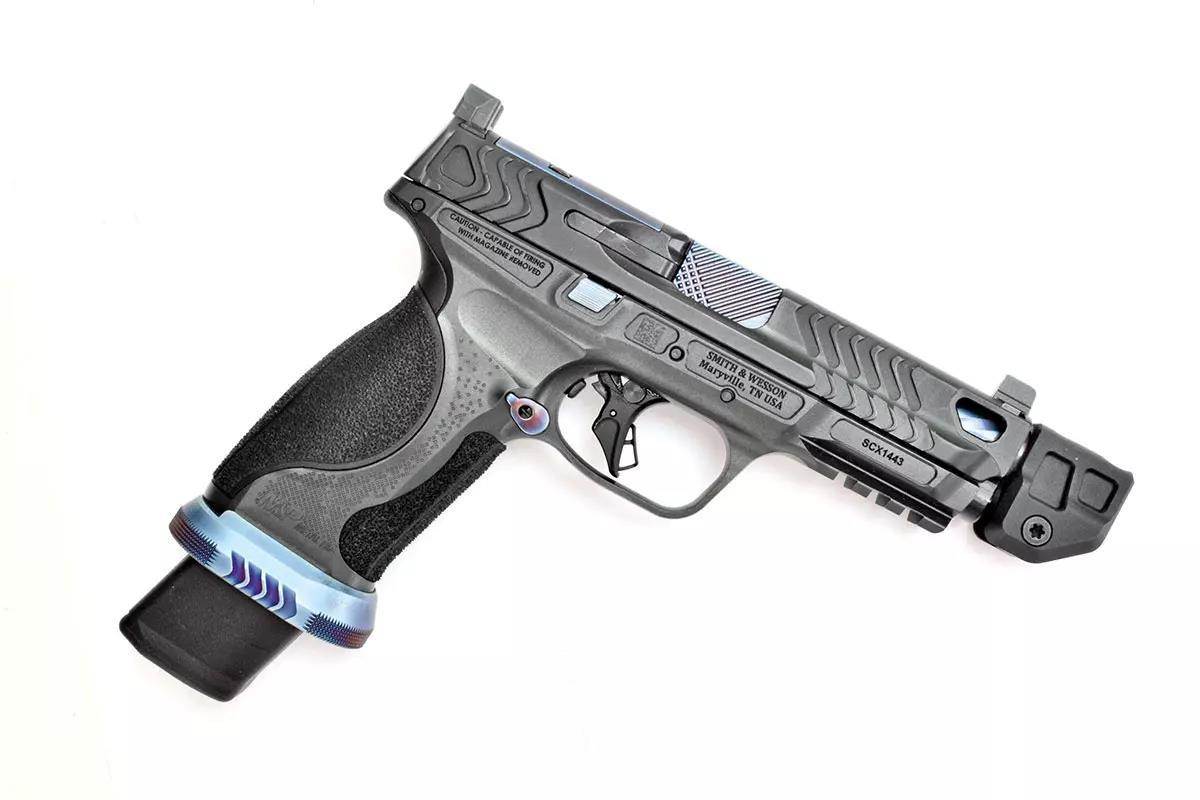
Smith & Wesson’s Spec Series has been various fancy iterations of the M&P, and the latest, the Spec Series V (as in Roman numeral 5) is the biggest, the heaviest, and the most likely to grab your attention.
Both the 3rd (2022) and 4th (2023) generation Spec Series guns are still available, but with the V, S&W really decided to step it up a notch. All the Spec Series guns are produced by Smith & Wesson’s Performance Center, offer looks and features just not available in other models, and are sold as packages with lots of extras nicely fitting into foam cutouts in locking hard cases. The 3rd gen Spec Series was built on a compact M&P with a polymer frame, extended threaded barrel, and offered in a Bull Shark Gray Cerakote. The 4th gen Spec Series was the first to feature S&W’s new metal (aluminum)-framed M&P on a full-size model. It had an OD Green Cerakote finish and a small compensator. For the 5th gen S&W went even bigger and bolder.
The Spec Series V is a full-size M&P C.O.R.E. (optics ready) chambered in 9mm, with a steel frame, with an extended threaded 47⁄8-inch barrel mounting a big compensator, and a removable steel magwell. It comes with three 23-round magazines, four backstraps, a nice liner-lock folding knife, and a challenge coin, all in a tough hard case. The frame and slide are dark gray Armornite (S&W’s version of nitride), and certain controls and parts are multi-hued blue, the color the result of a PVD finish. The combination is perhaps even more impressive and striking in person than it is in photos.
Let’s start with the base gun and work up from there. S&W introduced their first-generation M&P in 2006. It was an American-made polymer-framed striker-fired gun and has been a huge hit for them. It has been offered in .380 ACP, 9mm, .40 S&W, .45 ACP, and now 10mm, in everything from sub-compact pistols to full-size models. In 9mm, standard capacity in the full-size pistol is 17. After a decade or so, S&W introduced the second-generation M&P, the M&P M2.0. These pistols featured a reduced beavertail, improved grip texturing and slide serrations, a longer steel chassis inside the frame, and improved trigger pull.
Photo Gallery
Polymer is light, inexpensive to manufacture, resistant to chemicals and immune to rust. And yet…metal-framed pistols seem to be making at least a small comeback. There is renewed interest in the Beretta 92. Browning Hi-Power clones are all the rage, as are CZ 75s. Not quite four years ago SIG introduced an aluminum-framed version of their P320. And just over two years ago, Smith & Wesson debuted metal-framed models of their M&P, first aluminum…and now steel. Metal frames are stiffer and slightly change the recoil impulse, and also add some weight.
I will say that the aluminum frame doesn’t add as much weight over polymer as you might think, just one-plus ounces depending on the size of the gun, but steel adds that much or more again, and then once you add the mag well and the compensator and the loaded extended magazine and, perhaps, an optic, this is a big, heavy pistol. Far too big and heavy for carry, but for competition, or home defense, or just having fun and showing off at the range (and the blue does really stand out), it works. Overall, it is 8.75-inches long, 5.8-inches tall, 1.7-inches wide (at the mag well) and weighs 41.9 ounces with an empty magazine in place. This is far from light, but if you look at the weights of some Government-model 1911s with frame rails, they’re roughly equivalent. FYI: the barrel, slide, and frame are all machined from stainless steel before being given their coatings, so this pistol is about as corrosion-resistant as pistols get.
The barrel is 4.875-inches long, threaded 1/2×28, and spiral fluted. It also sports a blue PVD coating, as does the mag well, the slide plate cover, the slide stop, takedown lever, and magazine release. Mounted on the barrel, from the factory, is a sizable aluminum compensator made by Strike Industries with a single port at the top. S&W provides instructions on how to remove the comp from the barrel if you so desire, and the tools to do it, and supplies a thread protector. There is more of a gap between the comp and slide than I find aesthetically pleasing, but then again, some people may hate the blue accents—I really like them. There’s no accounting for taste.
There are decorative cuts in the sides and top of the slide to show off the blue fluted barrel, but the barrel itself is not ported. The slide has very aggressive texturing forward and rear, and in fact at the rear of the slide the sides are cut in deeply and there is a wide lip at the back. S&W equips their easy-to-rack EZ .380 models with the same ledge at the back of the slide to make it easier to grab/cycle, and it’s a neat feature on this slide you might miss unless you’re running your fingers along it.
There are no markings at all on the right side of the slide. On the left, you’ll see the M&P logo, the S&W Performance Center logo, and the markings indicating this pistol was made in S&W’s new Maryville, Tennessee, headquarters facility. I’ve been given a tour of S&W’s original historic facility in Massachusetts, and enjoyed the experience, but it always bothered me that under onerous unconstitutional state laws, the employees weren’t allowed to own half of the guns they were making. They don’t have that problem in Tennessee. Bad laws have driven a lot of firearms manufacturers out of hostile northeastern states. And citizens.
The sights on this model are tall “suppressor-height” night sights made by TruGlo, tritium inserts which glow green inside white circles for the traditional 3-dot sight picture. Forward of the rear sight is the steel slide cover plate engraved with S&W’s Spec Series logo, which sports a design similar to what it etched into the side of the barrel’s chamber.
This pistol offers S&W’s Competition Optic Ready Equipment (C.O.R.E.) feature which give you the option of mounting a mini-red dot to the rear of the slide. As it comes from the factory there is a steel plate on the slide covering the mounting area. S&W provides seven different adapter plates which allow you to mount any optic you desire atop the slide, as they accommodate pretty much every footprint on the market—Trijicon RMR/SRO, Docter/VortexVenom/Burris FastFire, C-More STS, etc.
The magazine release is reversible, and the slide stop is bilateral. This slide stop is wider than on the standard M&P, although you might not notice unless you compared the two pistols side by side. As for lefties attempting to release the slide using the right-side lever, you’re going to be disappointed. The leverage needed is so great you’ll need two thumbs to drop the slide even on a loaded mag using the right-side lever…which is maybe why S&W calls it an ambi slide stop, not an ambi slide release.
With the standard M&P, the curved trigger itself is the pivoting safety lever, hinged in the middle. The metal-framed M&Ps sport flat-faced triggers with safety levers in the middle. The trigger bow itself is nearly straight, with a gently rounded face, and on this model is aluminum. The safety lever is wider than you see with a lot of striker-fired guns, and it helps give the trigger a flat feel. Behind the trigger on the frame is a polymer overtravel stop. This trigger breaks at a ninety-degree angle which, combined with the flat, straight profile, helps to keep the muzzle from wiggling as much during the trigger break. Trigger weight on my sample was at 4.75 pounds, a little lighter and crisper than a standard M&P.
The three 23-round magazines are steel with full-length bodies, with oversize sleeve-like base pads to prevent over insertion. The magazine well is easily removable if you so desire, you just have to remove the takedown tool inside the backstrap of the gun and the mag well slides off forward, and then you can swap out the backstrap if you so desire. The pistol ships from the factory with the medium backstrap installed. If you run the gun without the magazine well, you’ll need to use the included alternate takedown tool to keep your backstrap in place.
First-generation M&Ps came with three backstraps, small, medium, and light. M2.0 M&Ps added one more size, the medium-large, which added some material under the web of the hand but had the same size palm swell as the medium. With the metal-framed M&Ps you get the same four polymer backstraps, but a glance at the frame might make you a bit confused. At the top rear of the frame there is a polymer insert. This is not part of the backstrap and stays in place when swapping out backstraps. It presses against the web of your hand, and I’m guessing that volunteers during the design and testing process complained the metal frame wasn’t as soft or warm or forgiving as the polymer frame of the original M&P, so they added this polymer insert. It looks good, and I don’t notice it’s there while shooting, which is what you want.
The metal-framed guns also have a polymer insert at the front of the frame. It has the same aggressive texturing as the backstrap but is not meant to be user-removable. You’ll also spot some minimal digital texturing on the frame in-between the backstrap and the front-strap insert. I don’t know that you’ll ever feel it while shooting, but: 1. Texturing on the frame is always better than smooth metal if you’re actually going to, you know, shoot the gun, and 2. It looks cool.
As I said, the Spec Series guns have always been sold as packages. In addition to the three magazines and the four backstraps, you get a knife. It’s an assisted flipper with a spring-loaded modified reverse tanto blade and a liner lock, with aggressively textured G10 grips. The pocket clip is positioned for tip-down carry. If you know anything about knives you know the S&W knives have always looked cool but have been entry-level on quality and below Civivis-brand knives in fit and finish, but as an added extra when buying a gun, it’s nice. The gray challenge coin has a picture of the gun on one side and the Spec Series logo on the other.
The Pelican-type case in which everything comes is very nice. Hard plastic with two latches and a pressure purge valve. There are metal-reinforced holes on either side for padlocks—and a quick public service announcement about the TSA and flying with guns. Within the last few years, they’ve unilaterally decided that however many spots your gun case has for padlocks, it needs to be equipped with that many padlocks. And I don’t recommend using TSA-approved locks, as that means they can open your locks/case when you’re not there, and you’ll never know. If I wanted strangers to be able to open my gun case when I wasn’t there, I wouldn’t put locks on it, and I don’t trust the average TSA agent to get my order right at Starbucks. Anyway….
Inside the case there are two layers of foam with cutouts for the various items. On the top level is the pistol, the knife, and the challenge coin. On the lower level is everything else.
The first opportunity I had to shoot this model it wasn’t actually the sample sent to me for testing. I was at the legendary Gunsite in Arizona, filming for Guns & Ammo TV. Doing full mag dumps for the high-speed (i.e. slow motion) cameras so they could catch brass in the air was fun, and really showed off how little recoil there was with this pistol.
Then, we removed the compensator and threaded on the new Banish 9K suppressor from Silencer Central. This is a fascinating little 9mm suppressor—4.1 inches long, and just 2.7 ounces as it’s 3D-printed from titanium. It directly threads onto 1/2×28 barrels and is so light it doesn’t feel real. It is so narrow that the suppressor-height sights on the M&P are unnecessary, but as small and light as it is, it has eight baffles. It is so light that it is advertised as not needing a booster/Nielsen device. Let me explain. With semi-auto pistols, under recoil, the barrel moves backward as well. Not a lot, but it does move. If you add a bunch of weight to that barrel (suppressor) it stops it from moving and chokes the gun. A piston/Nielsen device adds a spring and allows the barrel to move backward, briefly independent of the weight of the suppressor. I found, surprisingly, that the weight of the 9K was enough to prevent the Spec V from cycling properly no matter what ammo we used, and I think it’s because that gun has so little recoil to begin with that adding just that little amount of weight was enough to induce a malfunction.
I had fun punching paper at Gunsite, seeing just how fast I could run the gun with the comp—the answer was (unsurprisingly) pretty darn fast, as there was very little muzzle rise. Of all the tweaks that have been done to the M&P since the first-generation guns, none of them have been to improve reliability, as Smith & Wesson seems to have nailed that out of the gate. Even with the comp mounted on the barrel, the gun ate everything I fed it, from subs to supersonics. The magazine well has a big mouth, and if you’re one of those people who “looks” your reload into your gun, you’ll appreciate the fact that the inside of the magazine well has a nice golden hue.
Back at home, I took out my sample and did the requisite accuracy testing, which isn’t nearly as fun as shooting fast, but it’s a lot better than washing dishes in a seafood restaurant for $3.35/hr., which was my first job, so I should keep my whiny spoiled mouth shut. The Spec V wasn’t really any more mechanically accurate than the other M&Ps I’ve tested over the years, but between the improved trigger and the reduced recoil due to the weight/compensator you should be able to shoot it faster and more accurately—mechanical accuracy (what the gun can do locked in a vise), and what I’ll call practical accuracy (how well you can shoot it) are not the same thing. It was great fun hammering down steel basically as fast as I could pull the trigger.
If you’ve got an open-mouth holster built for a full-size M&P with tall sights, it will work with the Spec V, but a lot of those are meant for carry, and this isn’t a carry gun. If you’re the kind of person who wants to run it in competition, you’ll be going to one of the dedicated competition holster makers for something specifically made for this model.
As I’ve written, this pistol is fun to shoot and has an interesting collection of features that make it suitable for competition or for home defense, if you want a handgun for that role. At the front of the frame, you’ll see a three-slot MIL STD M1913 “picatinny” rail, and that is perfect for mounting a flashlight if you wanted to use the Spec V as a staged home defense weapon. With a flashlight, the night sights, and a 23-round magazine, whether or not you mounted a red dot atop the slide, the Spec V would serve you well.
The Spec V is the most expensive of the Spec series, but it’s also the biggest and provides the most accessories, so you’re getting what you paid for.
SMITH & WESSON SPEC SERIES V M&P PISTOL SPECS
- Type: Striker-fired semi-auto
- Caliber: 9mm Luger
- Capacity: 23+1
- Barrel Length: 4.875 in. (not including compensator)
- Overall Length: 8.75 in.
- Height: 5.8 in.
- Width: 1.7 in.
- Weight: 41.9 oz. (with empty magazine)
- Slide Material: Stainless steel with dark gray Armornite
- Frame Material: Stainless steel with dark gray Armornite
- Safeties: Sear block drop safety, trigger safety lever
- Sights: 3-dot tritium night sights C.O.R.E. optics ready
- Trigger: 4.75 lbs. (as tested)
- Accessories: Three 23-round magazines, 4 backstraps, optics plates, folding knife, challenge coin, thread protector, lockable case
- MSRP: $1,699
- Contact: Smith-Wesson.com, (800) 331-0852