Military Armament Corporation’s New MAC 2 Tactical Marine Shotgun
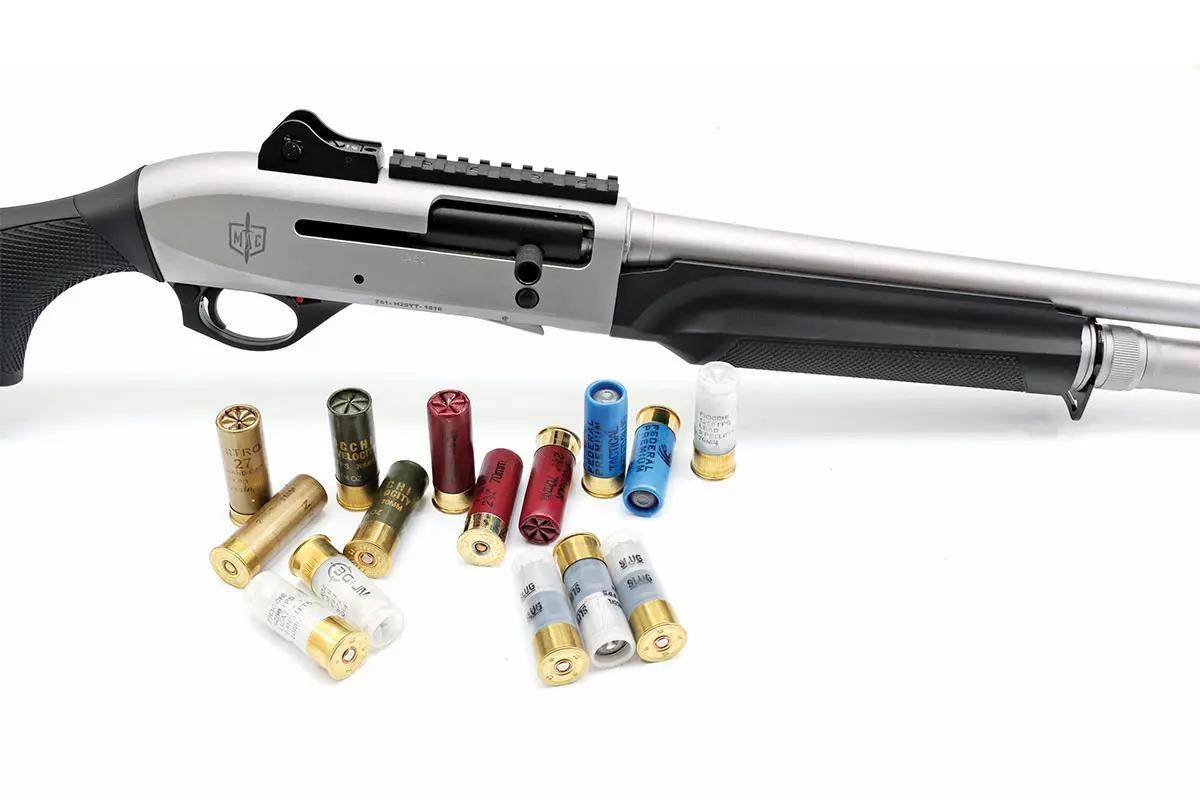
It is no great secret that when it comes time to deal a real thumping at relatively close ranges, I favor a shotgun. The latest big bore to pass through Gun Abuse Central is the MAC 2 Tactical Marine. Oh my! A lot of the attention paid to shotguns of late is because of box magazines, or AR-15-type layouts and handling. Call me old school (actually, some days I think I am the definition of old school), but I find the handling of a classically proportioned shotgun to be just right, and wicked fast. The MAC 2 Tactical Marine fits that bill and adds in a bunch of new that adds to the package.
Function
Okay, first, the MAC 2 and how it works. The MAC 2 is a licensed-from-Benelli, made-in-Turkey shotgun. The internals are a design that has been around for more than a couple of decades, and yet is still not fully grasped by a lot of shooters. A summary of the Benelli recoil system is simple: you take a thumping. When you discharge a firearm, you eject the payload of bullet (or in this case, slug, shot and wad, whatever) towards the targets. Sir Isaac Newton takes over, and your shoulder has to receive the same momentum in counterforce.
The timing of that is what matters. “Gas guns shoot softer.” You’ll hear it all the time, and yes, and no, it is and isn’t true. The total recoil of all of the various designs remains the same, regardless of how they operate. What matters is the timing. The gas gun disconnects, if we can use that term, the cycling mass from the felt recoil for a short time, and then once it bottoms out at the back end, delivers it again. So, you experience the recoil over a longer span of time. That gives the impression of being softer, but it isn’t, it helps to think of it as a time-plan for your recoil payment, without interest. (Shooters of the old Browning Auto-5 knew about this for sure.)
Okay, the Benelli system, which is what the MAC 2 uses? First, the parts involved. The bolt is the part that has the extractor and locking lugs. The bolt body is what the bolt rides in. The link connects the bolt body to the recoil spring assembly. When the MAC 2 jolts back in recoil, the whole shotgun drives back at you. However, the bolt body is connected to the bolt head by means of an inertia spring. The inertia of the bolt body keeps it motionless in space as the inertia spring is compressed. (The rest of the shotgun parts assembly moves back, but the bolt body does not. Within the frame of reference of the receiver the bolt body is seen to be driving forward. Physics can be a bit confusing.)
The “forward” movement of the bolt body rotates the bolt by means of the camming surfaces inside of the bolt body. The bolt unlocks, and the residual chamber pressure helps extract the hull, also while compressing the action spring. The hull blows out of the chamber, guided by the extractor, and driven by the earned inertia of the compressed inertia spring, the bolt, etc. (Again, physics can be complicated.) The action spring compresses, ticks the shell stop, bringing a new shell onto the lifter, and then drives forward, chambering and closing.
MAC 2 Tactical Marine
Got it? Alright, now for the MAC 2 Tactical Marine itself. Tactical? Marine? The Marine part is easy: MAC takes the receiver, barrel, magazine tube and treats them to an electroless nickel finish. Electroless nickel is just what it says: it is not an electrical deposition, or electrical plating method. The Nickel, with Teflon microbeads in the mix, precipitates onto the surface (this requires various complex chemical operations and is not a DIY process) in a smooth even layer, without the buildup on edges the electroplating can create. The result is a matte, soft and slick to the touch surface that wears well. If the surface of the electroless nickel layer is scuffed, there are still Teflon microbeads below the surface, and they still work to provide lubricity.
The receiver gets a ghost right rear sight, with the front and rear presenting a three-dot sighting system and the front blade is protected by side wings. This is a very fast system that provides the accuracy you need to deliver slugs right where needed, and yet you can still track clay birds with birdshot. Or buckshot on falling plates or poppers. When I went to Gunsite to shoot in a shotgun class [mumble, mumble], years ago, I used a ghost ring sighting arrangement to earn an E ticket. Wicked fast, plenty accurate, and did I mention that I set the class record for speed on the Dozier Drill?
If you are one to use a red-dot optic on a shotgun, which is becoming popular for good reasons then MAC has you covered there as well. The MAC 2 has a section of Picatinny rail on the top of the receiver, a convenient place to clamp on a red-dot sight. The receiver is drilled and tapped for that pic rail, so if you favor some other mounting solution then you can simply remove it and get to work installing your own setup. It had better be a really good setup, to go to the trouble, because the pic rail is plenty convenient.
The barrel, eighteen and a half inches long, is smoothbore, but is threaded for the Benelli/Mobil choke system, so you can put in choke tubes of whatever diameter works best for your application.
The Tactical part seems obvious: the extended magazine tube. Alas, the tube may be extended, but its capacity isn’t. It is a five shot tube that makes it a five-plus-one shotgun. But MAC does offer a plus-four extended tube you can add to your Tactical Marine. It, also alas, is not electroless nickeled. MAC adds a clamp and sling slot to make the Tactical as convenient as possible. The clamp supports the mag tube, which flexes during recoil, and the sling slot means you can add a sling if you feel the need. Me, I’m not too hot on slings on shotguns, but I can see the utility. Also, part of the Marine, the handguard, is polymer as is the stock, and the stock has a rubber recoil pad on it, which you will come to appreciate. MAC also adds an over-sized charging handle to the MAC 2, so you will find it easy to manipulate. Which is the next step.
The manual of arms with the Benelli system requires knowing a few details. To load, push the safety to the right. It is behind the trigger, on the trigger guard. On the right side of the trigger guard, ahead of the trigger is a small tab. Slide your finger back from the muzzle along the edge of the receiver and engage that tab, so it clicks back. This lets you lock the bolt back. If you do not do this, the bolt will not lock open when you cycle the charging handle. Lock the bolt back. Drop a round into the loading/ejection port, and then press the small button on the right side. This will close the bolt, chambering a round. Now, load the magazine by shoving shells into the mag tube, pressing the lifter out of the way with each one. That’s the straightforward way. There are other ways but read the manual and learn them. It would take the rest of the space I have to detail everything.
One of the advantages of the Benelli system is the speed of cycling. I have photos (a lot of them, actually) of the bolt closing, shoving the next shell ahead of it halfway into the chamber, with the just-fired empty not even inches away from the receiver. You are not going to out-run a Benelli. If it doesn’t go bang, the odds are (the very high odds, I have to add) are that you short-stroked the trigger. There’s just no beating the system. The downside is the recoil. In order for the Benelli system to work, you have to be a rigid recoil platform. That means you take the hit, and at just under seven pounds the MAC 2 Tactical Marine is going to come back with some enthusiasm. That’s life.
It isn’t any worse than what a pump shotgun will deliver, but there it is, you can’t escape. I found this out when the Benelli system was new, and adding weight to tame recoil made it non-functional. There’s only a small amount of porting you can do before the system starts to stall on you. And why doesn’t the disconnected bolt soften recoil, as it does on a gas gun? Mass. The Benelli bolt doesn’t have much, but your typical gas gun has a lot, relatively speaking.
Range Report
In testing, I found the MAC 2 Tactical Marine was responsive in handling, and it fit me quite well. The recoil pad made shooting less onerous, if not exactly fun (but then, this is a 12 gauge after all, there’s going to be some work involved) and there were no malfunctions. You’ll notice I used reduced-recoil shells in testing. I’m not sure there is something I dislike enough to subject my shoulder to the recoil of a one-ounce slug at 1,600 fps.
So, why this shotgun? Why not something 12-gauge else? As long as you can take the hit (and I’d suggest asking around at the gun club to see about trying someone’s Benelli-system shotgun, to see) the MAC 2 Tactical Marine is nothing but pluses. It is light, so it won’t be a burden to carry. The electroless nickel finish shrugs off corrosion and makes it easy to clean. The polymer handguard and stock are also tough, and you won’t shed a tear if it, or they get scratched in use, unlike a nicely-figured set of wood. Plus, if the nickel is too flashy, you can always apply a rattle-can camo paint job. Oh, the paint won’t stay under hard use, electroless nickel sheds paint, too, but for your time in the woods hunting, or wherever, the paint will stay on well-enough.
I objected to the recoil back in the day, but I’m getting more used to it, and the MAC 2 Tactical Marine is one reason why. Thumping costs, but the MAC 2 Tactical Marine does it in style.
But the best part is this: the price. With a list price right in the middle between four and five Benjamins, and we all know that over the counter at your local gun shop it is going to be less, you can hardly do this well with anything else. Birdshot, buckshot, slugs, the MAC 2 Tactical Marine eats it all, keeps on working, and won’t burn a hole through your wallet. That’s a tough combo to beat.
MAC 2 TACTICAL MARINE SHOTGUN SPECS
- Type: Hammer-fired recoil-operated semi-automatic
- Caliber: 12 Gauge, 2-3/4 in. & 3 in.
- Capacity: 5+1 rounds
- Barrel: 18.5 in.
- Overall Length: 34.5 in.
- Weight: 8 lbs., 12 oz.
- Finish: Electroless nickel
- Furniture: Polymer, with recoil pad
- Sights: Ghost ring rear, post front, top Picatinny rail
- Trigger: 5 lbs., 1 oz.
- MSRP: $450
- Contact: MilArmamentCorp.com, (865) 604-6894