Beretta’s New 92XI SAO Tactical Pistol
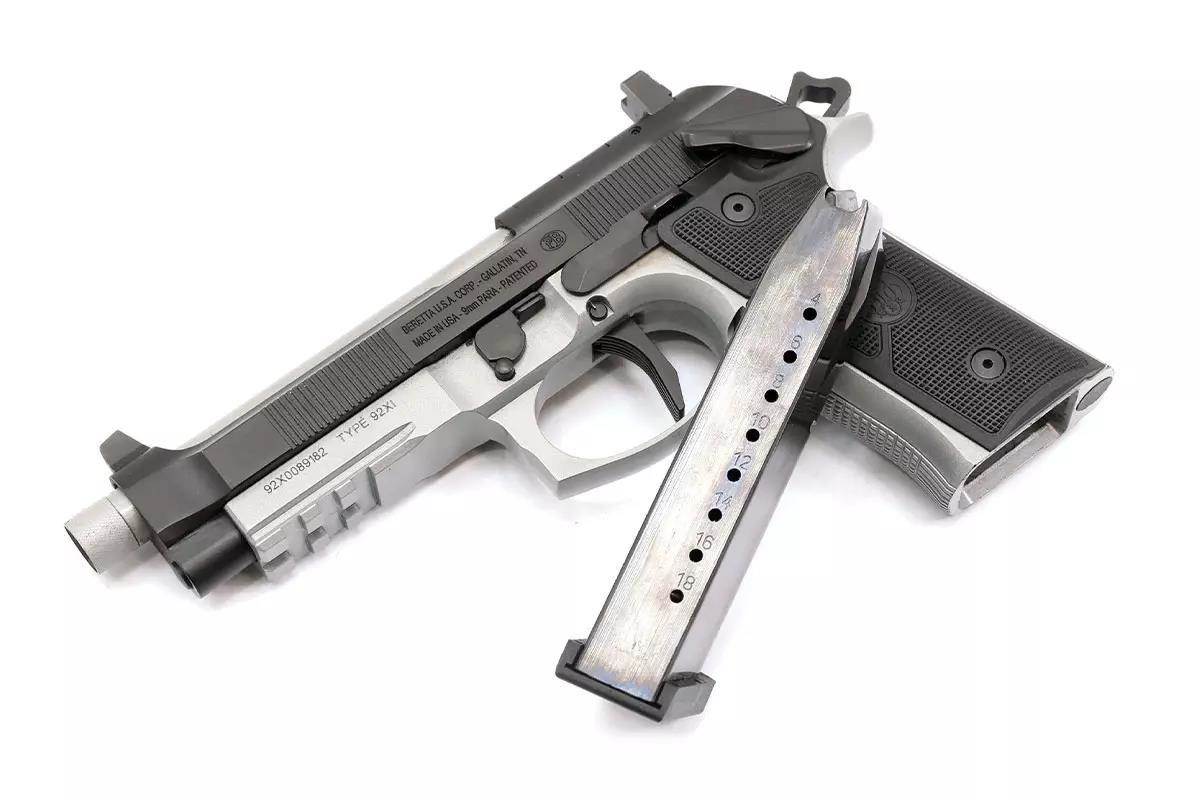
Once a year, the earth completes a circuit of the sun. Once a century or so, the US Army selects a new sidearm. Back in the 1980s, the sidearm selected was the Beretta Model 92, to be known after as the M9. It was the very model of a modern major transition. From single-action to double-action, from seven rounds to fifteen, and from .45 to 9mm. Ever since then, Beretta has been upgrading, improving and adapting the 92, until we arrive here today with the 92XI SAO Tactical.
In addition to serving as the M9 for our military, the Beretta 92 was widely adopted by law enforcement across the country. In the late 1980s and early 1990s, it was a good time to upgrade from a six-shot revolver to a sixteen-shot 9mm pistol. Crime was at an all-time high, and everyone wanted to be better-armed. The Beretta did that for LE. On duty or on a SWAT team, the 92 was often the tool of choice. The 92XI SAO Tactical improves on that history. Okay, the basics: the 92XI SAO Tactical (and I’m just going to call it XI, to save my fingers and my keyboard) uses much of the old 92, but also has the improvements since then. And the big thing is a leap to the past: single action.
What Beretta kept was the open-topped slide, which makes the designation “ejection port” a complete non-entity. The whole forward half of the slide top is the ejection port. The barrel is the same, with a tilting block locking system that was derived from the Walther P38, but improved, repeatedly. The frame is much the same, but there are tweaks and improvements there as well. The back strap on the 92, and the M9, was slightly arched. Later Beretta models changed that to a straight back strap, for better indexing and recoil control. This was part of the Beretta Vertec model line.
Another upgrade is the accessory rail, another Vertec change, one that was also part of the military M9A1 change as well. With the rail, and the multiple cross slots, you can now mount a light, laser, combo or whatever on the frame of your XI. (And other Berettas as well, they have not been asleep at the switch on this subject.) What hasn’t changed is the slide stop and disassembly lever locations and designs, or the magazine release. The slide stop is just on the left side of the frame, no ambis here, and the disassembly lever is the same as it has been on the many, many Beretta 92/M9 pistols since that day in America in 1986. (Actually, the lever was there even before then, as the 92 entered production in 1976.)
From that solid lineage, that stable base, Beretta has now crafted the 92XI SAO Tactical. Let’s go over what all that means. First of all, and the one that gets the most attention, is the single action trigger mechanism. Unlike the traditional double action (aka: TDA) the single action only (SAO) works like, well, let’s not beat around the bush, a 1911. In a TDA pistol, you use the trigger to cock and then drop the hammer to fire. After that, the slide cycling cocks the hammer for subsequent shots. On the Beretta, and other TDA pistols, engaging the safety safely drops the hammer, without firing the pistol. This lets you start over again and carry the pistol with the hammer down.
With so many shooters familiar only with striker-fired pistols these days, this background info is important. On the SAO (Beretta makes, and has made, more than one SAO-built pistol, one was the 96 Combat, so the XI is not unique in this), the double action portion of the mechanism is not present. Not just that those parts are left out, but that different parts are used in the assembly. The Beretta Xtreme-S single action only mechanism is designed with a much shorter reset in single action than that of the TDA design. So, you do not, and cannot, trigger-cock the hammer. There is no “DA” in the “S” of the “SAO.”
This means the safety function and design has to change. The safety is moved from the slide (on the 92/M9) to the frame. It locks the slide closed when the safety is applied, and it does not decock the hammer. It works (again, we can’t avoid the comparison) like the 1911. Beretta makes it as an ambidextrous lever, with paddles on both sides of the frame. Regardless of right or left-handed shooting, you have the safety lever there. Since the trigger mechanism is single action, the curved DA trigger of the 92 just isn’t needed. Beretta replaced it with a straighter trigger, and its length makes for some interesting changes. (More on that in the testing part.)
The frame is the straight back strap of the Beretta Vertec version of the 92, and there is checkering on the front strap and back strap. The tang is the same as it is on the 92, which does not need changing, so Beretta didn’t change it. The front outside face of the trigger guard (which is capacious and provides plenty of room for gloved fingers) is straight and smooth. Back in the 1980s, we practical shooters were still testing the idea of getting a support index finger up on the trigger guard, to provide leverage to combat recoil. The first video recordings showed us that we could not keep a finger in place, nor it didn’t help in recoil, so we gave up on the idea. The magazine opening is also beveled to a useful degree, it isn’t a competition-sized opening, but it does help without adding bulk as a competition funnel might do.
On top, Beretta gives the XI in the tactical version, all the bells and whistles. First, the barrel is extended and threaded. For the American market, the barrel is threaded 1/2×28, the common-over-here thread pitch for suppressor mounting. None of this euro-metric-lefthanded threads headache. To make aiming easier, they also installed taller iron sights, so you can see the sights over the suppressor barrel diameter. They also act to help you co-witness if you should install a red-dot optic. The slide has been machined for an optics mount, and there is an adapter plate you can get, that fits the Trijicon footprint. Then the XI gets a Cerakote finish, in silver on the frame, to provide an interesting and eye-catching two-tone contrast. But wait, there’s more.
The regular 92/M9 magazines hold fifteen rounds. There has been a bazillion of them made, and since the M9 was GI issue, they needed lots and lots of magazines. However, fifteen rounds is passé these days, so Beretta made a few tweaks on the magazine for the XI Tactical. You can buy the XI with ten-round magazines for those of you who live behind enemy lines, or fifteen if that’s the limit where you live, like Colorado, but the top sku XI comes with eighteen-round magazines, two of them. The ten and fifteen round magazines still work, as do all the other legacy magazines that have been made since 1986, but now you can have more.