U.K. to Meet with Northern European Allies to Discuss Russian Arctic, Atlantic Threat

The Royal Navy’s First Sea Lord Gen. Sir Gwyn Jenkins plans to hold a Navy summit in April as he calls on his service to take the lead in uniting Northern European navies against Russia’s growing threat in the Arctic and Atlantic.
“Right now, we are being tested in the Atlantic – our own backyard. These are unstable and dangerous times. Our job is to protect our island nation. We are the first and last line of defense for the United Kingdom,” Jenkins said while speaking at the Royal Navy’s 2026 Warfighting Conference, according to a Wednesday press release.
The U.K. faces an open and vulnerable northern border with Scotland on the front line against Russia’s expanding naval presence, Jenkins told attendees at the two-day conference held at the Royal Navy’s HMS Collingwood in Hampshire. Despite Russia’s war against Ukraine, where Russia has had millions killed or injured for modest gains in territory, the adversarial country has continued to pump huge resources into its Northern Fleet and increasingly capable sub-surface capabilities.

To combat the evolving threat, the First Sea Lord announced plans to convene a Northern European Navy Chiefs summit in April in London, led by the Royal Navy. The summit will focus on increasing joint efforts to meet shared and growing threats from Russia’s Northern Fleet. It will also discuss ways to enhance coordination of sallied responses to hybrid threats, including Russian shadow fleet shipping and probes against critical national infrastructure on the seabed, according to the news release.
“I am bringing together the Northern European Navies to develop our combined approach to the growing threat in the North,” Jenkins said. “The United Kingdom is taking the lead because this threat demands a unified response, and our geography, capability and historic role in these waters mean we must be at the forefront.”
It is unclear which nations will participate in the summit beyond the U.K. and Norway. The U.K. and Norway have a close defense relationship and a recent shipbuilding agreement between the two nations.
Jenkins emphasized that protecting the northern approaches to the Atlantic is essential to the security of NATO and that the U.K.’s new Atlantic Fleet priorities – Atlantic Bastion to protect sensitive waters, Atlantic Shield to defend against attacks from the sky in the vulnerable North and Atlantic Strike to assure interests in the Arctic – have provided the basis for a strategy.
“Because if we lose the Norwegian coast, we cannot keep the Atlantic open,” Jenkins said.
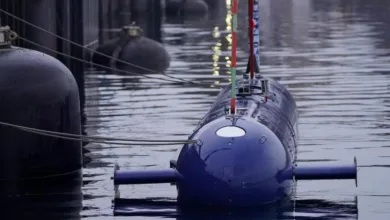
The service is working to build a hybrid fleet, combining crewed vessels with autonomous and uncrewed systems to meet evolving threats, Jenkins said. The U.K has conducted a number of experiments on such including a trial in October last year that saw a swarm of Rattler Unmanned Surface Vessels (USVs) shadow warships.
However, Jenkins also made clear in his speech that resource constraints can no longer serve as an excuse.

“This is where I must be absolutely clear: We fight with what we’ve got,” Jenkins said. “This is not a slogan. It is a statement of intent. It is the hard yards of leadership excellence that will determine whether we succeed or fail.”
On Wednesday, the U.K. and Norway further built upon their bilateral Lunna House defense cooperation agreement signed in December. Jenkins and the chief of the Royal Norwegian Navy Rear Adm. Oliver Berdal signed an agreement that ensures further cooperation and integration between British helicopters and Norwegian naval and coast guard vessels. The agreement includes the possibility of embarking U.K. helicopters on Norwegian vessels and stationing them at Norwegian bases.
The agreement builds upon last year’s deployment of a Wildcat helicopter and personnel from the RN’s 815 Naval Air Squadron on Norwegian frigate HNoMS Roald Amundsen (F311) when the Norwegian frigate deployed as part of the U.K. Carrier Strike Group during Operation Highmast deployment to the Indo-Pacific. Prior to the deployment, four Royal Navy Wildcat helicopters deployed to Norway and operated off Norwegian ships.
“We learned a lot from having embarked British Wildcat helicopters during Operation Highmast. Now we have the opportunity to build on these experiences and further develop operational concepts. At the same time as we strengthen cooperation with the United Kingdom, we strengthen our own defense capabilities by having the opportunity to conduct helicopter operations together with the British,” Berdal said in a Norwegian Armed Forces news release.
The Royal Norwegian Navy currently operates without helicopters, and it does not have a naval aviation wing. The Royal Norwegian Air Force provides the service with embarked helicopters, specifically NH90s from No. 334 Squadron.
However, in June 2022, Norway terminated its contract with NH Industries, manufacturer of the NH90, arguing the defense company failed to meet contractual obligations and immediately withdrew the helicopter from service. Norway subsequently ordered six MH-60R Seahawks in 2023, with deliveries scheduled to be completed in 2027. The helicopters will be assigned to support the Norwegian Coast Guard while Norway assesses a way forward for naval helicopter operations and capabilities.