Pentagon’s New $65.8B Shipbuilding Request is Highest Since 1962
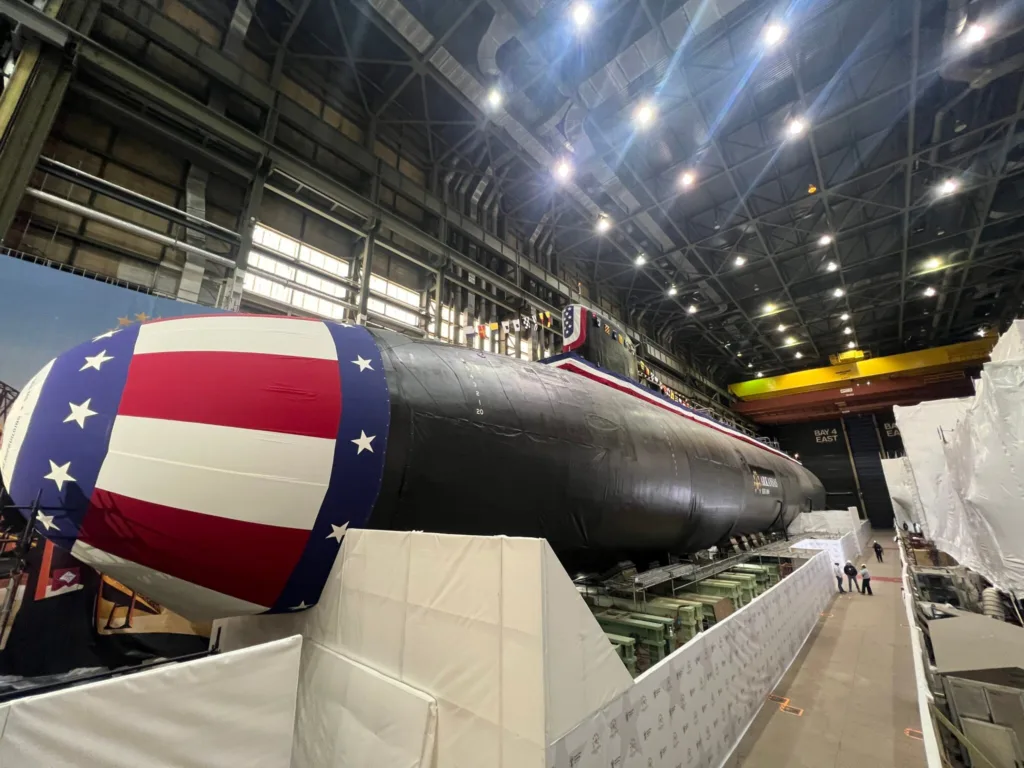
The Pentagon’s request for new shipbuilding funds is among the highest-ever since the Korean War, rivaling the Reagan-era 600-ship spending plan and the nuclear submarine buildup in the 1960s, according to budget documents.
In a $1.5 trillion Fiscal Year 2027 national security submission split between the base budget and reconciliation, the Navy wants a total of $65.8 billion for shipbuilding, as President Donald Trump pursues several new ship classes under the Golden Fleet concept.
The Navy is seeking $60.2 billion for shipbuilding in the base budget and $5.6 billion in reconciliation, according to Pentagon budget documents. When adjusted for inflation, the new request is the second-largest shipbuilding budget proposal since 1955, according to Congressional Budget Office data. The highest request in real dollars was in 1962, during the U.S. Navy’s “41 for Freedom ” ballistic missile nuclear submarine drive.
A two-page White House fact sheet detailing the so-called skinny budget proposal says the FY 2027 request is seeking 41 ships across the government, but does not provide a breakdown of classes or which services are buying the vessels. A separate section of the fact sheet says the administration is asking for “18 battle force ships and 16 non-battle force ships,” for a total of 34 naval ships.
The Navy wants two Virginia-class attack submarines, one Columbia-class ballistic missile boat, one FF(X) frigate, one Arleigh Burke-class guided-missile destroyer, one San Antonio-class amphibious transport dock, one America-class amphibious assault ship, six Megan McClung-class medium landing ships, two AS(X) submarine tenders, two John Lewis-class fleet oilers, one “special mission ship,” one T-AGOS ocean surveillance ship, one strategic sealift, one bulk fuel vessel, one T-AH(X), one used sealift ship, four ship-to-shore connectors, five fire boats and two Landing Craft Air Cushion (LCAC) Service Life-Extension Programs (SLEP).
“The Budget also supports strategic sealift vessels, hospital vessels, Consolidated Cargo Replenishment at Sea tankers, a special mission ship, submarine tenders and other vessels vital for logistics,” reads the document.
Last year the Trump administration used the reconciliation process to fund key defense programs and efforts in the FY 2026 budget by factoring the reconciliation money into the annual submission. Lawmakers initially said they saw the reconciliation funds as a one-time supplemental that the Pentagon could spend across four years. Congress ultimately supported the White House’s approach.
Additional details about the Pentagon budget are expected later this month. As for new programs, the Navy will pursue the Trump-class battleship and the frigate program based on the Coast Guard Legend-class National Security Cutter.
Late last year the Trump administration announced the Golden Fleet initiative, anchored by the pursuit of the new battleship. Navy Secretary John Phelan also axed the Constellation-class frigate program – long plagued by workforce challenges at the Wisconsin shipyard and ongoing design tweaks that hobbled progress. Instead the Navy will buy a variant of HII’s Ingalls Shipbuilding’s NSC ship.
The FY 2027 request is seeking $1.15 trillion in the base budget and $350 billion as part of reconciliation. The $1.5 trillion total includes some funding for the Department of Energy for developing and maintaining nuclear weapons.