Marines Test USV for Littoral Explosive Ordnance Disposal Operations
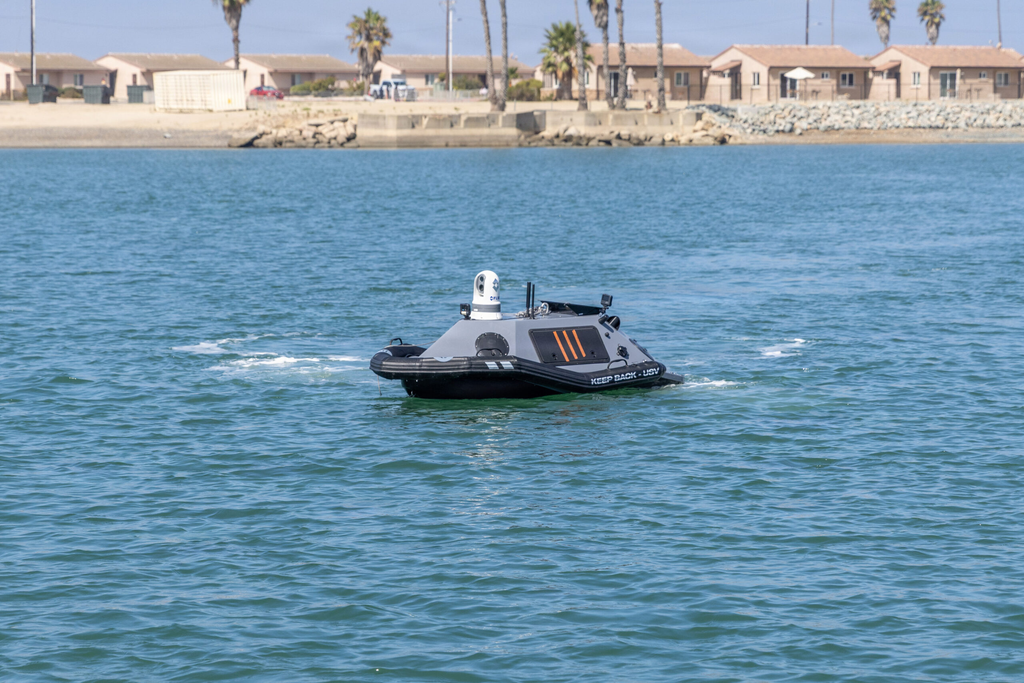
The Marine Corps trialled using an Unmanned Surface Vessel as part of its Littoral Explosive Ordnance Neutralization System last month.
The USV trials were carried out by Program Manager Combat Support Systems (PM CSS) of Portfolio Acquisition Executive Marine Corps (PAE MC) with a PM CSS Explosive Hazard Defeat Team at Camp Pendleton, Calif. The trials were held in response to a littoral capability gap with the solution being a commercial USV equipped with integrated autonomous driving and payloads that consist of Sonar, Forward-Looking Infrared cameras, Line of Sight Communications and Acoustic Communications (AComms), reads a PAE MC news release published Tuesday.
LEON enables explosive ordnance disposal teams operating in littoral environments to confirm hazards and obstacles from very shallow water to the beach zone. LEON consists of five increments of capabilities: a Remotely Operated Vehicle , diver equipment, an Unmanned Underwater Vehicle, an Unmanned Surface Vehicle and an Amphibious Unmanned Ground Vehicle..
As the fourth increment of LEON, the USV will allow Marine platoons to scan for potential hazards and provide a communications capability in the form of a Mobile Gateway Buoy. While the USV provides a search capability, it will primarily enable the other LEON systems to conduct operations below the surface, locating and identifying potential hazards, then relaying that information to the surface for real time updates, Capt. Timothy Guinan, project officer, Explosive Hazard Defeat Team said in the release.
“The LEON SOS will enable maneuvers by identifying safe routes for transit within the littorals,” said Guinan.
Unmanned systems, Guinan said, allow operations to continue without fatigue as these systems can be launched and left to conduct a mission for upwards of 14 hours, covering large areas of the littorals while requiring minimal manpower to monitor the system.

Marines from 7th Engineer Support Battalion, with the Explosive Hazard Defeat Team, carried out a two-week Field User Evaluation (FUE) of the USV that allowed the Marines to receive hands-on practical application and testing. Fleet users learned how to utilize waypoint navigation, deploy targets, verify locations and put the system to the test on the water. Crucially, the testing afforded Marines the opportunity to give feedback on the system to the program office during the development phase to ensure relevance and human-system interface in a near-operational environment.
“Unmanned systems have always been a part of the EOD family of systems. But now, we’re expanding that into maritime systems that allow more endurance and less risk for operators. Some of the conflicts that we are engaged in take a toll on the force, and surging in new forces is costly. It turns into a logistical problem. To preserve the safety and the health of the forces…the USV and the [LEON] program exist to ensure that we have readily available combat power,” Chief Warrant Officer 2 Alfredo Andrade, officer in charge, Explosive Ordnance Disposal Company, 7th ESB, said in the release.
System engineers with the Explosive Hazard Defeat Team and EOD technicians with 7th Engineer Support Battalion first tested the USV through calm waters, becoming comfortable with the control system and creating mock mine targets. Then, they challenged the USV through a wide-area search in different sea states just off the Pacific Coast. Andrade said the events were successful and the USV itself was running well, had long endurance and gave good results to refine and further develop the capability.
According to the news release, the validation of the USV will set a pathway to fielding systems to explosive ordnance disposal companies in Fiscal Year 2027. The validation will also enable the integration of the LEON family of systems to be fielded in the next two years.
The release did not identify the USV but Pentagon images and a video show the AEVEX Corporation Mako Lite USV, a 2.7 meter scaled down version of the company’s 3.4 meter Mako USV. The Mako Lite, according to company specifications, has a 12.5-hour endurance capability with a range of up to 250 nautical miles and a configurable 100 pound payload capacity.

Since 2021, the Marine Corps has deployed the Littoral Explosive Ordnance Neutralization (LEON) platoons as part of the service’s transformation to having mobile, littoral and expeditionary capabilities for operations under Force Design 2030, enabling Marine forces to have their own integral beach clearing capabilities.
In a June 2025 USNI Proceedings article, Lt. Cmdr. Matthew Hipple suggested that LEON detachments could be embarked on the Navy’s Littoral Combat Ships in a joint teaming that would support the Marine Corps’ expeditionary advanced base operations, as well as enabling an economical and rapid response for maritime counterinsurgency and influence operations. A LEON-LCS Multirole Unit would create a single-unit Mine Counter Measures capability that currently does not exist, that is a single-platform mine hunting and neutralization from the shore to the sea lane, according to the article.
“Alongside explosive ordnance disposal–qualified Marine Corps divers who could improve neutralization capabilities, a LEON would bring unique unmanned surface vehicles for near-surface mine detection and autonomous underwater options currently unavailable to the LCS. The LEON, and the Marine Corps in general, also could create opportunities to integrate with expeditionary unmanned aerial systems to extend communication and conduct surveillance and other supporting actions,” Hipple wrote.
The Marine Corps has released limited information on the LEON systems used. USNI News, in 2021, reported that the Marine Corps had introduced the first of the LEON systems in the form of the ROV. No information has been released publicly on the UUV used for LEON.
The AUGV is made by Greensea IQ, which announced in February of 2025 that it received a $5.36 million contract for a customized version of its Bayonet 250 AUGV for the Marine Corps LEON project.
“Designed for robust operations in both shallow water and surf zones, the Bayonet 250 provides autonomous capabilities for mine and explosive threat neutralization, supporting the Marine Corps’ modernization efforts for safer and more effective EOD operations,” reads the Greensea IQ announcement.
In a separate news release announcing a $9 million task order in August 2025, Greensea IQ said the task order was for nine robots along with the refurbishment of six robots acquired earlier in 2025. An additional four robots were acquired in July this year under a $3.7 million task order under the existing multi-year Indefinite Delivery/Indefinite Quantity (IDIQ) contract.
“This latest award continues the Marine Corps’ investment in Greensea’s Bayonet Autonomous Ground Vehicles, reinforcing the robots’ value as a reliable and scalable asset in the fight against the proliferation of subsea threats,” Greensea IQ said.

The Bayonet 250 was fielded by 7th Engineering Support Battalion during the Arctic Edge 2026 exercise held in Alaska from Feb. 23-March 13. The Marines deployed to Coast Guard Base Kodiak and used the AUGV to survey subsurface areas and identify environmental hazards before divers entered the water.
“By validating the AUGV in Arctic conditions and the challenging surf environment off Kodiak, Marines demonstrated how unmanned systems can expand access to the littoral battlespace while reducing risk to personnel,” reads a PAE MC news release.