Arctic Exercise Northern Viking Kicks off with U.S., Iceland
The United States, Iceland and NATO began the U.S-led biennial exercise Northern Viking 2026 (NV26) on Tuesday, which runs in Iceland and surrounding waters until Sept. 3. This year marks the 75th anniversary of the 1951 Bilateral Defense Agreement between Iceland and the United States.
A U.S 6th Fleet release stated that the exercise is designed to strengthen interoperability and force readiness between the United States, Iceland, and other allied nations. It strengthens multi-domain command and control of joint and coalition forces to defend Iceland and safeguard the sea lines between Greenland, Iceland, and the United Kingdom, known as the GIUK gap.
“As a vital global shipping corridor, keeping the GIUK gap secure is imperative for transatlantic trade, commerce, and security between North America and Europe,” read the release
Participating nations in NV26 include Belgium, Denmark, France, Iceland, Norway, Poland, and the United States, alongside specialized assets and personnel from Allied Maritime Command (MARCOM) and NATO Joint Force Command Norfolk. The allies will carry out anti-submarine warfare, mine countermeasure, expeditionary construction, search and rescue, humanitarian medical response and disaster response training scenarios.
“Together, we’re honing our war-fighting skills and ensuring our ability to secure this critical region and to project decisive combat power wherever and whenever necessary,” said Gen Alexus G. Grynkewich, Supreme Allied Commander Europe (SACEUR) and commander of U.S. European Command, in the release. “We will deliver precision effects and will practice defense against rapidly proliferating unmanned systems. Throughout this exercise, and others, we will leverage the power of data in AI enabled decision support tools, will integrate data streams in real time, and ensure our command and control structures can make decisions at the speed of future conflict.”
Grynkewich attended the Northern Viking opening ceremony at Keflavik Air Base. The previous day, he met separately with Iceland Prime Minister Kristrún Frostadóttir and Foreign Minister Þorgerður Katrín Gunnarsdóttir for a discussion that covered security prospects and increased NATO defense preparedness. Developments in the Arctic and growing bilateral defense cooperation between Iceland and the United States were also discussed, according to an Iceland government release.
“We had a good conversation about the situation following the Ankara summit and the increased defense preparedness of the alliance now that all states are strengthening their own capabilities to meet the changing security situation. We also reviewed the close and good defense cooperation between Iceland and the United States,” said Frostadóttir in the release.
The 1951 Defense Agreement designates the United States as responsible for Iceland’s defense in the absence of Iceland’s own standing military. Over the last 75 years, this partnership has adapted from Cold War deterrence to modern multi-domain defense operations, ensuring that the transatlantic bridge remains open and secure, according to the release by 6th Fleet.
Details on participating units and assets were not disclosed. Sixth Fleet only stated that U.S. sailors, Marines, airmen, and soldiers arrived in Keflavik for the exercise, though imagery from the opening ceremony showed a U.S. Navy P-8A Poseidon from Patrol Squadron Sixty-Two (VP-62) ‘Broadarrows’ and a Belgian F-16 in the hangar where the ceremony was held. The Navy rotationally deploys P-8s to Keflavik. The Belgian F-16 is part of a four-plane detachment that arrived in Iceland on Aug. 7 to carry out NATO’s Icelandic Air Defence mission.
Originally called as “Air Policing” when it began in 1961, NATO established a standing rotational deployment of fighter aircraft to secure the airspace above Iceland, the mission now takes a unified approach to Iceland and other NATO Air Policing missions in Lithuania, Estonia, and Romania as part of NATO’s comprehensive “Air Defence” posture.
“While Air Policing primarily was more oriented to protect against manned and unmanned aircraft in the air, the Air Defence framework, entailing a multi-layered, 360-degree approach, protects NATO territory against the whole range of threats across all domains, providing NATO greater flexibility to respond to changes in the security environment,” read a NATO release.
Both NV26 and the Belgian F-16 deployment are part of NATO’s enhanced Vigilance Activity (eVA) Arctic Sentry, which was launched in February to bring all NATO activities and exercises in the Arctic and High North region into a single overall operational approach, with concurrent activities in the same area complementing each other.
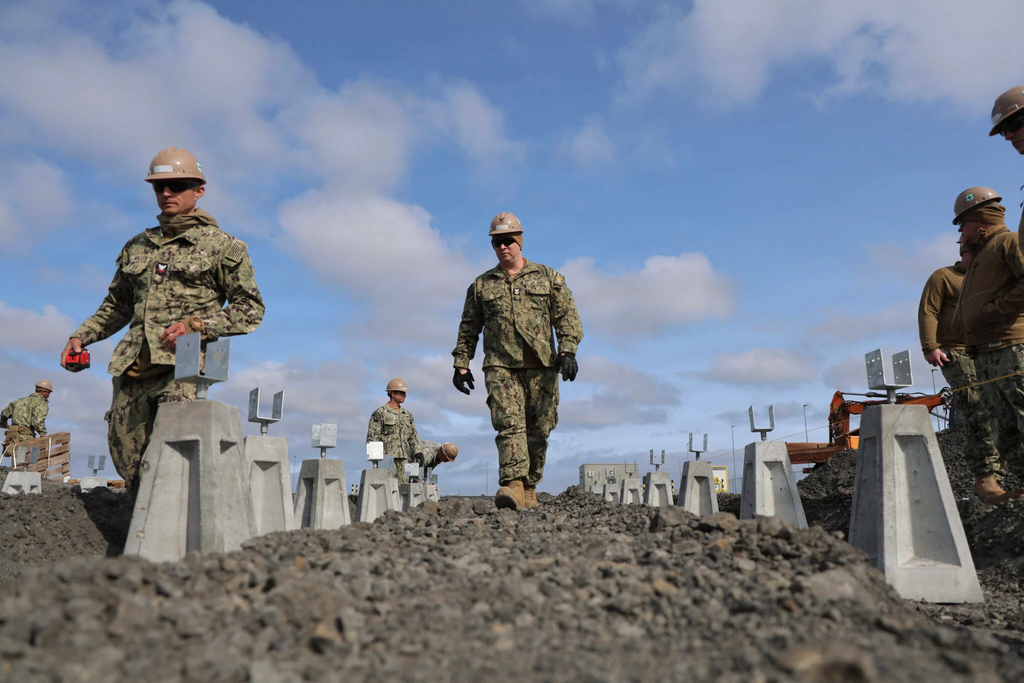
In a post on its social media account, Sixth Fleet stated that Seabees from Naval Construction Battalion 27 and the 22nd Naval Construction Regiment were preparing infrastructure for NV26. Standing NATO Maritime Group 1 (SNMG1) comprising of flagship Royal Canadian Navy (RCN) frigate HMCS Ville de Québec (FFH332) along with French Navy frigate FS Auvergne (D654) and German Navy fleet oiler FGS Rhön (A1443) will also take part in NV26, according to a social media post by NATO Joint Force Command Norfolk, which is responsible for NATO operations in the Atlantic and High North, including Denmark, Finland, Iceland, Norway, Sweden and the United Kingdom.
“In the North Atlantic, SNMG1 ships are sharpening their skills at sea ahead of Exercise Northern Viking 26, which gets underway in Icelandic waters in the coming days,” read the post.
Standing NATO Mine Countermeasures Group One (SNMCMG1), comprised of flagship Lithuanian Navy command and support ship LNS Jotvingis (N42), Royal Canadian Navy coastal defence vessels HMCS Edmonton (703) and HMCS Moncton (708), German Navy minehunter FGS Homburg (M1069) and Polish Navy mine countermeasures vessel ORP Mewa (603) along with an embarked Portuguese Navy diving team and Royal Danish Navy mine hunting and disposal team are also expected to take part in NV26. The task group was in the waters around Iceland conducting a Passage Exercise (PASSEX) with SNMG1.