U.S. Navy Eyes Advanced Payload Launcher for Future Attack Boats
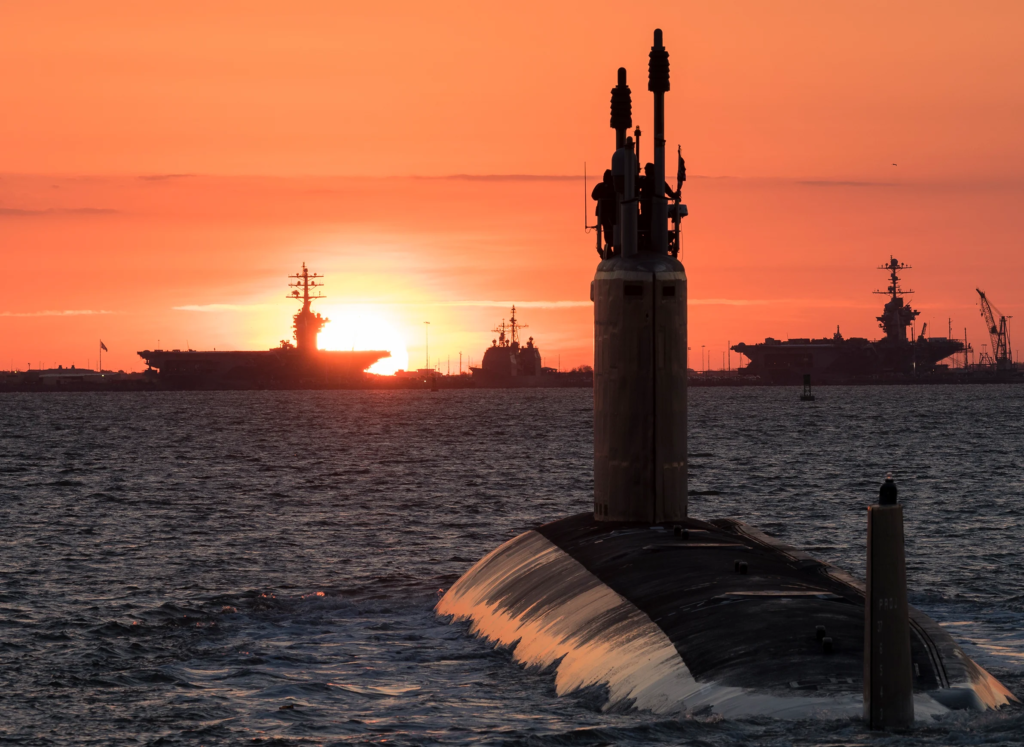
The U.S. Navy wants to integrate payload launchers capable of supporting undersea weapons and drones for the fleet’s future attack boats, according to an announcement last week.
The Navy announced on July 29 the Director of Submarine Programs’ interest in launchers that could “support a wider variety of payloads than the current fleet” ahead of an upcoming industry day. Representatives from General Dynamics Electric Boat and HII’s Newport News Shipbuilding division – the two yards responsible for American nuclear submarine production – will present concepts covering future payload integration from Sept. 29-30 in Alexandria, Va, according to the Navy’s announcement.
While unmanned underwater vessels – and other drone systems – were not explicitly named in the solicitation, attributes pertaining to supporting equipment of this type were highlighted in the Navy’s announcement. Technical specifications and concepts for the submarine payloads should be able to be launched and recovered underway, communicate via secure data exchange with the host attack boat and recharge and maintain while embarked. These payload modules also need to be designed with “producibility and sustainment” in mind, reads the announcement.
The interest in advanced payload launchers comes amid the ongoing conceptual development of the Next-Generation Attack Submarine or SSN(X) and the introduction of modernized Virginia-class submarines. This class of advanced attack boats is designed for hunting adversary underwater capabilities through enhanced speed and a larger payload capacity, according to Navy budgetary descriptions on the program.
American undersea capabilities have become one of the most highlighted capabilities with the rise of Beijing’s fleet. Concerns are further fueled with the expectation from U.S. Navy intelligence leaders that the People’s Liberation Army Navy Submarine Force is transitioning to a majority nuclear-powered fleet.
Last month at the U.S.-led Rim of the Pacific 2026 exercise, the U.S. Navy spotlighted the deployment of underwater drones from its Pacific-assigned attack boats. These drones were procured to extend the sensing range of the submarines against undersea and surface targets, a capability that could help the sea service’s submarines against increasingly advanced Chinese and Russian submarines.
“These platforms will simulate operating autonomously in denied areas, providing critical targeting data and enhancing our ability to detect, track, and hold adversary forces at risk. This demonstration leverages unmanned systems as force multipliers, enabling manned platforms to operate with greater stealth, lethality and efficiency,” reads a Commander, Submarine Force, U.S. Pacific Fleet release on the integration of UUVs at RIMPAC.
American defense firms have also pitched cheaper autonomous torpedoes and additional underwater drones to bolster attack boat firepower and surveillance. Aside from drones, the development of smaller torpedoes and next-generation anti-submarine mines are in the pipeline for the U.S. Navy.