70 Ships Trapped in Persian Gulf as Iran-U.S. Conflict Nears Six Months
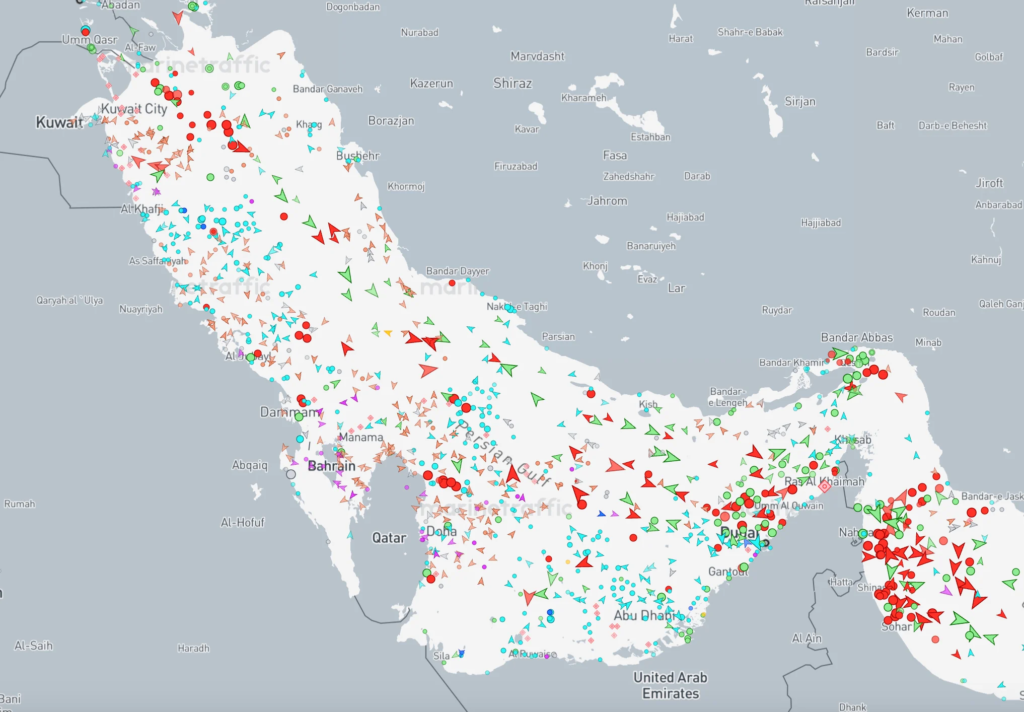
At least 70 ships remain trapped in the Persian Gulf nearly six months into the Iran-U.S. conflict with more ships now being stalled after the ceasefire between the countries broke down.
The memorandum of understanding implemented from June 18 to July 8 between Tehran and Washington created the opportunity for many of the stranded ships to finally exit the Persian Gulf after being stuck for months, Bridget Diakun, maritime intelligence and research director with London-based Lloyd’s List Intelligence, said during a Thursday webinar.
However, not all were able to escape before the ceasefire was called off. Of the approximately 70 ships remaining in the gulf, 29 are tankers. At the beginning of the conflict, there were 160 tankers trapped.
During the MOU period, ships also entered the Persian Gulf. There are now 65 ships that entered during that time that have not left, Diakun said.
The Strait of Hormuz saw an uptick in transits last week, but Diakun cautioned that it could be an outlier.
Transits, split almost evenly between east and westbound journeys, were up 39 between July 27 and Sunday compared to the previous week, according to Lloyd’s List Intelligence.
But while the numbers increased, transits are still far below pre-war numbers.
“This is not a trend. This is one data point,” Diakun said. “So it’s not indicative that owners are more confident in the situation. Right now, it’s kind of an outlier.”
Non-Iranian-linked traffic also saw a marginal increase, with 60 percent of ships exiting the Persian Gulf. At least a quarter of the non-Iranian-linked traffic used the route along Oman’s coastline.
However, dark transits – where ships turn off their identification systems – make it difficult to determine how many ships are using the Oman route.

The Red Sea is also seeing a drop in traffic – 24 percent week-on-week – due to the Houthi’s blockade on Saudi Arabia and ships linked to the country, Diakun said.
While there is a drop in Red Sea traffic, the numbers look closer to what Lloyd’s List Intelligence saw in early 2026, Diakun said. What the drop in current traffic is doing is eroding some of the gains in volume that the Red Sea saw as more oil was loaded through Red Sea ports when the Strait of Hormuz became increasingly unstable, she said.
Traffic in the Red Sea has not returned to pre-Houthi numbers seen in 2023. Lloyd’s List Intelligence dashboards put the containership transits through the Bab El-Mandeb about 61.5 percent lower in 2026 than in 2023.
Shipping Becomes Increasingly Deadly

The Strait of Hormuz saw two more attacks in the past week with one seafarer missing after a Monday attack on bulk carrier MV Minoan Pioneer (IMO: 9471630), according to the International Maritime Organization.
Both ships are Greek-controlled, Joshua Minchin, senior reporter at Lloyd’s List, said during Thursday’s webinar.
Other ships reported near misses or that they were contacted by the Islamic Revolutionary Guards Corps while transiting the strait, Minchin said.
The Houthis continue to claim that they’ve hit Saudi oil tankers in the Red Sea, with spokesperson Yahya Sare’e posting on social media site X that the Yemen-based group hit tanker MT Wafa (IMO: 1047615) on Wednesday. The Houthis claim to have hit eight tankers since July 22, but their claims are not verified.
“The Houthis claim attacks regularly,” Minchin said. “It’s one thing for them to claim on social media and another for us to confirm whether the vessel was actually hit or not. But still a very, very risky place in which to operate.”
The Black Sea, while not in the Middle East, is adding to the stress on the global market as Russia and Ukraine continue to trade strikes on maritime and shipping targets. It is one of the riskiest places to operate a commercial ship, Minchin said, as there have been a number of strikes on ships.
A Turn to Economic Warfare

Both the Russo-Ukraine War and the Iran-U.S. conflict are shifting toward economic warfare, Campbell University professor Sal Mercogliano told USNI News on Thursday.
The deadlock between Russia and Ukraine in the ground war has led the two countries to attack oil production and shipping. Ukraine is attacking Russian oil ports, as well as the Caspian Pipeline Consortium, while Russia is attacking commercial vessels, Minchin said.
Those attacks are continuing to stress the already tight global economy, USNI News previously reported.
China, which had been relying on its reserves, is now starting to pull oil from the global market again, turning to Brazil, Nigeria, Guyana and even the U.S., Mercogliano said. That could lead to an overstressed market.
All the tension on the global market affects the American people, who are continuing to see high gas prices at the pump. The U.S. did use oil that came from ports on the Persian Gulf. That’s been replaced, in part, by oil from Venezuela, Mercogliano said.
The U.S. is also ramping up its production of oil for export. While that is good for the oil companies, it can still hurt the average American as the oil companies find more profit in exporting American oil to countries that got oil from the Persian Gulf. The United States does not “operate in a confined, closed marketplace,” Mercogliano said.
The Jones Act waiver allows foreign tankers into the U.S. trade to shuttle oil. Since March 17, when the act went into effect, those tankers have moved about 15 million barrels of oil. In a typical year, the U.S. tankers move about 215 million barrels. While consumers in the U.S. might not be using more oil, the U.S. needs to replace the additional oil it is sending overseas, Mercogliano said.
“And the potential is [gas prices] are going to keep going up right now because, again, if we shut down the Strait of Hormuz and we shut the Red Sea, we’re putting more pressure on oil and gas being exported from the Middle East.”
The average price of a gallon of gas in the U.S. was $4.04 on Friday, according to AAA. Last month, it was $3.79. One year ago it was $3.17.