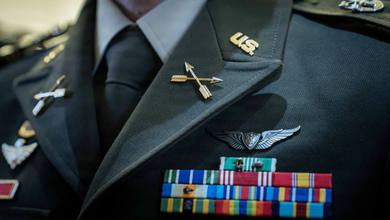
Before sunrise in Mannheim, Germany, my Class A dress uniform waited on the outside of the closet door. The jacket was already buttoned, its rows of ribbons pinned flat against a strip of cardboard hidden behind them. My trousers held the crease I had pressed into them the night before. Patent-leather shoes and black socks rested below, arranged in the order I would need them. By the time I slicked my hair into a bun, there was almost nothing left to decide.
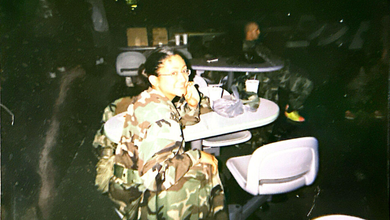
It was 2004. I was a young food service specialist with the 28th Transportation Battalion, already past the company, battalion, and brigade levels of Soldier of the Month. This board would choose Germany’s representative for the U.S. Army Europe Soldier of the Year competition. For weeks, my sponsor had stopped me between shifts to ask questions from Army regulations. The answers became rhythm before they became knowledge.
He met me at the dining facility and inspected the uniform one last time. Fingers adjusted the jacket near my ribs, then his attention traveled from the ribbons to my hair. His face softened with pride, and my shoulders rolled back.
Outside the boardroom, soldiers sat beside the leaders who had prepared them. Everyone looked without appearing to look. I noticed a dull shoe and a restless knee. Someone kept handling a portfolio as though it might offer reassurance. Sweat gathered in my palms. My heart pressed high in my throat. Then the room inside me receded, as if someone had lowered the volume without touching the dial.
When my name was called, I marched to the chair, turned, saluted, and reported. The facing movement landed so sharply that the sergeant major asked me to repeat it. His approval made the next turn cleaner. Questions followed about military knowledge and my work as a cook. I answered quickly because I had rehearsed until hesitation no longer had a place to enter. Most of what I said was accurate. The words belonged to memory before they belonged to judgment. In that room, certainty carried more weight than understanding.
I won the board. Back at the dining facility, my sponsor told the other noncommissioned officers how well I had performed. They congratulated him too. He had prepared a winning soldier, and I had made his belief in me visible. The certificate mattered less than the expression on his face. For a few minutes, approval felt close enough to belonging that I could not tell them apart.
Cardboard kept the ribbons from shifting. I had learned to do the same with my face.
That reflex existed before I enlisted; the Army gave it a mission. Basic training recognized my willingness to follow instruction completely and made me a platoon guide within weeks. In Germany, a perfect fitness score and strong weapons qualification widened the narrow expectations attached to being a cook. I was trusted with budgets and administrative work. Leaders sent me to more boards. Someone started calling me “Super Soldier,” and the name opened doors.
Military life gave my competence a clear exchange rate. Preparation earned trust, and endurance made leaders hand me more responsibility. A steady face read as readiness even when the body behind it was somewhere else. Each success confirmed that I had found the correct way to be seen.
By the time I won U.S. Army Europe Soldier of the Year, the pursuit no longer felt like a choice. I studied longer because winning drew me closer to the people whose respect I wanted. Praise faded quickly enough to keep me hungry. Another standard was always waiting, and I knew how to meet it.
Years later, a navy suit hung where the uniform once had.
It was for the final selection of Accelerate Ex Bellum, a residency that placed special operations veterans in advertising and related fields. In New York, I crossed a boardroom in heels instead of patent-leather flats. The ribbons were gone, but the room had familiar geometry: senior leaders measuring candidates across a conference table. I was the only woman there. Around me sat former Navy SEALs and Special Forces soldiers. My body recognized the assignment before I did, and the familiar discipline carried me through.
At my first agency in Boston, recognition stopped being enough. The office was bright and informal, its walls crowded with creative work. People wore sneakers to meetings. Direction did not travel cleanly down a chain of command. When a colleague asked why, the word landed like resistance.
In the Army, the reason behind a task often arrived already embedded in rank and mission. At C Space, why was not insubordination. It was part of the work. I knew how to enter a room with authority, but not yet how to make other people want to follow. That gap embarrassed me more than any military correction ever had.
I responded by lengthening the workday and looking for another credential. Movement kept me from sitting with the possibility that the version of myself everyone admired did not know what she wanted.
From the outside, my civilian life looked composed. My career advanced. Visitors entered a loft with exposed brick and ceilings so high my art had room to climb. The apartment suggested confidence before I spoke. I had learned how to make an exterior testify on my behalf.
Quiet told another story. I rarely asked for help because I had no practice being confused in front of someone else. Alcohol softened the hours that accomplishment could not fill. The same composure that once made leaders trust me kept other people far enough away so they could not see how lost I felt.
Years passed before I could separate discipline from the hunger beneath it. Preparation still shapes my life, and difficult work still matters to me. Now a pause comes before I agree to carry something. I try to know whether the effort belongs to me or whether I am offering it in exchange for the old reward.
Service remains central, though its form has changed. It lives now in writing and painting, often in conversations with veterans who recognize the cost of being perpetually capable. The work is quieter than a boardroom victory. It asks me to remain inside my own life while I do it.
I think often about the cardboard behind those ribbons. Its purpose was practical: keep every row straight while the soldier moved. For years, competence did something similar for me. It held the visible life in place while everything less legible stayed pressed behind it.
When I picture the young woman outside that boardroom now, I see what the judges could not. Her palms are wet, and her eyes keep searching the room. She is waiting for a verdict the board was never built to give. Eventually the room empties. What she came there to ask follows her home.