U.S. Air Force Increases Stealthy Cruise, Anti-ship Missile Production
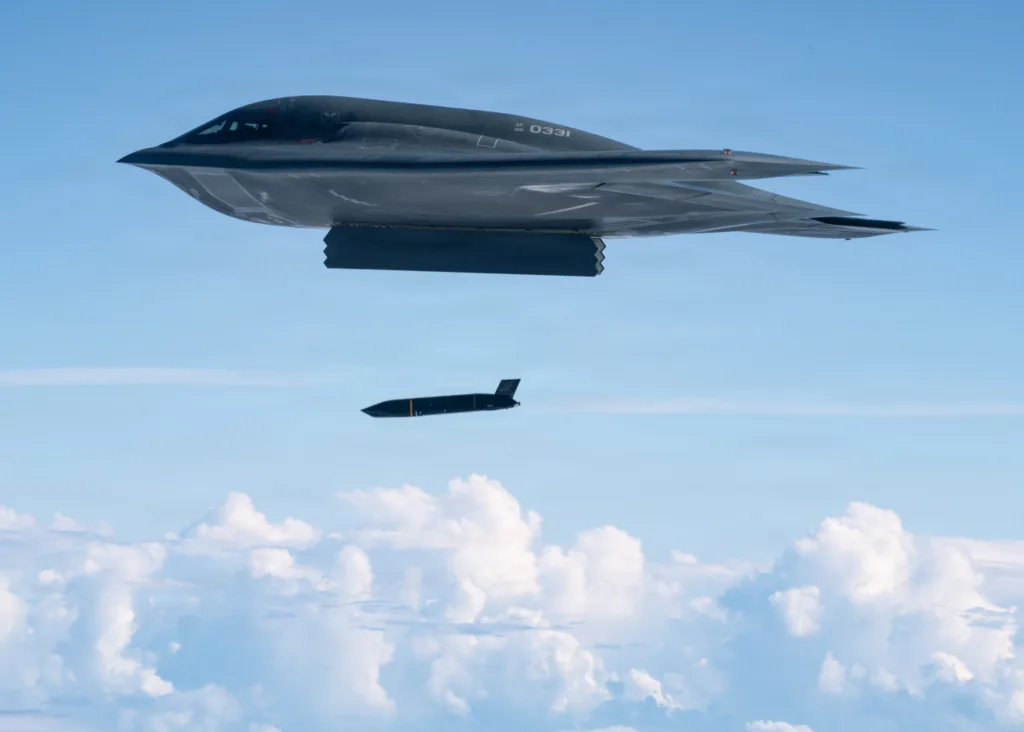
The U.S. Air Force will expand its procurement of stealthy air-launched cruise and anti-ship missiles, according to contract documents released Wednesday.
Two contracts for the procurement of Lockheed Martin-designed AGM-158 Joint Air-to-Surface Standoff Missiles and AGM-158C Long-Range Anti-Ship Missiles were expanded this month from an anticipated production run of 16,710 to 23,095 of the stealthy long-range strike munitions.
The notices updating solicitations covering lots – a term used for the tranches of procurement of a munition – 22 to 33 for JASSM and 9 to 19 for LRASM were released Wednesday. According to a Pentagon contract notification from 2025, work for JASSM lots 22 to 26 and LRASM lots 9 to 12 will be completed by 2033. The remainder of these lots are expected to be completed within a five to seven year period from the award date.
This increase in procurement coincides with defense industrial base efforts to step up production capabilities amid Pentagon demands for an increased stockpile to counter China.
American forces also fielded JASSM missiles in large quantities in the U.S.-Iran War this year.
The Pentagon used up to 1,100 of the advanced cruise missiles since Feb. 28, the beginning of the conflict, from an estimated pre-war inventory of 4,000 JASSMs, according to a report from the Center for Strategic International Studies. U.S. Air Force bombers operating from British bases were regularly observed equipped with the missiles throughout the onset of the war. CSIS’ quantity places the stealthy cruise missile as the most used long-range munition by U.S. forces against Iran.
Despite the usage of these high-end munitions in Iran, JASSM and LRASM remain crucial for American commanders stationed in the Indo-Pacific in countering China. U.S. Air Force bombers and Marine Corps fighters will rely on these stealthy missiles to punch through Beijing’s increasingly advanced air defense networks and anti-aircraft warfare destroyers.
Last month, the Air Force revealed its ability to fire LRASM missiles from the B-2 Spirit during a sinking exercise in the Central Pacific. Through these stealth bombers, the air branch has demonstrated that these proven and hard-to-detect bombers operating from airbases in the continental U.S. can strike maritime targets across the Pacific.
In the future, the Air Force plans to develop a next-generation missile capable of striking air and maritime targets at ranges of 1,000 nautical miles. A solicitation of the system, dubbed the Air Force Long Range Weapon program, reads that war planning scenarios covering the Indo-Pacific influenced this requirement.
To strengthen its long-range precision strike arsenal amid the U.S. war with Iran and concerns over countering China, Washington demands increased production from the defense industrial base.
Traditional missile suppliers, like Lockheed Martin and RTX, pledged to increase the rate and quantity of munitions produced. However, newcomers focused on building and delivering low-cost cruise missiles have also entered the competition. Within the last two months, the Army and Air Force contracted firms such as Anduril and CoAspire to deliver tens of thousands of missiles.