U.S.-funded Project Expanding Drone and Fighter Capacity at Philippine Air Base
Efforts are underway to expand U.S. aircraft and drone capacity at a Philippine air base used by Washington to monitor the South China Sea and assist Manila’s defensive needs, USNI News has learned.
The Airbus commercial satellite imagery, publicly shared on Google Earth, shows a clearing has been made at the northwest end of Basa Air Base that matches plans previously published on project solicitation documents detailing the project.
These construction efforts were initially approved in 2023 through a joint U.S.-Philippine military board to enhance American forces training in-country or using the base for contingency operations. Contracted in 2024 for $32 million, the 625,000-square-foot parking apron will be able to support up to 18 fighters and two large transport aircraft.
Additional approved projects at Basa near the aircraft spaces include hangars for unmanned aerial vehicles (UAV) and a tactical operations center. Future plans envision the creation of another apron dedicated to drone support, according to a U.S. Indo-Pacific Command graphic detailing projects at the base.
Located 40 miles northwest of Manila, Basa is the Philippine Air Force’s hub for its fighters and air defense systems. The airfield is also one of nine sites designated throughout the Philippines under the Enhanced Defense Cooperation Agreement (EDCA), a treaty inked over a decade ago that allows American forces to construct facilities at select areas across the Southeast Asian archipelago.
Following an increase of incidents with Beijing over disputed maritime features in the South China Sea, the two allies focused their EDCA funding at Basa. Starting in the early 2020s, American funding renovated the base’s runway, constructed new aviation support pads and refurbished munition storage facilities.
Aside from providing air defense for the capital, Basa’s location allows U.S. and Philippine forces to sortie aerial surveillance over the South China Sea.
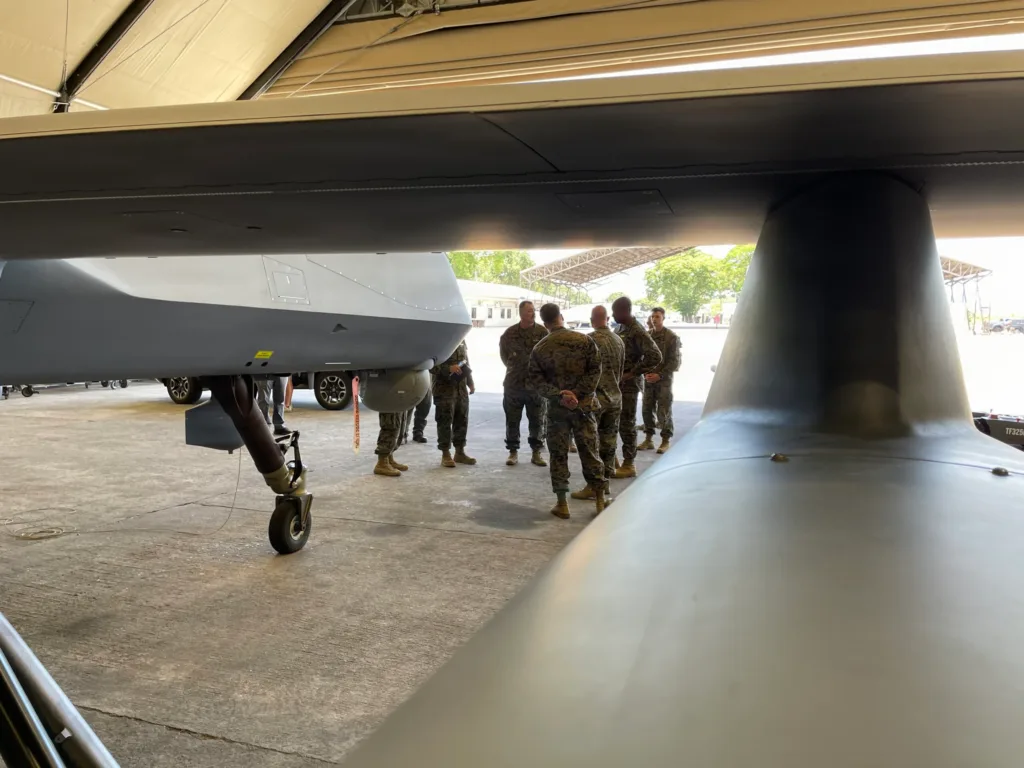
In 2024, Marine Unmanned Aerial Vehicle Squadron (VMU) 1 deployed an unspecified quantity of MQ-9A Reaper drones to the air base. The service told USNI News at the time that the deployment supported “Philippine regional maritime security.” During Balikatan 2026, Defense Department imagery of a Marine Corps leadership visit to the base showcased a forward-deployed detachment of VMU-1.
These Marine drones have been deployed in numerous exercises and joint operations with Philippine UAVs. Their cameras and sensors provide a crucial look for Washington and Manila into the South China Sea during high-speed maritime incidents with Chinese forces. Manila has used video and imagery from American-provided intelligence aircraft to relay Beijing’s actions in the disputed waters.