Navy Wants Sailors to Do Less Supplemental Work on USS Harry S. Truman Overhaul
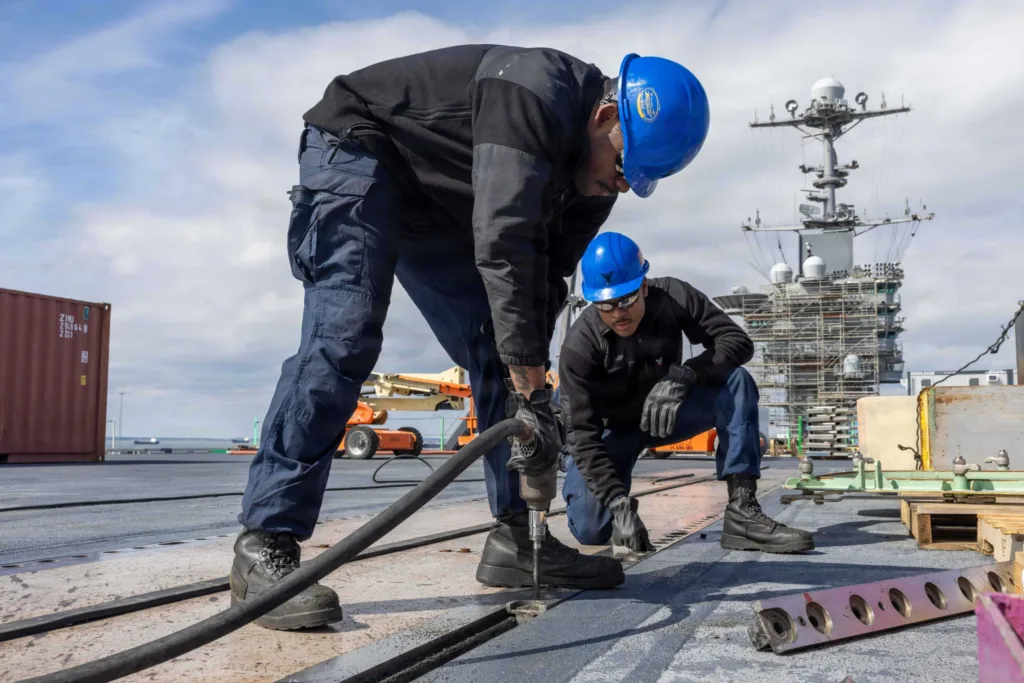
The Navy is turning to commercial contractors for more duties during the upcoming refueling and complex overhaul of USS Harry S. Truman (CVN-75) in order to free up more time for sailors, USNI News has learned.
Previously, sailors assigned to a ship in RCOH would be assigned supplementary, non-rate specific duties, such as painting, insulating or transportation services. Now, those duties will be given to contractors, and sailors will be able to use the time for training and operational readiness, reads a Navy release given to USNI News. Sailors will still perform rate-specific duties and, if necessary, could perform non-rate specific ones as well, a Navy official told USNI News.
The change was made by Navy Quality of Service Cross-Functional Team (QoS CFT) and PAE Maritime’s In-Service Aircraft Carrier Program Office (PMS 312).
“This shift is about putting our Sailors’ time and talents where they matter most,” Vice Adm. Scott Gray, who heads Navy QoS CFT, said in the release. “By contracting out routine tasks like transportation and preservation, we free our crew from traditional shipyard duties, empowering them to focus on their in-rate training and core warfighting capabilities.”
The change in RCOH will begin with Truman, which entered the maintenance period following its return home from an eight-month deployment in June 2025. HII’s Newport News Shipbuilding is performing the RCOH.
The Navy has awarded five contracts for the supplemental work, returning 690,000 labor hours to the crew, according to the Navy release. The change also means a smaller crew will be assigned to the ship.
As of Thursday, the switch to contractors has cost about $32 million, referenced as an “investment in sailor readiness,” a Navy official told USNI News.
“By alleviating hands-on, non-rate-specific maintenance tasks, Sailors can concentrate on developing critical warfighting skills and completing their professional development. This approach maintains a higher state of overall readiness while significantly improving the crew’s quality of life in the shipyard environment,” reads the release.
Sailors may pursue advanced technical training, enroll in academic programs or switch to career-enhancing billets with the extra time, the Navy official said.
“This is one of several enhancements driven by the Navy’s Quality of Service Cross-Functional Team, established in 2023 to prioritize and elevate sailors’ quality of life,” a Navy official said. “The CFT unites representatives from across Navy commands that directly influence our sailors’ quality of life. By bringing key stakeholders together into a single effort, the CFT’s primary objective is to rapidly identify areas of concern and efficiently implement changes that make the most significant, positive impact for our force.”
The Quality of Service Cross-Functional Team was set up under former Chief of Naval Operations Adm. Lisa Franchetti while she was still deputy CNO. The team was part of the Navy’s response to reports of poor quality of life for sailors assigned to ships in RCOH.
RCOH periods are notorious for extensions. USS John C. Stennis (CNV-74) is currently in an RCOH that has been extended by around 14 months, USNI News previously reported. Stennis arrived in May 2021 with the RCOH expected to take five and a half years.
USS George Washington (CVN-73) redelivered to the Navy in 2023 after delays led to a near-six-year RCOH. During the RCOH period, the carrier experienced multiple suicides, including a span of three within a week of each other. Investigations into conditions while George Washington was in the shipyard led to quality of life-focused changes, including moving sailors off the ship and addressing parking challenges.