Drones could mean the end of sprawling bases seen during Iraq and Afghanistan Wars
“I think we need to make ourselves a smaller target. We have to be harder to be detected, hit.”
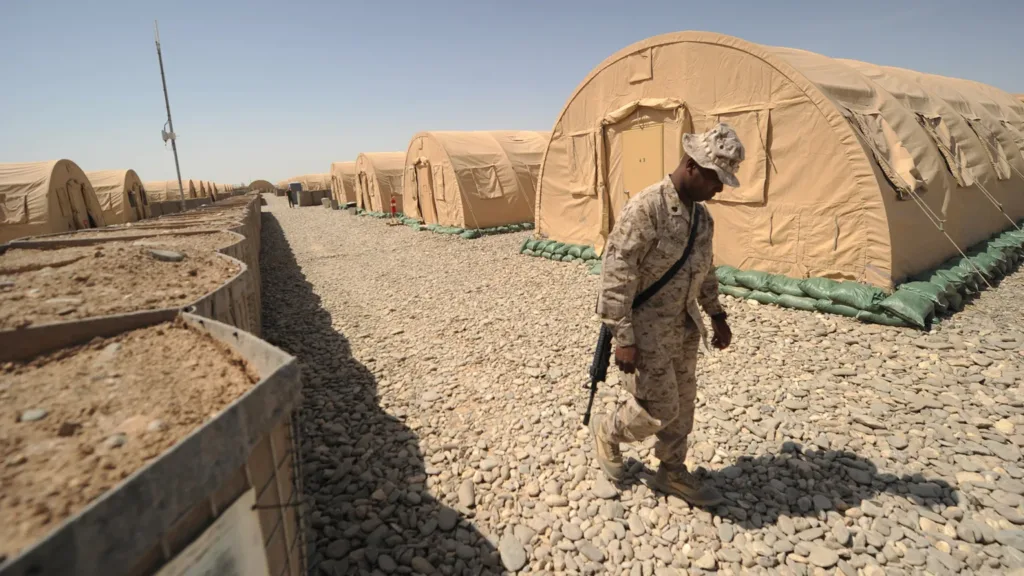
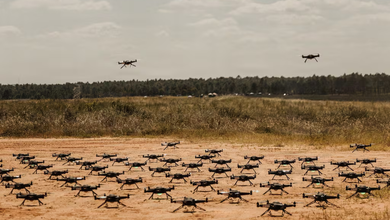
The types of massive troop deployments of the Iraq and Afghanistan wars are becoming dangerous as attack drones become a ubiquitous presence on battlefields, the head of U.S. Southern Command said on Tuesday.
“I think we need to make ourselves a smaller target,” said Marine Gen. Francis Donovan. “We have to be harder to be detected, hit.”
During both those wars, the U.S. military adopted the mantra that “more is better,” Donovan said during this year’s SOF Week exhibition in Tampa, Florida.
At the peak of both conflicts, roughly 100,000 U.S. troops were deployed to Afghanistan, and 170,000 were in Iraq. Although many of those service members were deployed at smaller combat outposts during the course of the wars, the U.S. military maintained huge bases in both countries, such as Bagram Airfield, Afghanistan, and Joint Base Balad, Iraq, which served as major logistics and transportation hubs.
But having so many forward operating bases, chow halls, and vehicles in theater required a huge amount of logistical support, Donovan said on Tuesday.
“The key is, I think we’re also made ourselves more vulnerable because of our requirements, specifically our logistics requirements in that, when you go, [you] have to go more firm or solid and build up logistics base for our own logistics needs, you make yourself more vulnerable,” Donovan said.
At the time, U.S. troops in Iraq and Afghanistan faced small arms and roadside bomb attacks. But the threat that enemy drones now pose should force the U.S. military to rethink how it wages war, Donovan said.
“We haven’t fought really under the gun in a long time,” Donovan said.

The Army has already practiced having soldiers move in smaller units and use concealment, camouflage and dispersion to avoid being spotted by enemy drones.
Donovan stressed the need for the U.S. troops and commanders to make it tougher for the enemy to target and hit them.
“It’s very hard to hide anywhere these days,” Donovan said. “It is. But the reality is, we could be much better at deception. We could be much better with our own kind of discipline in how we set ourselves, move into a location, work with partners, and reduce our digital footprint.”
He added that it would be hard for the military to change its mindset on large deployments because for two decades it was able to operate out of large forward operating bases, send quick reaction forces to help troops under attack, and medically evacuate wounded service members within the “golden hour.”
But in the age of drone warfare, “that’s not true,” Donovan said, adding that “if we need all those things, then the enemy has an easier way to target us, and I think we have to kind of flip the script on that and think differently.”
In terms of what that means for deployments of conventional and special operations to South America, “What we need is less,” Donovan said.
Donovan’s theater of operations includes Latin and South America, where he said partner nations are dealing with threats seen in the Middle East, including drones guided by fiber optics.
“We have to be careful not to get too strong, too big at any location; still be dynamic, still be expeditionary, and put the force that needs to be applied to the target and match that appropriately,” Donovan said.