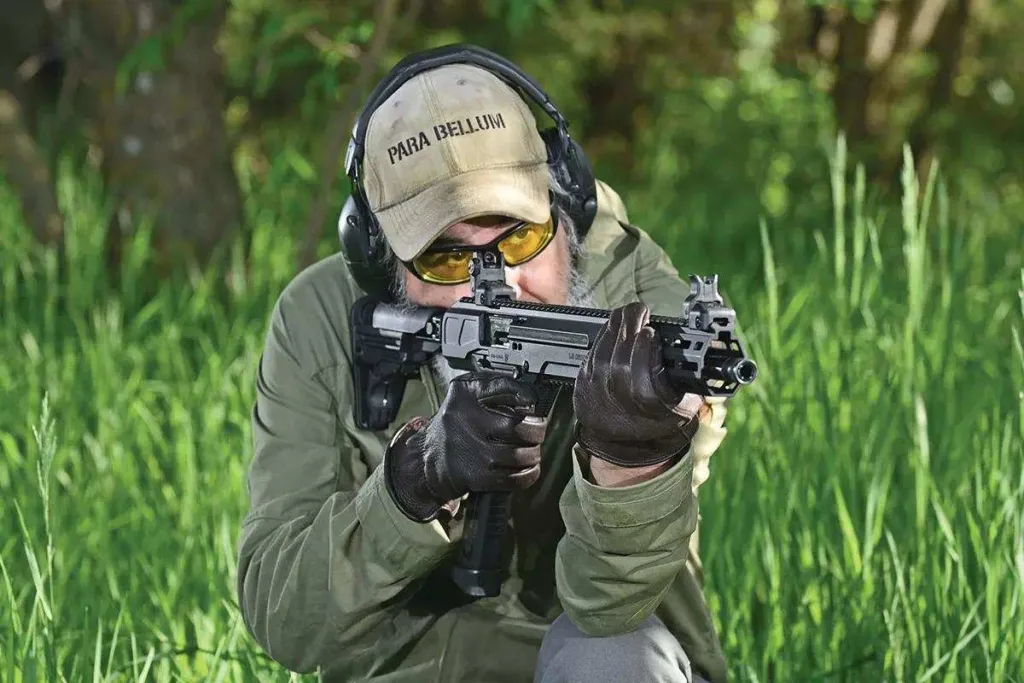
Afew years back, Ruger caught the attention of shooters when they introduced their compact, and modern-looking LC Carbine chambered in FN’s 5.7x28mm. Ruger single-handedly breathed new life into the seemingly stagnant 5.7x28mm cartridge. Next, Ruger expanded their LC Carbine line in 2024 with a slightly updated model chambered for the classic big-bore .45 ACP. Much more modern in appearance, compared to their more traditional PC carbine, the LC Carbine again turned heads. Now, Ruger is back, shaking things up again with another new offering in their ever expanding LC Carbine line, this time chambered for the hard-hitting 10mm Auto cartridge. Many shooters have been asking Ruger to offer the LC Carbine in 10mm Auto, and they listened.
My own interest in the 10mm Auto cartridge was sparked many moons ago reading Jeff Cooper’s thoughts in our sister title Guns & Ammo magazine. Designed when FMJ projectiles were still de rigueur for personal protection, it was intended to be the “perfect” defensive handgun cartridge. Thinking at the time that a .40-caliber 200-grain FMJ launched at 1,200 fps would provide an edge in terminal performance over existing cartridges like the .38 Special, 9mm Parabellum, and .45 ACP. Plus, the .40-caliber design would provide increased capacity over the larger diameter .45 ACP.
Without a doubt, the 10mm Auto set the shooting community on fire when it was introduced way back in 1983. Not everything went smoothly though, which could have spelt the end for the new cartridge. While Dornaus & Dixon’s Bren Ten pistol was a business disaster, the 10mm Auto cartridge was too good to die with it. Norma, of Sweden, had stepped up to the plate and produced ammunition and both Colt and Smith & Wesson introduced handguns. It wasn’t long before none other than the FBI took note of the cartridge. They adopted it in 1989 and fielded it along with Smith & Wesson 1076 pistols. The FBI’s adoption led a number of police departments around the country to follow suit. [EDITOR’S NOTE: The FBI choosing the 10mm was so influential that HK manufactured MP5 submachine guns in 10mm. This followed Auto Ordnance manufacturing 10mm-chambered Thompson submachine guns at the FBI’s request.]
I purchased a Smith & Wesson 10mm 1076 pistol around 1991, had some work done to it, and spent countless hours behind my reloading press rolling up a variety of loads. I tested various bullet weights and configurations from heavy lead 200-grainers to lightweight 135-grain Nosler JHPs. Eventually, I sold the Smith and built a very pretty custom 10mm Delta Elite with a carry comp. I never could get it totally reliable though. The FBI eventually dropped the 10mm Auto in favor of .40 S&W, and I did the same.
For a time, it seemed like the 10mm Auto was headed for the history books, but it proved just too damn good to lie down and die. It retained a faithful following who loved its accuracy, exterior and terminal ballistics. Outdoorsmen and hunters in particular appreciated the cartridge, and the level of performance it offered in an auto-loading handgun.
Eventually, the 10mm Auto found a niche it could call its own, and both sales and interest in it have steadily increased over the years. Today, a new generation of shooters, not old enough to remember its genesis or fall from grace are embracing it. I never lost that spark for the 10mm Auto. It has many wonderful qualities. It can drive fairly heavy bullets fast enough for hunting medium game. It penetrates well with the proper projectile and offers reliable expansion with modern designs. With lightweight bullets in the 135- and 155-grain range, it really sizzles and can provide Tokarev like velocities. Accuracy is usually quite acceptable. Recoil of full-house loads tends to be a bit stiff for many interested in using it for concealed carry. One option is the 10mm Auto FBI pressure loads which are similar in velocity to the .40 S&W. These mellow it out noticeably, but do take the magic away.
Why 10mm Auto in a pistol caliber carbine like this new Ruger? It has long been popular to have a long gun that fires the same ammunition as your sidearm. This has been widespread with American sportsman, hunters and adventurers since the 19th Century, especially in the old West. The Winchester 1873 and 1892 lever-actions were hugely popular due to this capability (many were chambered in .44-40). In the modern era, it makes economic sense if you have a 9mm pistol to also have a 9mm pistol caliber carbine. It only follows that owners of 10mm Auto handguns will find a 10mm carbine appealing.
Even so, the 10mm Auto from a carbine is interesting enough to be desirable even if you do not own a 10mm Auto handgun. It offers a noticeable step-up in performance over the 9mm Parabellum and can drive bullets weighing from 115 to 220 grains. On the lighter side of the scale, Lehigh Defense offers a 115-grain monolithic copper solid with an advertised velocity of 1,700 fps from a five-inch barrel. This generates 738 foot-pounds of energy at the muzzle.
On the opposite end of the scale, Buffalo Bore offers a 220-grain hard cast flat nose Outdoorsman load that has an advertised muzzle velocity of 1,200 fps from a five-inch handgun. This load generates 703 ft-lbs. of energy at the muzzle. From a carbine’s longer barrel, both of these loads will pick up velocity and hit even harder. However, depending upon the load, velocity gained from a 16-inch barrel may not be as much as some expect.
If you enjoy time spent at your press, it’s an easy cartridge to handload. Today, unlike in 1991 when I was first playing with it, there are a host of modern projectiles to choose from. A number of powders work well with it, plus dies and data are all readily available. You can load it very mild to make it pleasant to shoot on the range. Or, you always have the option of loading it heavy for hunting, personal protection or recreational shooting.
To find out how well the new Ruger performs, I had them send a 10mm Auto LC Carbine on temporary loan for review in Firearms News. This allowed me to examine and test it on the range to form an opinion to share with you. There is growing interest in 10mm Auto chambered pistol caliber carbines (PCC) today, so I was interested to see what this new Ruger brings to the table.
The heart of the carbine is a blocky looking receiver. The design utilizes an over-hanging bolt to reduce the receiver’s overall length and is similar in concept to the well-known UZI submachine gun. Also, like the UZI, the magazine well is located in the grip for easy “hand to hand” reloading. The non-reciprocating charging handle comes from the factory on the left side, but it can be reversed to the right side if the owner so chooses. The controls are similar to the Ruger-5.7 pistol and include ambidextrous manual safety levers.
The first question many will ask is, “What magazine did Ruger chose to feed their new 10mm Auto LC Carbine with?” This simple question is extremely important to many. The good news is Ruger selected readily available Glock pattern magazines. My review sample came with one 30-round polymer magazine. These are robust, reliable, fairly easy to load, and economical to buy. The magazine is a double-column design with single-position feeding and witness holes are provided on the back. Factory Glock or aftermarket magazines may be utilized.
Ruger selected a simple blow-back operating system and paired it with their familiar Secure Action fire-control system. This features a protected internal hammer with a bladed-safety trigger design. A pre-cocked double-action design, the hammer is partially cocked by the slide, but pulling the trigger brings it back slightly to full-cock before releasing it. Trigger pull on this design has some sponginess in its initial take-up and a bit of a heavy break. Reset is distinct but a bit long.
At the rear of the receiver is a MIL STD 1913 rail section onto which a side-folding buttstock attaches. This multi-position collapsible stock provides a length of pull running from 12.6 to 14.6 inches. The design is reversible and standard AR-pattern stocks will fit onto the Ruger’s tube. The stock features a rubber pad to keep the butt from sliding around on your shoulder as well as multiple sling mounting points. If you prefer a different folding stock, the LC Carbine will accept aftermarket stocks which attach to a MIL STD 1913 Picatinny rail. So, there are plenty of options available on the aftermarket.
The 10mm Auto LC Carbine’s barrel is 16.2 inches in length. The muzzle features a .578″x28 TPI thread pitch which is covered by a muzzle nut. The barrel features six groove rifling and a one turn in 16 inches right hand rifling twist. This rifling twist rates facilitates a wide range of bullet weights from light to heavy. For corrosion resistance, the barrel is nitride treated.
Surrounding the barrel is a CNC-milled M-LOK handguard. This is Type III hard-coat anodized aluminum and it features M-LOK slots on seven sides. The handguard is an improvement over the original design introduced on the 5.7x28mm model. The more numerous M-LOK slots allow easy mounting of accessories.
Running the full length of the top of the carbine is a MIL STD 1913 “Picatinny” rail. This full-length rail makes mounting optics or iron sights a snap. The carbine weighs 7.4 pounds and its overall length with the stock folded is only 22.5 inches. With the stock unfolded but fully collapsed the overall length measures 28.7 inches.
The 10mm Auto LC Carbine comes with Ruger’s Rapid Deploy flip-up polymer sights. These consist of a protected front post adjustable for elevation and a protected rear aperture adjustable for windage. If you prefer, you can mount a red dot, magnified optic, night vision or thermal unit. The LC Carbine comes with one Glock-pattern 30-round magazine, M-LOK QD sling socket and hex wrenches for disassembly.
Having tested both earlier models in 5.7x28mm and .45 ACP, I was interested to see if the 10mm Auto model would behave much differently. Handling it, I noticed rounds load easily into the magazine, and the magazine locks securely into place with a simple upward push. The 10mm Auto LC carbine features ambidextrous 1911-style safety levers and these are well-placed and easy to manipulate. On the left side, just to the front of the safety lever, is a pistol-style bolt catch/release. This can be used to lock the bolt to the rear or release it.
On the right side of the receiver, forward of the trigger, is a round button, which acts as a bolt release. This is very well-placed allowing easy operation with the trigger finger. The mag release is on the right side of the pistol grip and easy to manipulate. The charging handle does not require a great deal of force to operate and the carbine is comfortable to shoot. The trigger is a bit mushy and heavier than I’d prefer. While certainly serviceable, it is my only gripe.
Due to its design, the 10mm Auto LC carbine is very easy to accessorize and personalize. It’s very easy to add a sling, optical sight, white light and other accessories. As the muzzle is threaded, it’s also very easy to mount a muzzle brake, flash suppressor or sound suppressor. The Ruger 10mm Auto LC carbine is a prime candidate to suppress as both subsonic and supersonic loads are available.
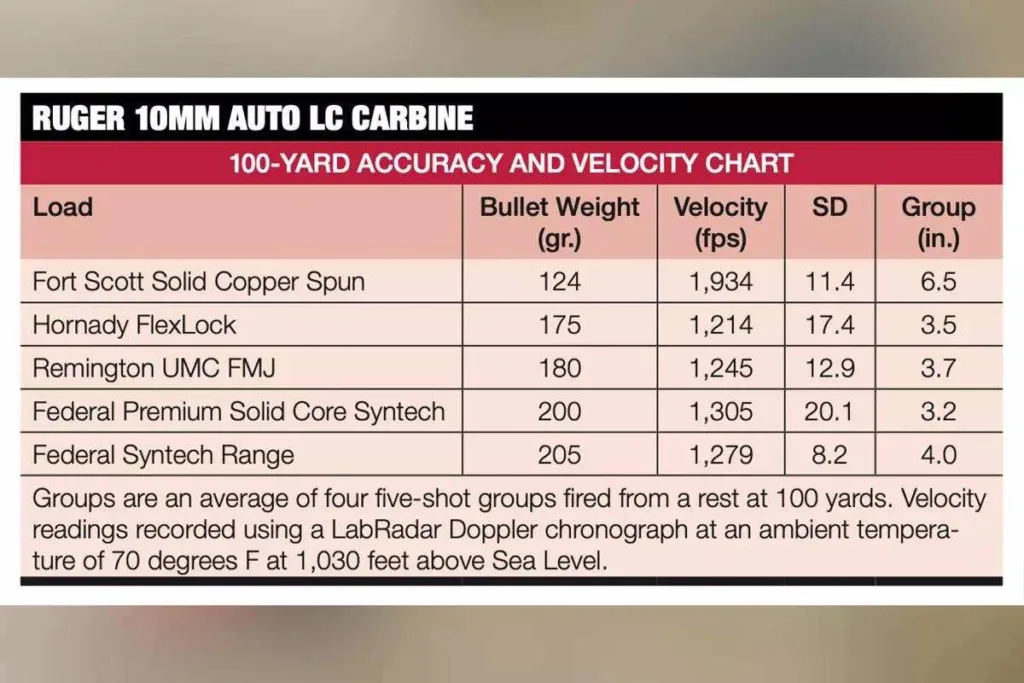
To check Ruger’s 10mm Auto LC Carbine’s performance, I collected five different loads. The first is a modern lightweight 124-grain solid copper spun projectile from Fort Scott. This is not designed to expand but is claimed to have a very early yaw cycle to disrupt tissue. Unlike a hollow point, it cannot become plugged and is designed to work well through barriers. The next is Hornady’s 175-grain FlexLock from their Critical Duty line. From Remington, I selected their 180-grain FMJ load from their UMC line. From Federal I selected their 200-grain Solid Core with Syntech Jacket and their 205-grain Syntech Range load. These five loads were intended to both check the LC Carbine’s accuracy and reliability.
Accuracy testing was conducted from off a bag on my bench. I would expect most who buy an LC Carbine will outfit it with some type of red dot sight, so I added an Aimpoint T1 red dot. A quick zero on a steel silhouette, and I got to work. Testing was then conducted at 100 yards with four five-shot groups fired with each load and velocity measured using a LabRadar Doppler chronograph.
The Ruger was fun to fire from the bench and accuracy was consistent. Best 100-yard accuracy was obtained using Federal Premium’s 200-grain Solid Core Syntech load which averaged 3.2 inches at 1,305 fps. Hornady’s 175-grain Critical Duty FlexLock load was right behind it though averaging 3.5 inches at 1,214 fps. Remington’s 180-grain UMC FMJ load averaged 3.7 inches at 1,245 fps and Federal’s Syntech Range 205-grain load averaged four inches at 1,279 fps.
As you can see, standard 10mm Auto loads do not gain a great deal of velocity in the longer barrel compared to a standard five-inch handgun. As an example, Hornady’s 175-grain Critical Duty load averaged 1,152 fps from a Smith & Wesson M&P 2.0 10mm pistol. In comparison, the LC Carbine gained just 62 fps with this load. On the flipside, Fort Scott’s 124-grain Solid Copper Spun solid averaged 6.5 inches at 100 yards at a blistering 1,934 fps. This load exhibited some vertical stringing in its groups, but really zipped. Recoil was a bit heavier than with say Hornady’s 175-grain Critical Duty load. Function was flawless with all of these loads.
Moving from the bench, I ran the LC Carbine through some drills on steel at 25 and 50 yards. I noted the recoil to be similar to the .45 ACP LC carbine, allowing fast follow-up shots. It moves around a bit, but not bad. I noted it shouldered quickly, swung fast and pressing the trigger provided a nice “THWOK” on the steel. I ran drills both using the factory iron sights and with a red dot.
The carbine is comfortable in the hands, the stock adjusts easily and it’s easy to fold. The pistol-like controls are straight-forward to understand and employ. Reloading is fast. Practical accuracy is very good for a pistol caliber carbine. It proved capable of making rapid multiple hits at the distances you would envision employing it at in a realistic personal protection scenario. I suppose more importantly to some is, it’s fun to shoot. It’s fun enough with that 30-round magazine you will wish 10mm Auto ammunition was cheaper!
It folds up into a fairly short package for stowing in a backpack. Retrieving it from a pack it is fairly quick to unfold the stock, chamber a round and put into action. It can be fired with the stock folded if needed. The LC Carbine shines at distances out to 100 yards. However, plinking on the range will show that it is fully capable of making hits on a man-sized target at 150 and 200 yards if you do your part and know your drop in trajectory. Just remember, as velocity drops off, so does terminal performance. While the 10mm Auto offers a step-up in performance compared to other traditional service pistol cartridges, like the 9mm, it is by no means a rifle. PCCs are fun and useful, but if you need a rifle, reach for an honest-to-God rifle.
Throughout testing, Ruger’s 10mm Auto LC Carbine performed well with no issues. MSRP is $1,049, which is not bad for a pistol caliber carbine chambered in 10mm Auto. Ruger’s 5.7x28mm LC Carbine ignited a lot of interest and I suspect their new 10mm Auto version will as well, just for different reasons. It’s a perfect match for 10mm Auto handguns and certainly adds a bit more thump compared to a 9mm. If you like the 10mm Auto cartridge, the new Ruger might be very appealing.
If you have any thoughts or comments on this article, we’d love to hear them.
RUGER 10MM AUTO LC CARBINE SPECS
- Caliber: 10mm Auto
- Operation: Blowback
- Barrel Length: 16.25 in.
- Barrel Twist: 1:16 inches, RH twist
- Trigger: Secure Action Double-Action
- Feed: Detachable 30-round Glock pattern box magazine
- Overall Length: 22.7 in. folded, 28.5 in. to 30.6 in. stock unfolded
- Weight: 7.4 lbs.
- Sights: Protect post and adjustable rear aperture, Ruger Rapid Deploy
- Finish: Hard coat anodized and Black Nitride
- MSRP: $1,049
- Contact: Ruger.com, (336) 949-5300