Space Force Program Office Turns to New Acquisition Tools to Leverage Commercial
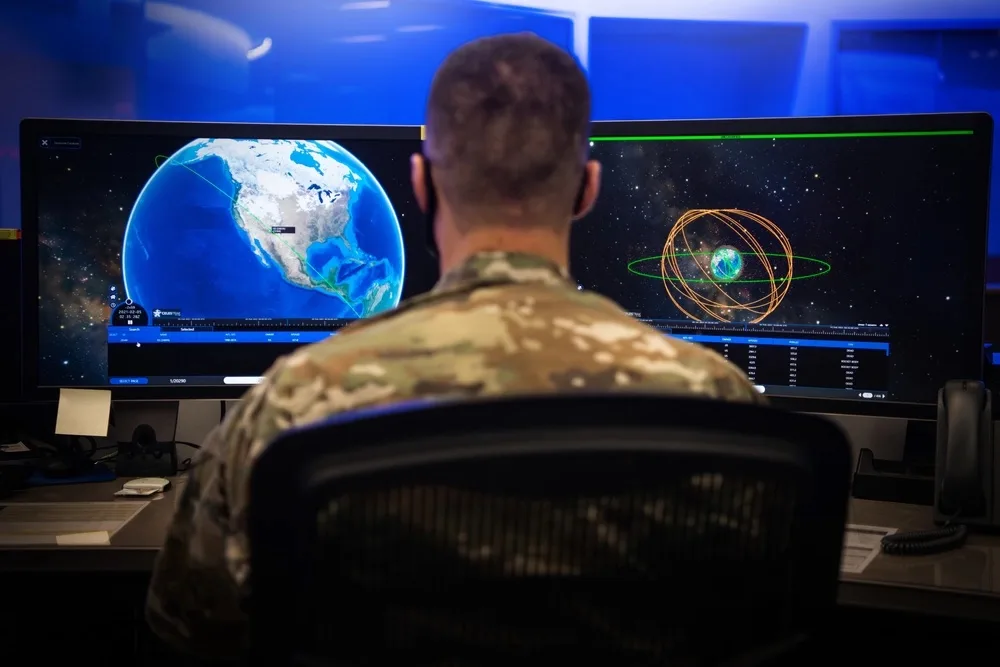
Crews of the National Space Defense Center at Schriever Space Force Base, Colo. provide threat-focused space domain awareness across the national security space enterprise. U.S. Space Force photo by Kathryn Damon.
Space Force leaders have been saying for months that they are uniquely prepared among the services to embrace the Trump administration’s acquisition reforms.
Now, officials from the Program Executive Office for Battle Management, Command, Control, Communications and Intelligence, or BMC3I, are implementing some of those reforms through a Commercial Solutions Opening—a contract vehicle that can be used to buy a wide range of innovative off-the-shelf technologies.
At a Jan. 23 industry day, those officials said they would soon reopen a Commercial Solutions Opening called KRONOS focused on three “areas of interest:” battle management, regional global command and control, and space intelligence.
“When we put out KRONOS in December, we just cracked the window open and in came this flood of amazing ideas,” said Col. Jason West, the commander of System Delta 85, which is running the KRONOS program.
He said the delta is on track to make the first set of awards under the CSO by March. Although it is not currently open, he explained, there will be “a regular cadence of awards in this program.”
“The KRONOS CSO is really intended to be always open,” he explained, but the delta had to close it temporarily, because they initially staffed “only a small team to start getting after the process of getting this software in.” The closure was necessary “to meter the flood of ideas somewhat,” he said.
But West urged the audience of defence contractors to keep thinking about innovative products and services they could offer in the three areas of interest. “It’s going to open back up again,” he said, “so be ready to go for it.”
SSC has not released any dollar numbers for the KRONOS CSO.
‘A Very Different Mindset’
Always open, never closed CSOs would entail “a very, very different mindset. … A couple of big differences for us to try to wrap our brains around,” West said.
CSOs allow the military to bypass the usual Federal Acquisition Regulations when buying off-the-shelf commercial products. It’s one of a series of tools that Congress has granted the Defense Department over the past decade in an effort to streamline the process of buying technology, and especially IT. Critics have charged FAR-based purchasing with being barely effective for major hardware programs and cripplingly useless when it comes to buying software products which can be obsolete within 18 months.
In a speech to defense industry CEOs at the National War College on Nov. 7, Defense Secretary Pete Hegseth announced a series of acquisition policy changes designed to speed the deployment of emerging technologies to the U.S. military, including by making greater use of new authorities like CSOs and relying more on off-the-shelf technology, as opposed to boutique products crafted especially for the Pentagon.
Through CSOs like KRONOS, explained West, “we reach agreements. We don’t sign FAR-based contracts. There’s a FAR path [available through a CSO], but the preferred path is that we’re going to reach an agreement like a business.”
Some of the changes entailed by a CSO “might make people uncomfortable,” he acknowledged. In the current system, for example, there are lengthy “blackout periods” when contracting officials cannot talk to vendors, designed to ensure buyers aren’t being influenced or suborned. By the time the proposals are evaluated, an award is made, and the post-award possible challenge period is over, West said, “it’s been about 18 months where I’m not talking to industry, and in software, that’s three generations.”
“The CSO allows me to never, ever have a blackout period with industry,” he said, pledging that System Delta 85 “are going to continuously engage with software developers to understand what’s the art of the possible in software today, and how we might exploit that to get after our mission.”
‘Jumping Off the … Cliff’
West added that the KRONOS program was also putting its shoulder behind the software acquisition pathway—a series of reforms first introduced in 2020, but foot-stomped by Hegseth in March 2025.
“The KRONOS CSO is jumping off the software pathway cliff. We are all in,” he said, pledging the program would “show the full power of the software pathway.”
The pathway encourages the licensing, rather than the purchase, of software capabilities. “I don’t want to buy code in this model,” West said, noting that a static codebase—the typical deliverable for a traditional FAR-based contract—was “useless,” because it quickly became outdated. Actually, a static codebase quickly became worse than useless, he said, because maintaining it “is a burden, and I don’t want to have to bear that burden.”
The CSO was designed to be “the on-ramp for full stack solutions to integrate into the operational baseline.”
He made clear that full stack was a key term. “The government is also not going to be the integrator. We’re looking for full stack solutions, and what that means is we want to be the Integration Manager, but we want to allow industry to bring that full stack solution to bear,” he said.
The software acquisition pathway was a way for the government to buy continuously evolving and improving capability-as-a-service, West said.
“What I’m funded to go buy [in the KRONOS CSO] is continuous delivery of an adaptable, integrated capability that’s moving at a speed ahead of the threat, and that threat includes the cyber threat. So that’s what … this CSO is for: Continuous improvement of our baseline capability through a commercial licensing model.”
“The capability that I really want is a team of coders who are going to come work for us under a license agreement and continue to give us more and more capability as we go.”
But that doesn’t equate to a meal ticket for the service provider, he stressed. “If another offer comes along that can outpace you or has a better starting product, that capability can very easily shift. And so the CSO is always open.”
Unified, Distributed Data Ecosystem
At the industry day, West also unveiled a new market research effort—called a request for information or RFI—aimed at identifying cutting-edge commercial tools and services the Space Force could use to help bring together the huge disparate data streams it needs to track—and eventually shoot at or intercept—objects in orbit.
The RFI, dubbed Enterprise Data Integration Space Operations Node, or EDISON, is part of a new program of record, West said. The service has built a Unified Data Library—a single cloud-based data lake for accessing and managing all its data. But now it was looking to industry and academia for tools to manage the on-boarding and federation or integration of new data sources for cataloging and analysis.
“Transform the Space Force data infrastructure from isolated monolithic systems into a unified, distributed ecosystem,” read a slide West showed.
“We’re going after some … additional capabilities that allow us to move data, onboard data, expose data,” West said, “things that aren’t currently being done at the speed and scale that we need within the architecture.”