U.S., Japan Pledge to Expand Joint Training Across First Island Chain

The U.S. and Japan have pledged to further expand joint training across Japan’s southwest region, including the first island chain, Defense Secretary Pete Hegseth and Defense Minister Shinjiro Koizumi said Thursday.
In a 50-minute meeting held this week in Washington D.C., the two defense leaders agreed to prioritize several initiatives meant to strengthen the response capabilities of the U.S.-Japan Alliance, according to a Ministry of Defense news release. The initiatives include the expansion of joint training in Japan’s southwest region, particularly around the first island chain, with more advanced and practical exercises aimed at accelerating joint missile production and maintenance in support of U.S. ships and aircraft.
“Strengthening our forces through realistic training and exercises in Japan, across the first island chain, again, is the kind of operational demonstration we need to be capable of showing,” Hegseth said in an opening statement by the two defense heads prior to the meeting.
The U.S. Marine Corps-Japan Ground Self-Defense Force (JGSDF) annual exercise Iron Fist, held annually in the U.S. since 2006, was shifted in 2023 to southwest Japan as part of U.S.-Japan efforts to increase the joint presence in the area.

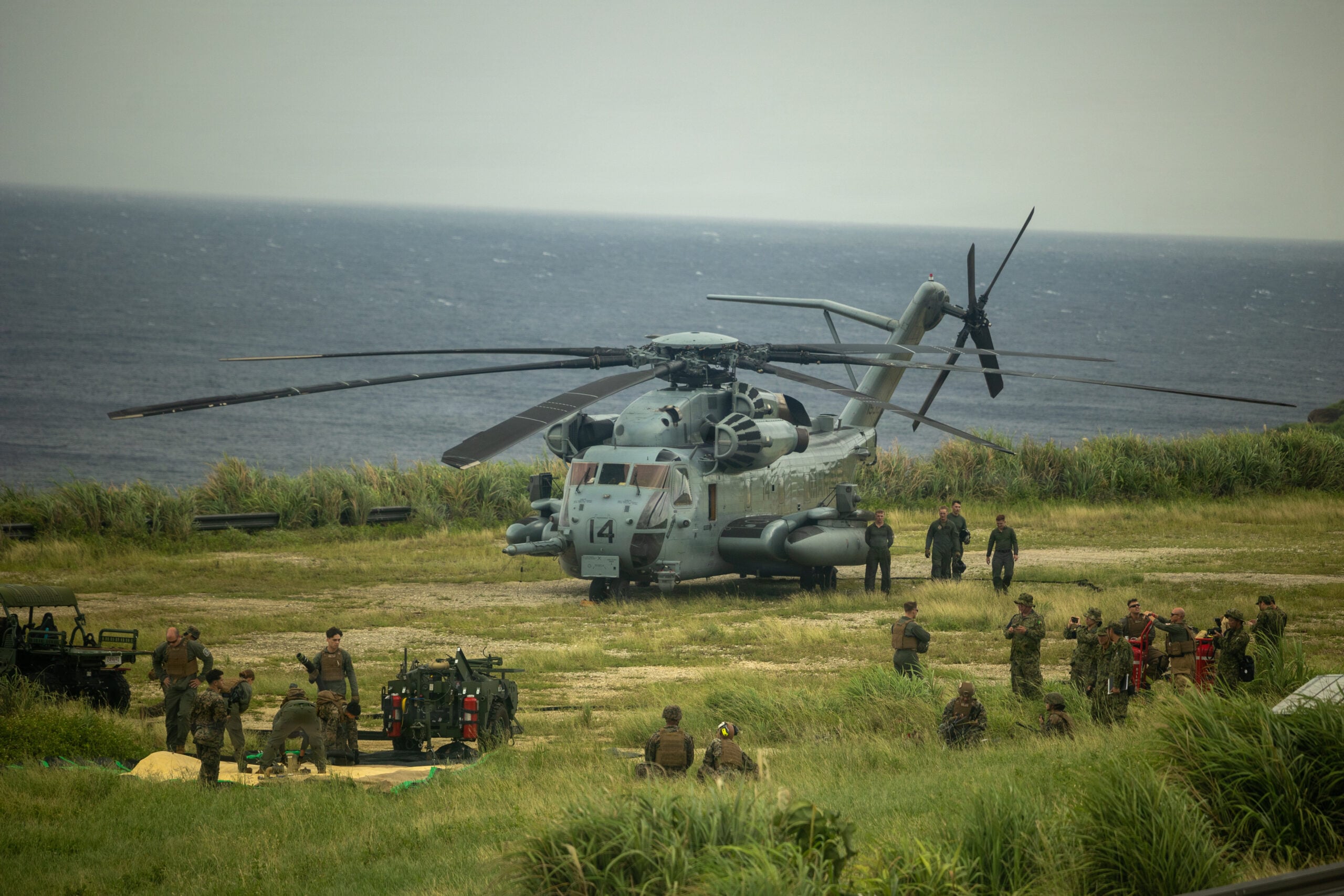
The annual Marine Corps-JGSDF exercise Resolute Dragon, which spans Japan, saw the Marine Corps deploy a mobile radar in 2024 to Yonaguni Island, the closest Japanese Island to Taiwan. In 2025, the Navy/Marine Corps Expeditionary Ship Interdiction System (NMESIS) was employed for the first time in Resolute Dragon drills in Japan’s southwest region. One month later in October, the Marine Corps and JGSDF established a forward arming and refueling point (FARP) on Yonaguni Island as part of a joint drill – another first for the joint drills.
Tokyo has been concerned about the security of Japan’s southwest region, which includes a string of Japanese islands that form a crucial part of the strategic first island chain archipelagos that acts as a natural barrier to China’s naval expansion into the Pacific Ocean. China continues to claim the Senkaku Islands held by Japan, and People’s Liberation Army Navy (PLAN) ships conduct regular transits between the East China Sea and Philippine Sea. Additionally, a PLAN carrier strike group recently held drills around the area, and there was a joint Russian-Chinese bomber flight over the region. As a result, Japan has bolstered its military presence there and plans to deploy long-range standoff weapons in the region.
In line with strengthening defense equipment and technology cooperation, Koizumi emphasized the importance of advancing preparations for the early holding of the next Japan-U.S. Defense Industrial Cooperation, Acquisition, and Sustainment Consultation (DICAS) meeting. The meeting is expected to cover the production of AMRAAM missiles and PAC-3MSE surface-to-air missiles, joint maintenance of U.S. military ships and aircraft and initiatives on supply chain resilience, including cooperation on critical minerals.
The two defense chiefs also agreed to accelerate work to mutually complement and strengthen the U.S. and Japanese defense industrial bases. Additionally, both agreed to advance discussions on significantly increasing production of SM-3 Block IIA ballistic missile defense interceptor missiles, according to the Ministry of Defense release.
Prior to the meeting, in his opening remarks, Hegseth expressed appreciation for Japan working to gradually increase its defense spending in recent months. The Trump administration previously called on Japan to up its defense spending with a focus on investing in capabilities necessary to protect the first island chain.
“We see the strength and the investment that Japan is making, and we think that’s a really important step and welcome and appreciate that,” Hegseth said.
According to Koizumi, Japan is building up the equipment and investments necessary to protect its people, based on its own independent judgment, and is in the process of revising Japan’s three national security documents.
“In any event, the Ministry of Defense intends to continue to work closely with the United States, steadily advance broad-based Japan-U.S. security cooperation and strengthen the deterrence and response capabilities of the Japan-U.S. alliance,” Koizumi said.
The Japanese defense minister also earlier met with Vice-President J.D Vance at the White House, where they discussed the regional situation and Japan’s plans to strengthen its defense capabilities. The U.S.-Japan alliance remained unwavering, and Washington is committed to the Indo-Pacific, according to Koizumi.
When asked about concerns over U.S. involvement in the Indo-Pacific, Koizumi responded, “There are always people in the region who are uneasy about America’s involvement in the Indo-Pacific region, but it is clear who will be pleased and who will benefit from that uneasiness.”