Pentagon announces new way military will measure troops’ body fat
To pass the new standards, a service member’s waist measurement can be only slightly more than half of their height.
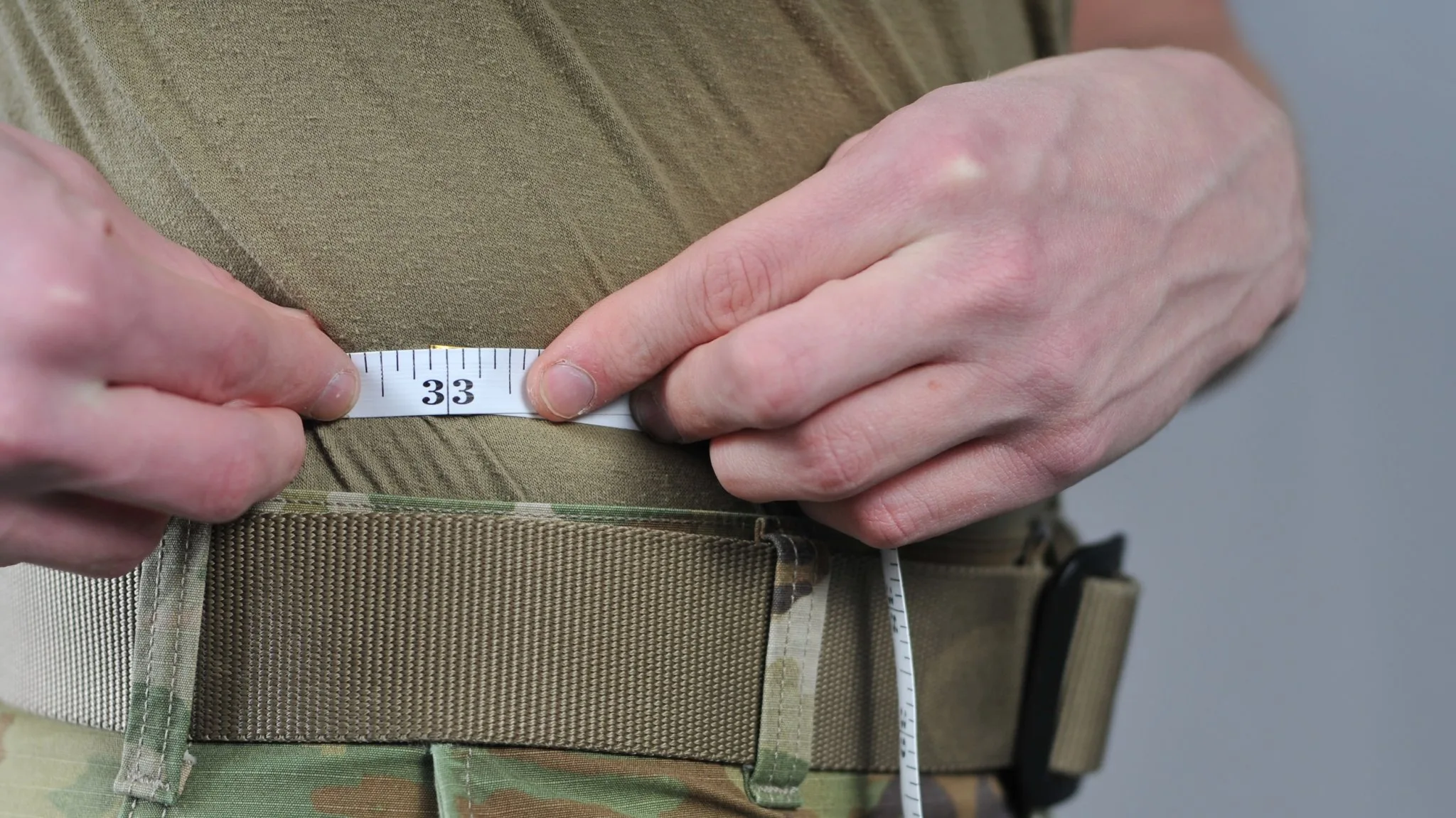
The Pentagon is officially ditching height and weight tables in favor of using a waist-to-height ratio to estimate troops’ body fat, according to an official memo released on Monday. And to pass, a service member’s waist measurement can be only slightly more than half of their height.
The method will divide the measurement of a service member’s waist circumference by their height to estimate body fat percentage.
The new body fat standards are between 18% and 26% for men and between 26% and 36% for women, according to a Dec. 18 memo from Undersecretary of Defense for Personnel and Readiness Anthony J. Tata that was provided by the Defense Department on Monday.
Troops in every military branch will get two measurements each year, according to the memo, a version of which began circulating on social media in December.
“The upper limit for allowable WHtR [waist-to-height ratio] for Military Service body composition policies shall be less than 0.55,” the memo says.
Higher waist-to-height ratios could be an indicator of increased risk for heart disease, Dr. Marcio Bittencourt, an associate professor of medicine at the University of Pittsburgh, told Task & Purpose.
Under the new policy, service members with a waist-to-height ratio of 0.55 or above will be further tested, and if found to exceed body fat standards, placed in their service’s remedial programs and referred to medical authorities for an evaluation, Tata’s memo says.
“Failure to meet established standards may result in the withholding of favorable personnel actions, including promotions,” the memo says. “Continued failure or those not demonstrating adequate progress will be subject to administrative measures to include processing for administrative separation.”
Traditionally, the military services have assigned troops maximum weight standards based mostly on height and weight. But that approach has long led to complaints that muscular people can be flagged as overweight due to muscle mass rather than body fat, said Dr. Kunihiro Matsushita, a professor at Johns Hopkins Bloomberg School of Public Health.
But while many military members follow weight-lifting regimens that build big muscles, even serious bodybuilders usually retain a relatively skinny waist, which keeps the waist-to-height ratio a valid measurement, Matsushita, told Task & Purpose.
“The main reason for the increased waist circumference is fat (visceral fat), not muscle,” Matsushita said. “Muscular people usually grow their muscles in arms, legs, chest, etc., but keep their waist slim.”
Tata’s memo also addresses another common complaint with body composition tests: the plight of troops who hit high scores on fitness tests, despite measurements that fail traditional tape tests, which involve measuring someone’s waist or neck to estimate body fat.
“High performers on fitness tests may be granted allowances, but only within defined limits as prescribed by each Military Service,” the memo says. “High performance does not excuse non-compliance with body composition standards.”
Defense Secretary Pete Hegseth first announced in a Sept. 30 memo that the military would adopt the waist-to-height methodology “to promote consistency and fairness across the Joint Force,” and that all service members would be evaluated twice per year.
Hegseth also wrote at the time that the Pentagon would publish guidance within 60 days on implementing the waist-to-height standards this year.
Based on Tata’s Dec. 18 memo, the Navy has implemented waist-to-height standards as part of its physical fitness program, according to the service.
Both the Marine Corps and Army are expected to announce soon how they plan to implement Hegseth’s directive to use the waist-to-height ratio to evaluate troops’ body composition, service officials said.
The Air Force has announced that it will use the waist-to-height ratio as part of a scored event on the service’s revised fitness test. The service has not yet released updated score charts for the test.
The Space Force will measure guardians’ waist-to-height ratios for a pass/fail evaluation that is separate from the service’s fitness test.