Jordan carries out airstrikes in Syria against drug smugglers
The Kingdom of Jordan conducted airstrikes in Syria that targeted drug smugglers between December 23 and 25. The strikes came days after reports at the Jordan News Agency, a state media outlet, that the Kingdom had faced drug smuggling incidents on its borders.
“The Jordanian Armed Forces–Arab Army have been responding since Tuesday evening [December 23] to a number of groups involved in attempts to smuggle weapons and narcotics along the Kingdom’s northern border,” the agency. In the wake of the strikes, Jordanian authorities continued to report incidents that prevented smuggling attempts on its northern border.
“The [Jordanian] Armed Forces said they are conducting an operational and intelligence assessment of the situation to neutralize those groups and prevent all forms of infiltration and smuggling, as part of their mandate to safeguard Jordan’s security and stability,” Arab News in Saudi Arabia reported after the first round of strikes on December 24. The Jordanians targeted factories and workshops allegedly used by groups involved in trafficking drugs. “Armed Forces destroyed the sites after receiving intelligence in coordination with regional partners,” Arab News added, citing Jordanian state media. The report did not specify which regional partners.
Syrian media reports said that the initial strikes hit areas near Shaab, Khazma, and Malah, Syrian villages that are all located in the Salkhad District of Suwayda Governorate, near the Jordanian border. The UK-based Syrian Observatory for Human Rights (SOHR) noted on December 24 that residents of Shaab “experienced mass displacement of the village’s residents towards the Syrian desert. This followed a series of airstrikes targeting several houses in the village belonging to drug dealers from Al-Rumaythan tribe, according to local sources.” SOHR said the village was targeted twice, on December 24 and 25.
The New Arab noted that on December 25 that strikes had also targeted an area near Umm Rumman in the Salkhad District. “In a statement on Thursday, the Suweida ‘National Guard’ — the Druze militia which dominates the province — said that the Jordanian army had only targeted smuggling facilities, without attacking any ‘National Guard’ site,” The New Arab added.
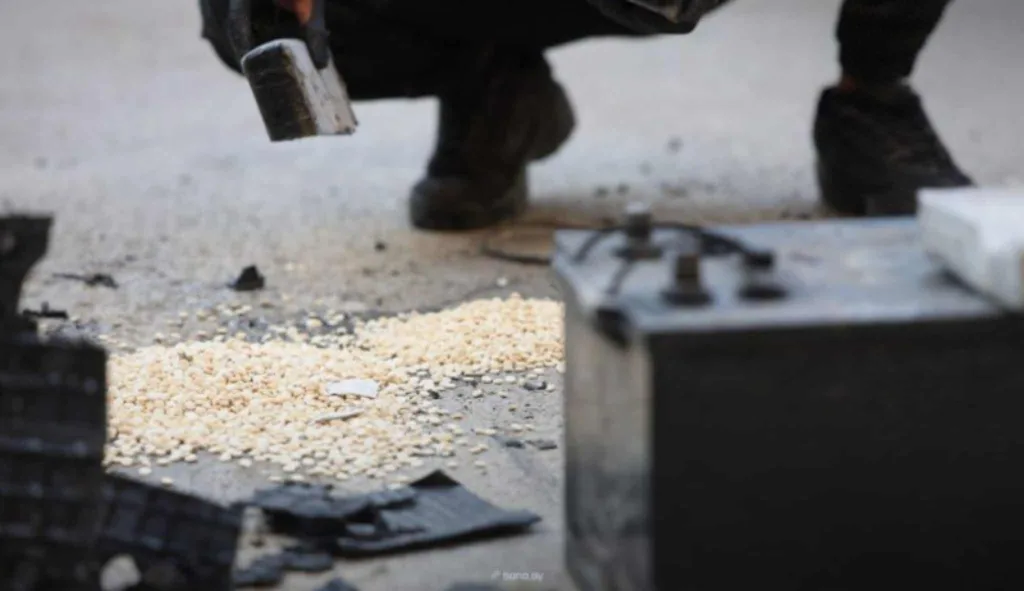
The Alma Research and Education Center in Israel, which concentrates on covering developments in northern Israel, Lebanon, and Syria, produced a short report on December 30 examining and geolocating the targets of the Jordanian strikes. The report concluded that two rounds of strikes on December 24 and 25 “hit warehouses and factories used by traffickers for storage and as launch pads for cross-border smuggling of Captagon pills and weapons.”
Syria has been a center of the trade in fenethylline, an illegal psychostimulant widely known by the brand name Captagon, over the last decade, a result of the former Bashar al Assad regime’s policies that enabled drug trafficking. However, the smuggling phenomenon may have shifted over the last year under the new Syrian transitional government. A December 22 report by the United Nations Office on Drugs and Crime (UNODC) noted that some of the trade in Captagon has been “mitigated with the Syrian authorities’ commitment to dismantle illicit manufacturing.” Regardless, southern Syria remains divided and under limited government control due to clashes between the Druze minority in Suwayda and the Syrian transitional government.
Jordan has launched airstrikes on Iranian-backed drug smugglers in the past, such as in December 2023. However, it refrained from doing so after the fall of the Assad regime and also condemned Israeli raids in Syria, saying the Kingdom supports Syria’s “security, stability, and sovereignty,” according to the Syrian Arab News Agency (SANA). Jordan joined US Central Command airstrikes on Islamic State targets in Syria on December 19.
Opinions on the cross-border strikes in the Jordanian media varied. “There is […] concern over escalating chaos in southern Syria, with scenarios suggesting the emergence of various armed groups attempting to infiltrate Jordan,” Maher Abu Tair, a Jordanian writer and analyst, argued.
Husayn Sarayreh, who describes himself as a justice, human rights, and sustainable development activist, added that Suwayda represents a power vacuum in southern Syria that is being exploited by armed groups. “Suwayda becomes a living example of post-war complexities. It is not an open battlefield, yet it is not a stable zone. Internal tensions, the proliferation of weapons, and the lack of a central authority capable of full control have made it a fertile environment for the emergence of transnational smuggling networks,” he wrote.
Tarek Dilwani, a Jordanian author who writes for Jordan’s Independent Arabia, argued that the strikes were a kind of pre-emptive deterrence against “separatist projects.” This phrase appears to refer to the Druze forces in Suwayda, although Dilwani didn’t mention the Druze specifically.